Improving the Use of Evaluation Findings in Decision-Making: Common Challenges and Practical…
Introduction: Monitoring and evaluation (M&E) are widely used across social sector programs to generate evidence on performance and…
Improving the Use of Evaluation Findings in Decision-Making: Common Challenges and Practical Approaches
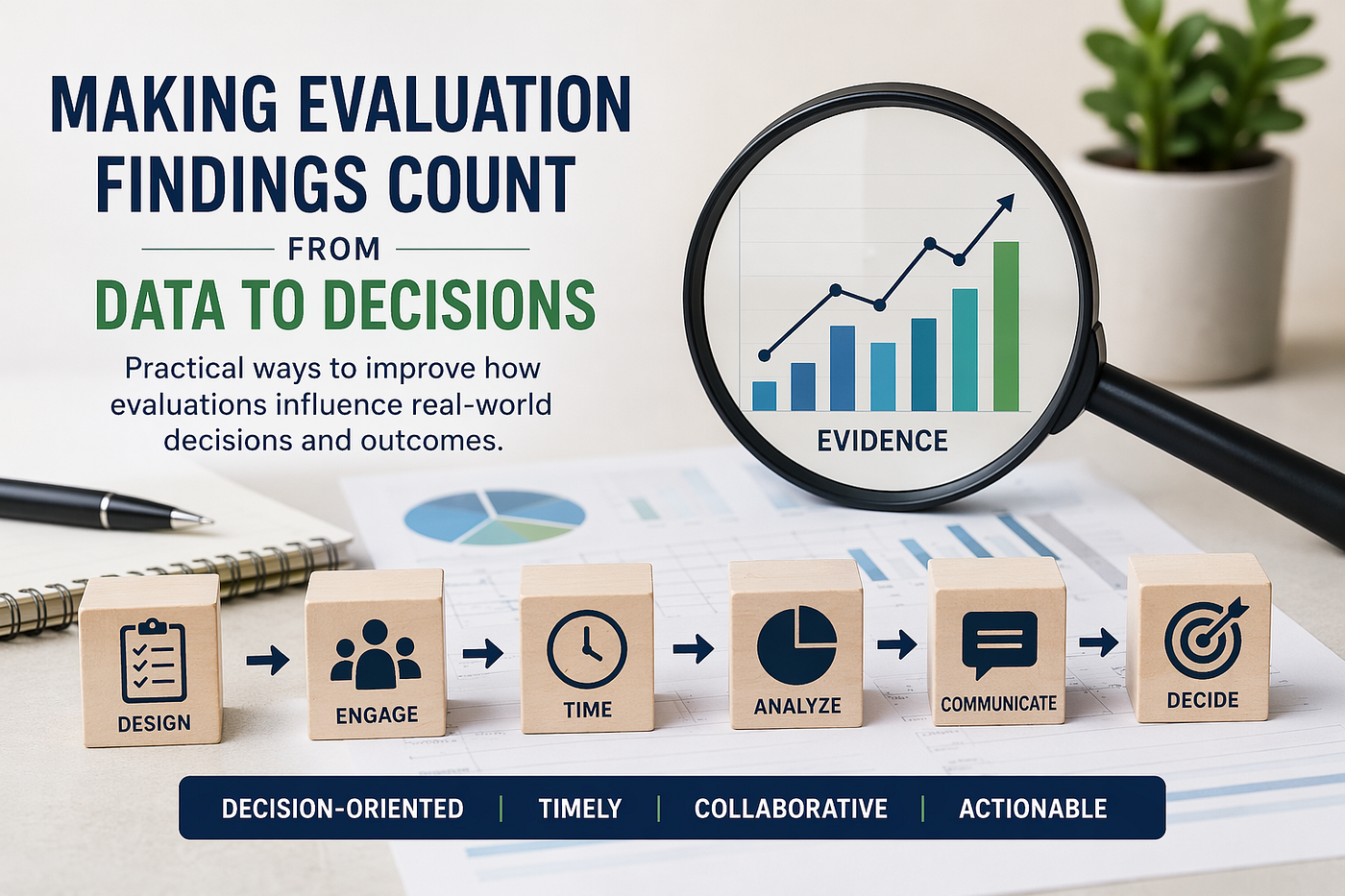
Introduction: Monitoring and evaluation (M&E) are widely used across social sector programs to generate evidence on performance and outcomes. Despite substantial investments in evaluations — such as baseline studies, mid-term reviews, and endline assessments — there is often a gap between the production of evidence and its use in decision-making. This article outlines common factors that limit the use of evaluation findings and suggests practical approaches to improve their utility for program design and implementation.
- Evaluations are not explicitly linked to decision needs
Evaluations are frequently designed to meet reporting or compliance requirements. While this ensures documentation of results, it does not always ensure that findings are relevant to key program decisions.
Implication: Evaluation questions may not align with decisions related to program adaptation, scale-up, or resource allocation.
Possible approach:
At the design stage, identify:
· The primary users of the evaluation
· The specific decisions the evaluation is expected to inform
Framing evaluation questions around these decisions can improve the relevance and use of findings.
2. Misalignment between evaluation timelines and decision cycles
Evaluation timelines are often determined by project milestones rather than decision-making needs. As a result, findings may be delivered after key decisions have already been made.
Implication: Opportunities for course correction during implementation are limited.
Possible approach:
· Align evaluation activities with key decision points in the program cycle
· Consider incorporating interim outputs or rapid assessments to provide timely inputs
Even partial findings, if delivered at the right time, can support adaptive management.
3. Limited engagement of implementers in the evaluation process
Evaluations are sometimes conducted as external exercises with limited involvement from program implementers. This can affect both the interpretation of findings and their subsequent use.
Implication:
· Findings may lack contextual understanding
· Ownership of results among implementers may be low
Possible approach:
Engage implementers at multiple stages:
· During design (to refine questions and methods)
· During data collection (to contextualize findings)
· During interpretation (to validate and prioritize insights)
This can improve both the quality of findings and their uptake.
4. Evaluation outputs are not tailored for intended users
Evaluation reports are often comprehensive but may not be easily usable by decision-makers. Lengthy documents with detailed analysis can make it difficult to identify key insights and actions.
Implication: Findings may not be translated into programmatic changes.
Possible approach:
Develop multiple formats for communicating findings:
· Summary briefs highlighting key insights and recommendations
· Visual presentations of key results
· Clear articulation of implications for action
Tailoring outputs to different audiences can improve accessibility and use.
What supports effective use of evaluation findings?
Across different contexts, evaluation findings are more likely to be used when processes are:
· Decision-oriented: Linked to clearly defined decisions
· Timely: Aligned with program and policy cycles
· Participatory: Involving key stakeholders throughout
· Accessible: Communicated in formats suited to different users
Conclusion: Improving the use of evaluation findings does not necessarily require more data or more complex methods. In many cases, it requires closer alignment between evaluation design and the practical realities of decision-making. Strengthening this alignment can help ensure that evaluation contributes not only to accountability, but also to learning and program improvement.
메타데이터
- post_id
- e413fb62180f
- slug
- improving-the-use-of-evaluation-findings-in-decision-making-common-challenges-and-practical-e413fb62180f
- url
- https://medium.com/@swapnildube1978/improving-the-use-of-evaluation-findings-in-decision-making-common-challenges-and-practical-e413fb62180f
- canonical_url
- https://medium.com/@swapnildube1978/improving-the-use-of-evaluation-findings-in-decision-making-common-challenges-and-practical-e413fb62180f
- author_url
- https://medium.com/@swapnildube1978
- status
- ok
- fetched_at
- 2026-06-09 15:37:30

