Why Is Japan’s Goalkeeper Black?
The beautiful game has crossed borders for generations. Now the World Cup is showing us just how much the world has crossed with it.
Why Is Japan’s Goalkeeper Black?

The beautiful game has crossed borders for generations. Now the World Cup is showing us just how much the world has crossed with it.
The World Cup has always been about nations. This one is also about who gets to belong to them. It is the sort of question that can make a room suddenly uncomfortable. Ask it badly and it sounds racist. Ask it honestly and it opens the door to one of the most interesting stories of this World Cup.
Look around the tournament. Black players are wearing the shirts of England and France, which surprises nobody. They are also representing Japan, Switzerland, Canada and countries with very different histories of race, immigration and empire. Then there is Argentina, where the absence of Black players is almost as striking as their presence elsewhere.
Something is happening in international football.
The World Cup has become a map of human migration wearing football shirts. Colonialism, immigration, multiculturalism, diaspora and mixed heritage are all on display, occasionally alongside a defensive midfielder whose grandmother has suddenly become extremely important.
Zion Suzuki is Japan’s goalkeeper. He has a Ghanaian father and Japanese mother, grew up in Japan and came through the academy system at Urawa Red Diamonds. He is Japanese, which should settle the matter.
Yet the fact that the question is asked tells us something. Many of us still carry an image in our heads of what a Japanese person, an English person or an Argentine is supposed to look like. Football keeps interfering with the picture.

The presence of Black players in former European colonial powers is relatively easy to explain. Britain, France, Belgium, the Netherlands and Portugal spent centuries travelling around the world, acquiring territories and developing an unhealthy interest in other people’s natural resources.
Eventually, people travelled in the opposite direction.
Families settled, children were born, and generations grew up as British, French, Belgian, Dutch and Portuguese citizens. Some became footballers, which is when governments discovered multiculturalism was much easier to celebrate with a trophy in the cabinet.
France’s World Cup-winning team of 2018 became the obvious example. Many players had family connections to African countries and former French colonies. Victory turned them into symbols of a successful multicultural France. Politics has spent much of the period since then returning to normal service.
England tells a similar story. Generations of migration from Africa and the Caribbean have changed British society, culture and football. Black players wearing the England shirt are now unremarkable. Acceptance, however, can be conditional. The racist abuse following England’s defeat in the Euro 2020 final demonstrated how quickly some people can rediscover an interest in ancestry after a missed penalty.
The more interesting stories come from countries without the same colonial relationship with Africa.
Japan has Suzuki. Switzerland’s national team reflects generations of immigration. Canada’s squad comes from one of the world’s most diverse societies. Cape Verde provides perhaps the clearest example of how international football has changed. Only 12 of the 26 players selected for its World Cup squad were born in Cape Verde. The others were born in countries including Portugal, France, the Netherlands and the United States and represent the nation through their family heritage.

The Cape Verdean diaspora is larger than the population living on the islands. A country with fewer than 600,000 residents can therefore recruit footballers raised and developed across several continents.
FIFA has rules deciding who can represent whom. Players may qualify through birthplace, citizenship, parents or grandparents, and some have several countries competing for them.
Football can check the paperwork; belonging is harder. I know something about that question.
I was born in Nigeria and later made my life in Britain. My son was born in London to a Nigerian father and Icelandic mother. We are both avid football supporters and have naturally discussed which country we would represent if either of us had possessed enough talent to trouble an international manager. Our answers were different. Neither was wrong.
England is the country of his birth. Nigeria is part of his ancestry. Iceland comes through his mother and another side of his family. Who does he belong to? More importantly, who gets to decide?

Millions of people live with several identities without giving the matter much thought. International football changes that because eventually the player must choose one shirt. FIFA can inspect passports, birth certificates and grandparents. It cannot measure which anthem produces the biggest lump in your throat.
The spread of football itself is another part of the story.
Football dominates much of Africa, Latin America and large parts of Asia partly because the beautiful game is also the simple game. You need some space and something capable of being kicked. Tennis requires courts and rackets. Swimming requires pools. Motorsport requires parents with the finances of a small Gulf state. Football barely requires a football.
Across poorer countries and communities, children play with rolled-up socks, bundles of plastic and objects whose relationship with a regulation ball is largely theoretical. Stones become goalposts and streets become pitches.
Poverty can prevent people from playing many sports. It has never been particularly successful at stopping football. European leagues then supplied the money. Players moved from Africa, South America and elsewhere towards richer competitions and greater opportunities. Some settled and families followed.

Children were born and entered European academies. A generation later, those children were representing European national teams. Does that make football a Black game? Probably not. It makes football a game unusually good at finding talent wherever people are able to play it. Its low financial barrier gave it extraordinary reach across poorer countries and communities.
Money then moved the best players around the world, migration did the rest.
Argentina provides the most striking contrast. Black players are common in the national teams of Brazil, Colombia and Ecuador, yet Argentina’s squad remains overwhelmingly white. The reasons lie in the country’s demographic history, including mass European immigration and the decline and marginalisation of the Afro-Argentine population.

The difference matters because national teams are more than collections of footballers. They are photographs of history wearing shorts. Look closely and you can see empire, slavery, migration, war and economic opportunity. Occasionally, several centuries of human history are competing for possession in the same midfield.
The location of this World Cup makes the subject even more appropriate.
Canada, Mexico and the United States did not exist in their current political forms three centuries ago. Their populations and borders were shaped by colonisation, conquest, slavery, migration and war. Now they are hosting a tournament where players represent countries through birth, citizenship, parents and grandparents. Some were born thousands of miles from the nations whose anthems they sing.
The World Cup still presents the comforting theatre of national identity. Flags appear, anthems are sung and people who have ignored their country for four years suddenly develop strong opinions about patriotism and whether the left-back understands what it means to wear the shirt.
The players tell a different story. Human beings move, families cross borders, children inherit several identities. Football simply puts them in front of several billion viewers and asks them to choose one. That is why asking why Japan’s goalkeeper is Black is not necessarily the wrong question. It depends what we do with the answer.
Zion Suzuki belongs in Japan’s goal because nationality has never been as neat as the flags, anthems and team sheets suggest. The modern World Cup is a tournament of nations played by people whose family histories cross borders, continents and generations.
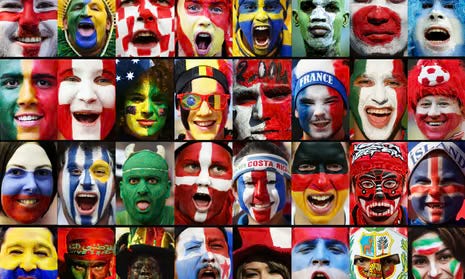
Perhaps that is what makes this World Cup such an accurate picture of the world beyond the stadium. The countries remain carefully separated on the scoreboard, while the people representing them tell a far more complicated story.
So perhaps the real question is not why Japan’s goalkeeper is Black. It is why, in 2026, we are still surprised that he is.
메타데이터
- post_id
- e75e7c7831e9
- slug
- why-is-japans-goalkeeper-black-e75e7c7831e9
- url
- https://medium.com/@chucknwosu/why-is-japans-goalkeeper-black-e75e7c7831e9
- canonical_url
- https://medium.com/@chucknwosu/why-is-japans-goalkeeper-black-e75e7c7831e9
- author_url
- https://medium.com/@chucknwosu
- status
- ok
- fetched_at
- 2026-08-26 14:48:54