Choosing the Right Dynamics 365 Modules: A Decision Framework for Business Leaders
The most common mistake in Dynamics 365 implementations is treating module selection as a technical decision. It is not. It is a business…
Choosing the Right Dynamics 365 Modules: A Decision Framework for Business Leaders
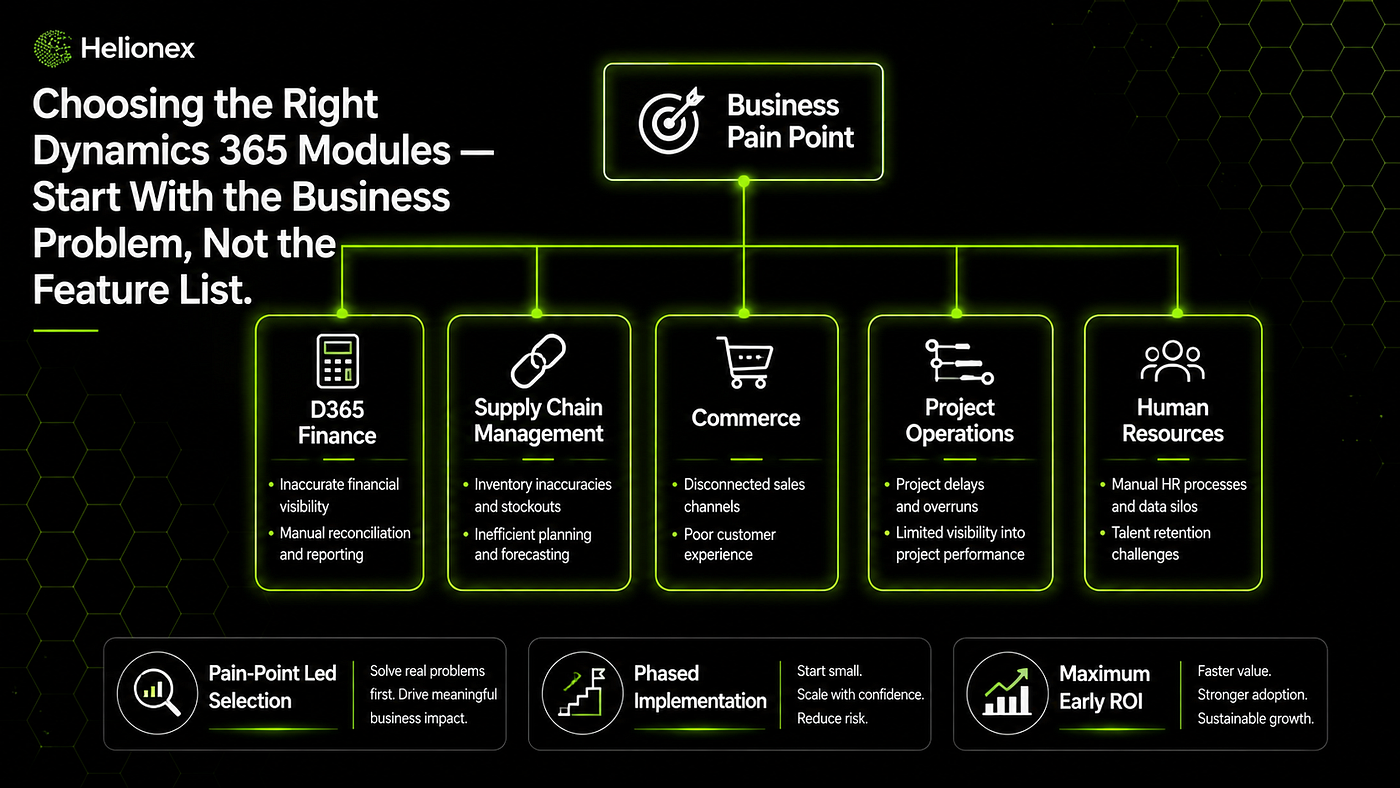
A practical framework for choosing the right Dynamics 365 modules — starting with business pain points, understanding core module capabilities, and sequencing phases for maximum early ROI.
The most common mistake in Dynamics 365 implementations is treating module selection as a technical decision. It is not. It is a business decision — about which operational problems the organization is solving, in what sequence, and with what capacity to absorb change.
Organizations that approach module selection this way — starting with operational priorities rather than feature catalogues — implement more successfully, go live faster, and see measurable business impact earlier than those that begin with a comprehensive review of everything D365 can do.
This guide provides a practical framework for making the selection decision well.
Why Module Selection Matters More Than Most Organizations Realize
Dynamics 365 is a platform. It contains more capability than any single organization needs to deploy at once. The question is never which modules exist — it is which ones address the specific operational gaps the business is facing right now, and which ones can wait.
Deploying too many modules simultaneously is one of the most reliable predictors of implementation difficulty. User adoption suffers when too much changes at once. Configuration quality suffers when the implementation scope exceeds the available capacity to design and test each module thoroughly. And go-live risk increases with every additional module in scope.
The right module selection is the one that addresses the organization’s most significant operational pain points in the first phase, creates the foundation for subsequent phases, and does not overwhelm the organization’s capacity to absorb change at go-live.
Start With the Business Problem, Not the Module Catalogue
Before any module is evaluated, the implementation team needs honest answers to a specific set of questions:
- Where are the most significant operational inefficiencies costing the most time and money right now?
- Which business functions are generating the most errors, delays, or customer complaints?
- Where is manual work creating bottlenecks that limit the organization’s ability to grow?
- Which reporting gaps are most frequently causing poor decisions?
- What compliance or regulatory requirements are the current systems failing to support?
The answers to these questions identify the operational priority areas. Module selection follows from that identification — not the other way around.
How Microsoft Dynamics 365 improves financial reporting is one of the most frequently cited motivations for D365 adoption — because manual financial consolidation, slow close cycles, and limited multi-entity reporting are pain points that most mid-to-large organizations recognize immediately. If financial reporting is the primary pain point, the Finance module belongs in phase one.
The Core Modules and What They Solve
Dynamics 365 Finance
Finance is the module most organizations implement first, and for good reason. It addresses the operational problems that affect the entire business: slow close cycles, manual reconciliation, multi-entity financial consolidation, compliance reporting, and limited real-time financial visibility.
Key capabilities that drive selection:
- Automated financial close workflows that reduce period-end processing time
- Multi-entity, multi-currency financial management from a single platform
- Real-time financial dashboards replacing manual report compilation
- Regulatory compliance reporting built into the core financial structure
- Integration with operational modules that eliminates manual journal entries for operational transactions
How modern businesses improve financial reporting with Dynamics 365 is a practical question with a consistent answer: the Finance module delivers the most visible early ROI for organizations where financial reporting quality and timeliness are current pain points — which describes most businesses considering a D365 implementation.
Finance belongs in phase one when:
- Month-end close takes more than five working days
- Financial data exists in multiple disconnected systems requiring manual consolidation
- The organization operates across multiple legal entities or currencies
- Regulatory reporting is currently managed through manual compilation
Dynamics 365 Supply Chain Management
Supply Chain Management addresses the operational challenges that Finance cannot touch: inventory accuracy, procurement efficiency, warehouse operations, demand forecasting, and supplier performance visibility.
Unlocking efficiency with D365 Supply Chain Management is particularly high-value for organizations where inventory inaccuracy, stock-outs, or procurement delays are directly affecting customer service or operational cost.
Key capabilities:
- Real-time inventory visibility across multiple locations and warehouses
- Automated replenishment triggered by actual demand signals rather than manual review
- Supplier performance tracking integrated with procurement workflows
- Demand forecasting that uses historical sales data to optimize inventory positioning
- Warehouse management for organizations with complex pick, pack, and ship operations
Supply Chain Management belongs in phase one when:
- Inventory inaccuracy is causing stock-outs, overstock, or customer fulfilment failures
- Procurement is managed through manual processes generating approval delays and purchase errors
- The organization cannot see real-time stock positions across multiple locations
- Demand forecasting relies on spreadsheets that are frequently inaccurate
Dynamics 365 Commerce
Commerce connects physical retail operations, e-commerce, call center, and back-office functions into a unified platform. It is the right choice for organizations that sell across multiple channels and currently manage those channels in disconnected systems.
Key capabilities:
- Unified point-of-sale connected to central inventory and customer data
- Omnichannel order management supporting buy-online-pick-up-in-store and ship-from-store
- Centralized pricing, promotion, and assortment management across all channels
- Customer loyalty program management integrated across in-store and digital channels
Commerce belongs in phase one when:
- Pricing and inventory data is managed separately for physical and online channels
- Customer data is fragmented across POS, e-commerce, and CRM systems
- Fulfilment options like click-and-collect are creating operational complexity the current systems cannot handle
Dynamics 365 Project Operations
Project Operations serves professional services organizations, consulting firms, and any business where revenue is generated through project-based delivery rather than product sales. It connects project planning, resource management, time and expense tracking, and billing into a single workflow.
Project Operations belongs in phase one when:
- Project profitability is difficult to assess in real time because cost and revenue data lives in separate systems
- Resource utilization is managed through spreadsheets that do not reflect current project commitments
- Project billing relies on manual timesheet compilation and approval processes
Dynamics 365 Human Resources
The HR module manages the employee lifecycle — from recruitment and onboarding through performance management, leave administration, and compliance. It is most valuable for organizations where HR processes are currently manual, inconsistent, or creating compliance risk.
HR belongs in phase one when:
- Employee data exists in multiple systems that are not synchronized
- Leave management and attendance tracking are managed through manual processes
- HR compliance reporting requires significant manual effort to produce
The Phasing Question: What Goes in Phase One vs Later
The most important module selection decision is not which modules to implement — it is which to implement first.
A sound phasing principle: phase one should include the modules that address the most significant current operational pain points and that create the data foundation subsequent modules will depend on. Finance and one operational module — Supply Chain, Commerce, or Project Operations depending on the business model — is the most common and most effective phase one scope for mid-market organizations.
Subsequent phases add modules that build on the data and operational structures established in phase one — HR connecting to the organizational structure defined in Finance, additional Commerce capabilities building on the inventory foundation established in Supply Chain, and so on.
The considerations that go into D365 implementation planning for organizations looking ahead to their 2030 technology landscape include the sequencing of module adoption as a core strategic decision — not just an implementation detail. The modules selected and the order in which they are deployed determine the operational data foundation the organization will have available for AI capabilities, automation, and real-time intelligence over the next several years.
Common Selection Mistakes and How to Avoid Them
Selecting modules based on vendor demonstration rather than operational pain points. Dynamics 365 demonstrations are compelling. Every module looks valuable in a well-constructed demo. Selection should be anchored to the operational problems identified before the demonstration, not the capabilities that seemed most impressive during it.
Including too many modules in phase one to minimize the number of implementation phases. This reasoning is understandable but consistently produces worse outcomes. More modules in phase one means more configuration complexity, more user training requirements, more go-live risk, and lower adoption quality across all modules. A focused phase one delivered well creates more value than a comprehensive phase one delivered under pressure.
Selecting modules without assessing data migration requirements. Each module requires clean, structured data to function effectively. Finance requires a clean chart of accounts and accurate opening balances. Supply Chain requires accurate inventory positions and product master data. Understanding the data migration work each module requires is essential to realistic timeline and budget planning.
Deferring licensing decisions until after module selection. Dynamics 365 licensing is modular and the cost structure varies significantly between modules. Understanding the licensing implications of module selection before finalizing scope prevents budget surprises that require scope changes after the implementation is already underway.
How Implementation Quality Connects to Module Selection
Module selection and implementation quality are directly connected. Modules implemented with adequate time for process mapping, configuration design, data migration testing, and user acceptance testing deliver measurably better outcomes than modules rushed through implementation to meet a compressed timeline.
A structured D365 F&O implementation approach that allocates realistic time to each phase — discovery, configuration, testing, training, go-live — is the single most important factor in whether the selected modules deliver their intended business value. Organizations that invest in getting implementation quality right consistently see faster post-go-live stabilization, higher user adoption, and stronger early ROI than those that compromise implementation quality to accelerate the go-live date.
Helionex works with manufacturing, retail, wholesale, and professional services organizations to design and execute D365 implementations that align module selection with operational priorities, sequence phases to maximize business impact, and deliver implementations that stabilize quickly and generate measurable operational improvement from month one.
Frequently Asked Questions (FAQs)
1. How many Dynamics 365 modules should a typical organization implement in phase one?
Most mid-market organizations implement two to three modules in phase one — typically Finance plus one operational module aligned to their primary business model. The right number depends on the organization’s change management capacity, data migration complexity, and the implementation timeline available. Fewer modules implemented thoroughly consistently outperform more modules implemented under pressure.
2. What is the difference between Dynamics 365 Finance and Dynamics 365 Business Central?
Dynamics 365 Finance and Operations (including Supply Chain Management) is designed for mid-to-large enterprises with complex multi-entity, multi-currency, and multi-geography requirements. Dynamics 365 Business Central is designed for smaller organizations with simpler financial and operational requirements. The right choice depends on organizational size, complexity, and the operational sophistication the business needs from its ERP platform.
3. Can modules be added after the initial implementation?
Yes. Dynamics 365 is explicitly designed for phased adoption. Modules added in subsequent phases build on the organizational structure, master data, and configuration established in phase one — which is why the foundation modules are so important to get right. However, adding modules after go-live does require additional implementation work, testing, and user training for each new module.
4. How does module selection affect Dynamics 365 licensing costs?
Dynamics 365 licensing is modular, with each module carrying its own licensing requirements. Some modules are available as add-ons to base licenses; others require specific base licenses as prerequisites. Understanding the full licensing cost of the intended module scope before finalizing the implementation plan prevents budget surprises and allows for informed decisions about phasing if cost constraints require prioritization.
5. What is the most important factor in making Dynamics 365 module selection successfully?
Anchoring the selection decision in specific operational pain points rather than in comprehensive feature evaluation. Organizations that identify the three to five operational problems causing the most significant business impact and select the modules that most directly address those problems consistently make better selection decisions than those that approach the decision as a feature comparison exercise.
6. How long does a typical D365 implementation take per module?
Finance-only implementations for a single legal entity typically take eight to sixteen weeks. Adding Supply Chain Management or Commerce to a Finance implementation typically adds eight to twelve weeks to the timeline depending on operational complexity. Multi-entity, multi-currency implementations with significant customization requirements take longer. Realistic timeline planning based on actual scope — rather than compressed timelines based on budget constraints — is one of the highest-leverage decisions in the implementation planning process.
7. How should organizations handle Dynamics 365 modules that partially overlap with existing specialized systems?
Evaluate whether the existing specialized system provides sufficient capability advantage over the D365 equivalent to justify the integration complexity of maintaining both. In many cases, the integration maintenance cost of keeping a specialized system alongside D365 exceeds the capability advantage over time. In cases where the specialized system provides genuinely superior capability, a well-designed integration is typically the right answer — but the integration requirements should be scoped and budgeted before finalizing the module selection.
8. What data preparation is most important before starting a D365 implementation?
Chart of accounts and financial master data for Finance implementations — ensuring the account structure is designed for the organization’s reporting requirements before configuration begins. Product master data and inventory positions for Supply Chain implementations — ensuring that product records are complete and accurate before the implementation team builds inventory configuration around them. Customer and vendor master data for any implementation — eliminating duplicates and ensuring required fields are populated before data migration begins.
메타데이터
- post_id
- ed6898d4a002
- slug
- choosing-the-right-dynamics-365-modules-a-decision-framework-for-business-leaders-ed6898d4a002
- url
- https://medium.com/@aamir_78092/choosing-the-right-dynamics-365-modules-a-decision-framework-for-business-leaders-ed6898d4a002
- canonical_url
- https://medium.com/@aamir_78092/choosing-the-right-dynamics-365-modules-a-decision-framework-for-business-leaders-ed6898d4a002
- author_url
- https://medium.com/@aamir_78092
- status
- ok
- fetched_at
- 2026-08-12 09:31:03