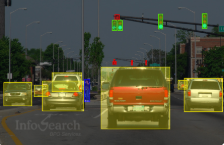
Enhancing Object Detection in Autonomous Vehicles with 3D LiDAR Annotation
Infosearch provides the best LiDAR and Point Cloud annotations, one of the most important services required for Autonomous Vehicles.
Enhancing Object Detection in Autonomous Vehicles with 3D LiDAR Annotation
Infosearch provides the best LiDAR and Point Cloud annotations, one of the most important services required for Autonomous Vehicles.
The use of autonomous vehicles (AVs) is based on the accurate perception of the environment to navigate safely and efficiently. LiDAR (Light Detection and Ranging) is one of the other sensing technologies that are instrumental in helping vehicles to view the world in three dimensions. Nonetheless, raw LiDAR data are inadequate as precise 3D LiDAR annotation is necessary to train powerful object detectors.
With the increasing pace in the race to full autonomy in driving, there has been a rush towards researchers and industry leaders to enhance the object detection capability by using high-quality annotation.
The concept of 3D LiDAR in Autonomous Driving
LiDAR sensors release a laser pulse and record the duration of time taken when the laser pulse bounces off objects. This forms a fine-point cloud image of the environment, representing:
• Information on distance and depth.
• Object forms and geometry.
• Geometry and barriers of the road.
LiDAR is also essential to AVs as opposed to cameras, which work well in low-light situations and offer precise depth perception.
What does it mean by 3D LiDAR Annotation?
In 3D LiDAR annotation, objects are labelled in a point cloud data to enable machine learning models to identify and classify them. Objects annotated by annotators usually include 3D bounding boxes around objects, including:
• Vehicles
• Pedestrians
• Cyclists
• Traffic signs and road barriers.
Such annotations are used as ground truth data to train perception algorithms.
Why is the Quality of Annotation Important?
The quality of annotated data is directly related to the performance of object detection models. Bad annotations may result in:
• Misclassification of objects
• Inaccurate distance estimation
• Not identifying key barriers.
High-quality annotation ensures:
• Precise object localisation
• Better model generalisation
• Increased security and dependability.
Even small mistakes can be very costly to safety-critical systems, such as autonomous vehicles.
The main Methods of 3D LiDAR Annotation that Infosearch provides
The most frequently used technique is to put 3D bounding boxes (cuboids) around objects. These boxes are used to store the position, the orientation and the size of the object in the 3D space.
Each point on the cloud has a label (e.g., road, pedestrian, vehicle) instead of a bounding box. This gives more detailed information on more complex perception tasks.
Annotating LiDAR data with camera images enhances the accuracy of the annotations. Images provide visual clues to enable annotators to recognize objects that cannot be clearly detected using point clouds.
- Temporal Annotation
Labelling of objects in different frames guarantees consistency and assists models in comprehending motion and object tracking through time.
AI in the Annotation Role
AI is being increasingly employed to help human annotators. Semi-automated tools can:
• Label objects with the help of existing models.
• Suggest bounding boxes
• Trace objects between frames.
This not only accelerates the annotation process but also ensures accuracy by human validation.
Difficulties with 3D LiDAR Annotation.
LiDAR annotation is important but has a number of challenges:
• Sparse data: Objects far away might not have as many points, thus making it more difficult to label.
• Occlusion: It can be hard to annotate objects partially obscured by other objects.
• Complicated environments: There are urban scenes of high traffic and people that complicate the environment.
• High cost and time: Manual annotation is time-consuming.
All these challenges can be overcome with the help of a combination of up-to-date tools, qualified annotators, and effective workflows.
Effects on Object Detection.
3D LiDAR annotation is a vital factor that directly enhances the main performance metrics of object detectors:
• Increased accuracy and recall.
• Improved visibility of small and far-away objects.
• Enhanced resilience to different environments.
• Enhanced real-time decision-making
This results in more autonomous systems and safer sailing.
Trends in LiDAR Annotation in Future.
The discipline is developing quickly, and some trends defining the future include:
• AI-driven automated annotation pipelines.
• Active learning to focus on the most useful data to label.
• Synthetic data to complement real-world data.
• Interoperability of annotation formats.
The aim of these advancements is to make it less expensive and enhance the quality and scalability of data.
Conclusion
The LiDAR annotation is a basic building block of autonomous vehicles development. It can convert raw point cloud data into structured, labelled data, and thus allows machine learning models to efficiently recognize and perceive objects in complex scenes.
With the further development of AI-assisted annotation, sensor fusion, and better methods, the fusion of AI-assisted annotation and sensor fusion with better methodologies will further improve the object detection capabilities, leading us towards a future of safe and fully autonomous transportation.
Contact Infosearch to Outsource Annotations
메타데이터
- post_id
- f1504eb8eb77
- slug
- enhancing-object-detection-in-autonomous-vehicles-with-3d-lidar-annotation-f1504eb8eb77
- url
- https://medium.com/@infosearchbpo/enhancing-object-detection-in-autonomous-vehicles-with-3d-lidar-annotation-f1504eb8eb77
- canonical_url
- https://medium.com/@infosearchbpo/enhancing-object-detection-in-autonomous-vehicles-with-3d-lidar-annotation-f1504eb8eb77
- author_url
- https://medium.com/@infosearchbpo
- status
- ok
- fetched_at
- 2026-06-09 15:37:30