How to Depanel Irregular PCBs Without Custom Fixtures
Irregular PCB designs are becoming increasingly common in 2026.
How to Depanel Irregular PCBs Without Custom Fixtures
Irregular PCB designs are becoming increasingly common in 2026.
From automotive electronics and wearable devices to industrial controls and smart consumer products, manufacturers are using more customized board shapes to maximize space and improve product design.
While these complex layouts offer many advantages, they also introduce a common manufacturing challenge:
How do you depanel irregular PCBs without relying on expensive custom fixtures?
For many manufacturers, custom fixtures can increase:
- Engineering time
- Project costs
- Production complexity
- Changeover time
As product life cycles become shorter and PCB designs change more frequently, flexibility is becoming just as important as precision.

Why Irregular PCB Depaneling Is Challenging
Unlike standard rectangular panels, irregular PCBs often feature:
- Curved outlines
- Internal cutouts
- Complex routing paths
- Uneven support areas
- Sensitive edge-mounted components
These characteristics make depaneling more difficult because the board may not be evenly supported during the cutting process.
Without proper process control, manufacturers may encounter:
⚠️ PCB movement during cutting ⚠️ Edge defects or burrs ⚠️ Component stress ⚠️ Reduced cutting accuracy ⚠️ Lower production consistency
The challenge becomes even greater when multiple PCB designs need to be processed on the same production line.
The Traditional Approach: Custom Fixtures
Historically, many manufacturers solved this problem by creating dedicated fixtures for each PCB design.
Custom fixtures can provide: ✔ Board support ✔ Positioning accuracy ✔ Process stability
However, they also introduce several limitations.
Higher Costs
Each new PCB design may require:
- Fixture design
- Manufacturing
- Validation
- Maintenance
These costs can add up quickly, especially for low-volume or high-mix production.
Longer Lead Times
Waiting for fixture design and fabrication can delay:
- New product introduction (NPI)
- Prototype validation
- Production ramp-up
In fast-moving industries, this delay can become a competitive disadvantage.
Reduced Flexibility
Every product change may require fixture modifications or entirely new tooling.
This becomes particularly challenging for manufacturers handling multiple product variants.
Why More Manufacturers Are Looking for Fixture-Free Solutions
As electronics production evolves, manufacturers are increasingly prioritizing:
✔ Faster product changeovers ✔ Lower tooling costs ✔ Greater manufacturing flexibility ✔ Reduced engineering effort
This is driving interest in depaneling technologies that can adapt to different PCB shapes without dedicated fixtures.
Vision-Guided PCB Depaneling
One of the most effective approaches is the use of CCD vision alignment systems.
Instead of relying solely on mechanical positioning, vision systems can automatically:
- Identify fiducial marks
- Detect board position
- Compensate for placement variation
- Adjust cutting paths in real time
This allows manufacturers to process different PCB layouts with minimal setup changes.
For irregular boards, this flexibility can significantly reduce the need for dedicated tooling.
Precision Router Depaneling
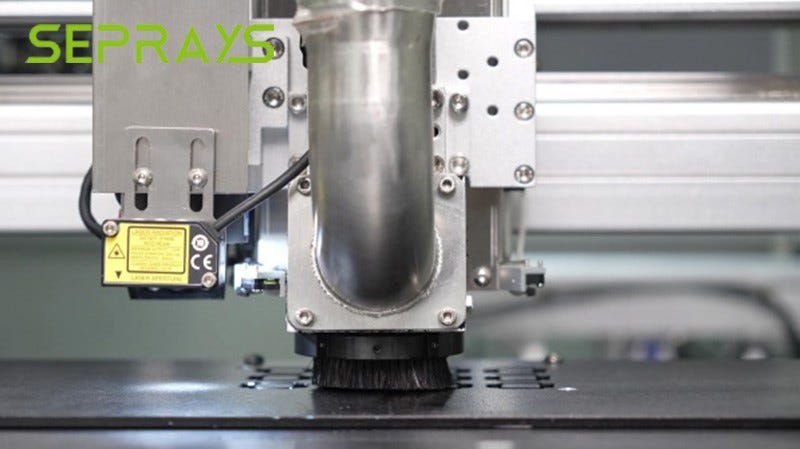
Router depaneling remains one of the most widely used methods for irregular PCB separation.
Its advantages include:
✔ Flexible cutting paths ✔ Support for complex board geometries ✔ High positioning accuracy ✔ Compatibility with multiple product types
Because the cutting tool follows programmed routing paths, it can adapt to complex PCB outlines that would be difficult to process using fixed mechanical methods.
When combined with vision alignment, router systems can often process irregular boards without custom fixtures.
Vacuum and Universal Support Systems
Another trend in 2026 is the use of universal support platforms.
These systems help stabilize PCBs through:
- Adjustable supports
- Vacuum holding mechanisms
- Modular positioning structures
Rather than building a dedicated fixture for every product, manufacturers can configure support points according to board requirements.
This provides a balance between:
- Stability
- Flexibility
- Lower tooling investment
Hybrid Depaneling Approaches
Some production environments require multiple cutting methods.
For example:
- V-Cut sections
- Mouse-bite connections
- Irregular routing paths
In these cases, hybrid depaneling systems can combine different cutting technologies within a single workflow.
This approach allows manufacturers to process complex boards more efficiently while reducing the need for multiple dedicated setups.
Benefits of Reducing Fixture Dependency
Manufacturers that successfully reduce custom fixture usage often experience several advantages.
Faster Product Changeovers
New PCB designs can be introduced with fewer tooling modifications.
This is particularly valuable for:
- NPI projects
- Prototype production
- High-mix manufacturing
Lower Operating Costs
Reducing fixture inventory means fewer expenses related to:
- Design
- Manufacturing
- Storage
- Maintenance
Greater Production Flexibility
Production lines can switch between products more efficiently, supporting modern manufacturing requirements.
Improved Scalability
As product portfolios expand, fixture-free processes are often easier to scale than dedicated tooling strategies.
Industries Driving the Trend
Demand for fixture-free irregular PCB depaneling is growing across several industries:
Automotive Electronics
Complex PCB shapes are increasingly used to optimize packaging and space utilization.
Wearable Devices
Compact designs often require unconventional PCB geometries.
Medical Electronics
Precision and flexibility are essential for evolving device designs.
Industrial Electronics
High-mix production environments benefit from reduced tooling requirements.
What to Consider Before Choosing a Solution
Not every irregular PCB can be processed the same way.
When evaluating a fixture-free depaneling strategy, manufacturers should consider:
✔ PCB shape complexity ✔ Component proximity to cutting paths ✔ Production volume ✔ Required cutting accuracy ✔ Stress sensitivity ✔ Automation requirements
The best solution will depend on both product design and manufacturing objectives.
Final Thoughts
As PCB designs continue becoming more specialized, relying on dedicated fixtures for every product is becoming less practical.
Modern depaneling technologies — including vision-guided routing systems, universal support platforms, and hybrid processing solutions — are helping manufacturers achieve greater flexibility while maintaining precision.
For many electronics manufacturers in 2026, the goal is no longer simply to separate PCBs efficiently.
It is to do so with: ✔ Less tooling ✔ Faster changeovers ✔ Lower costs ✔ Greater production flexibility
And for irregular PCB production, fixture-free depaneling is becoming an increasingly attractive path forward.
Read the original article here: https://seprays.com/how-to-depanel-irregular-pcbs-without-custom-fixtures/
메타데이터
- post_id
- f48802d14144
- slug
- how-to-depanel-irregular-pcbs-without-custom-fixtures-f48802d14144
- url
- https://medium.com/@sales_40837/how-to-depanel-irregular-pcbs-without-custom-fixtures-f48802d14144
- canonical_url
- https://medium.com/@sales_40837/how-to-depanel-irregular-pcbs-without-custom-fixtures-f48802d14144
- author_url
- https://medium.com/@sales_40837
- status
- ok
- fetched_at
- 2026-06-13 12:55:53