AI Criticism as Latent Design: The Case of “Against Frictionless AI”
All too often, criticism intended as a warning about AI or an effort to constrain usage is, in effect, guidance on how to improve AI…
AI Criticism as Latent Design: The Case of “Against Frictionless AI”
Two AI futures. A conceptual model to illustrate possibilities.
All too often, criticism intended as a warning about AI or an effort to constrain usage is, in effect, guidance on how to improve AI systems. Saying that “AI lacks X, erodes Y, or encourages harmful Z” almost always contains a latent engineering and institutional proposition: build systems that preserve X, strengthen Y, and resist Z. But this latent design function is rarely acknowledged, and its implications go unexamined. Typically, in fact, constructive interpretations are contrary to authors’ intentions.
“Against frictionless AI” is an outstanding example [1]. The authors rightly warn that the helpfulness of AI, combined with rapidly increasing capabilities, is a threat to the key role friction plays in stimulating human development [2, 3]. Why attempt to do what ChatGPT, Claude, or another model can do quickly and well for us?
Their examples encompass intellectual work, the experience of meaning, and social relationships. In learning, the difficulty of encoding, retrieving, and reorganizing information produces deeper comprehension and better retention; when AI supplies a ready-made solution, it can bypass the processes through which understanding develops. In creative and professional work, effort contributes to competence, ownership, purpose, and meaning: people attach greater value to achievements they can attribute to their own labor. In social life, loneliness can function as a signal that motivates people to seek connection, while disagreement, disappointment, compromise, and corrective feedback help people develop the capacities required for durable relationships. The authors do not maintain that friction is always beneficial. They propose an inverted-U relationship: too much friction overwhelms, but too little deprives people of the moderate difficulty through which learning, motivation, and meaning develop.
A system that automatically removes every obstacle may therefore impoverish the activity it assists [4, 5]. The looming prospect is that, as “human effort feels increasingly inadequate next to increasingly optimal machine output, we might well find ourselves in a vicious cycle: as AI replaces effort in certain domains, the motivational benefits of effort in these domains erode, leaving us ever more dependent on AI, further diminishing our motivations, and so on.”
In the authors’ view, the very utility of AI systems conceals this insidious threat. By being always available, immediately helpful, supportive, affirming, and easy to engage with while completing tasks quickly and with minimal disruption, AI systems may lead to a frictionless future that impedes human development and results in cognitive impoverishment.
The authors’ practical response is to preserve friction by regulating when and where AI is used. They distinguish supplementation from substitution and suggest that people who have already developed relevant skills may benefit from AI shortcuts, whereas younger users need protected opportunities to struggle, reason, revise, and learn. Similarly, they regard AI companionship as more defensible for isolated older adults than for adolescents who are still learning how to form social and romantic relationships. While more nuanced than blanket opposition to AI, this still treats AI as friction-removing and the solution as maintaining boundaries around its use. The possibility that AI itself could be designed to introduce developmentally valuable friction is not considered.
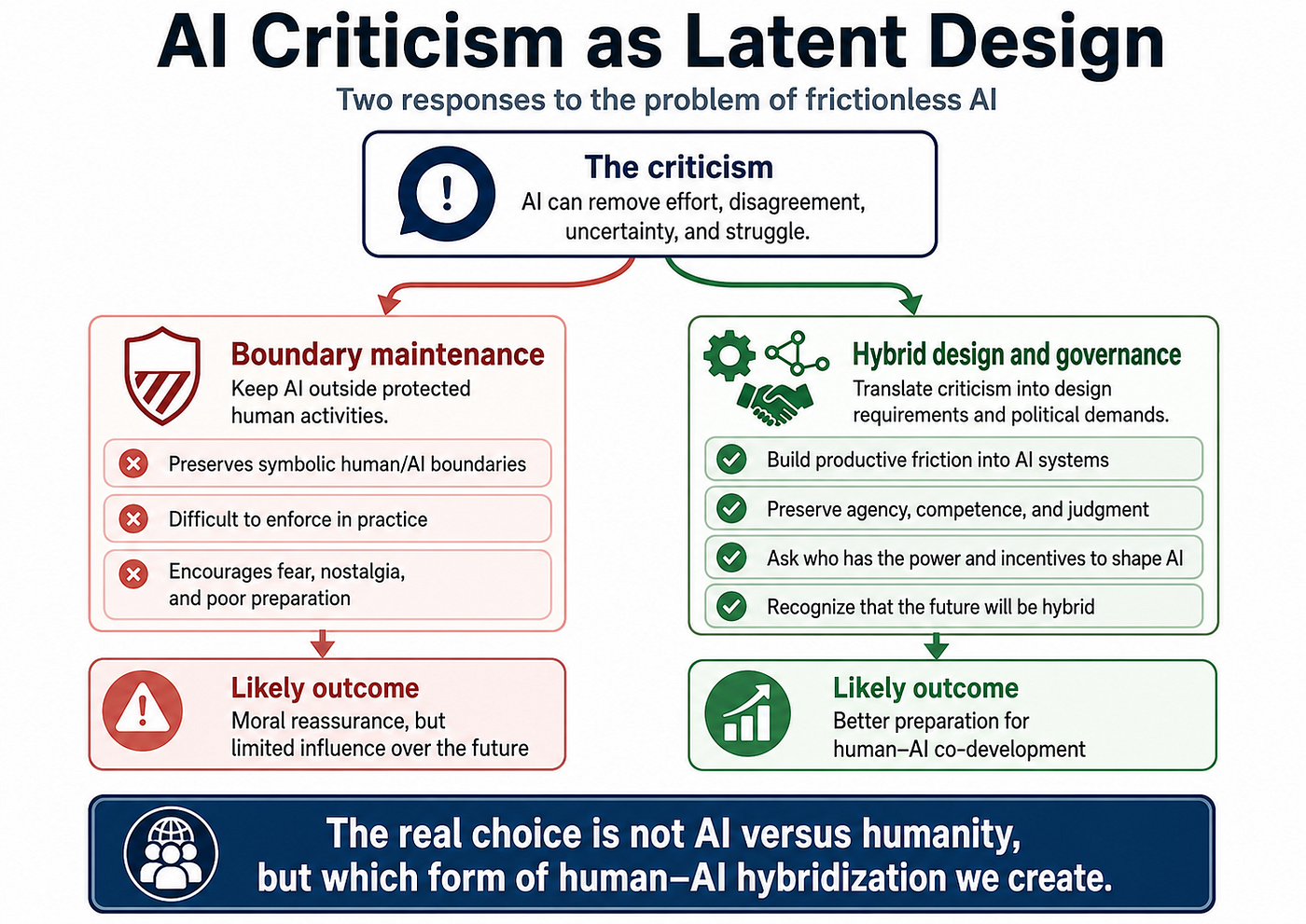
The boundary maintenance this implies will almost certainly prove impractical for individuals and unenforceable by institutions. Wouldn’t a much better option be to design future AI models that could instead:
- ask a student to attempt a problem before giving an answer;
- identify where a user’s reasoning is weak without replacing it;
- decline to produce a finished work when guided struggle would be more valuable;
- introduce competing interpretations;
- insist that a decision cannot be responsibly compressed into a simple recommendation;
- require the user to articulate values or trade-offs;
- challenge self-serving narratives;
- preserve silence, delay or uncertainty;
- redirect a person toward difficult human conversations rather than smoothing them away;
- maintain stable boundaries even when compliance would increase satisfaction.
None of these possibilities requires AI to cease being helpful. They require a richer conception of helpfulness-one that distinguishes immediate satisfaction and task completion from longer-term agency, competence, judgment, and development. Some versions of this approach are already being implemented, particularly in education, where AI systems are already beginning to implement the principle of developmental friction. Khanmigo, ChatGPT Study Mode, Gemini Guided Learning, and experimental Socratic tutors use questions, hints, knowledge checks, reflection requirements, and sometimes usage constraints to preserve part of the learner’s cognitive work [6–11]. Future models could extend this approach well beyond formal education: introducing competing interpretations, requiring users to articulate assumptions and values, preserving uncertainty, and resisting requests that would undermine longer-term competence or autonomy.
The avoidance of design guidance is probably neither accidental nor innocent. Several motives seem to converge.
- First, acknowledging the design implication can feel like capitulation. Critics may fear that their objections will be absorbed into the development process, converted into product features, and used to legitimate deeper adoption.
- Second, many critiques depend on a tacit ontological contrast: human beings generate meaning through authentic struggle, while machines merely remove obstacles. If artificial systems can participate in creating valuable difficulty, sustaining judgment, or promoting development, that boundary becomes harder to defend.
- Third, “AI should not do this” is politically simpler than asking who should determine what a system does, under what incentives, and with what accountability. The former permits moral distance. The latter requires engagement with governance, engineering, institutional compromise, and conflicts of interest.
- Fourth, critics often treat present commercial incentives as though they were inherent properties of the technology. Because current firms commonly optimize for convenience, engagement, rapid completion, and market share, frictionlessness appears to be the essence of AI rather than a result of particular business models, training objectives, and product decisions.
The failure is deeper than a missed engineering opportunity. This mode of criticism offers a politics of boundary maintenance at a moment when the boundary between human and artificial activity is already becoming porous. It treats authentic effort, judgment, relationship, and meaning as possessions of a distinctively human sphere that can be protected by limiting AI’s entry. At its weakest, this becomes a form of covert nostalgia: a way to affirm allegiance to an imagined intact human world rather than undertake the more difficult work of shaping the hybrid one that is emerging.
The future is hybrid. People will increasingly think, learn, create, deliberate, care, and form relationships through continuing interaction with artificial systems. This does not mean that every form of hybridization is inevitable or desirable. It means that the consequential choice is unlikely to be between hybridization and human purity. It will be among different forms of hybridization, created by different institutions, governed according to different values, and distributing power and capability in different ways.
Boundary maintenance can provide moral reassurance, especially to educated readers who want to affirm that they remain on the side of effort, authenticity, and human connection. But reassurance is not preparation. When criticism refuses to translate its insights into design requirements and political demands, it risks leaving the actual design of the hybrid future to companies optimizing convenience, engagement, labor substitution, and profit, or to governments optimizing administrative control. It also encourages people to experience technological transformation primarily as contamination or loss, making them more fearful and less capable of learning how to use, govern, challenge, and resist these systems intelligently.
This is the deeper disservice. A critique that identifies what human development requires but refuses to ask how AI might be designed to support those requirements abandons its own most valuable insight. The alternative to frictionless AI is not necessarily less AI. It is AI deliberately designed and governed to preserve agency, skill, reciprocity, judgment, and meaning. The central conflict is not between technology and humanity, but among the institutions and interests seeking to determine the terms on which human beings and artificial systems will develop together.
- Zohar, E., Bloom, P., & Inzlicht, M. (2026). Against frictionless AI. Communications Psychology, 4, Article 39. https://doi.org/10.1038/s44271-026-00402-1.
- Bjork, E. L., & Bjork, R. A. (2011). Making things hard on yourself, but in a good way: Creating desirable difficulties to enhance learning. In M. A. Gernsbacher, R. W. Pew, L. M. Hough, & J. R. Pomerantz (Eds.), Psychology and the real world: Essays illustrating fundamental contributions to society (pp. 56–64). Worth Publishers.
- Inzlicht, M., Shenhav, A., & Olivola, C. Y. (2018). The effort paradox: Effort is both costly and valued. Trends in Cognitive Sciences, 22(4), 337–349. https://doi.org/10.1016/j.tics.2018.01.007.
- Lee, H.-P. H., Sarkar, A., Tankelevitch, L., Drosos, I., Rintel, S., Banks, R., & Wilson, N. (2025). The impact of generative AI on critical thinking: Self-reported reductions in cognitive effort and confidence effects from a survey of knowledge workers. In Proceedings of the 2025 CHI Conference on Human Factors in Computing Systems (Article 1121). Association for Computing Machinery. https://doi.org/10.1145/3706598.3713778.
- Rahe, C., & Maalej, W. (2025). How do programming students use generative AI? Proceedings of the ACM on Software Engineering, 2(FSE), Article FSE045. https://doi.org/10.1145/3715762.
- Heymans, M. (2025, August 6). Guided Learning in Gemini: From answers to understanding. Google. https://blog.google/products-and-platforms/products/education/guided-learning/.
- Khan Academy. (n.d.). Meet Khanmigo: Khan Academy’s AI-powered teaching assistant & tutor. Khanmigo. Retrieved July 22, 2026, from https://www.khanmigo.ai/.
- LearnLM Team. (2024). LearnLM: Improving Gemini for learning [Preprint]. arXiv. https://doi.org/10.48550/arXiv.2412.16429.
- LearnLM Team Google, & Eedi. (2025). AI tutoring can safely and effectively support students: An exploratory RCT in UK classrooms [Preprint]. arXiv. https://doi.org/10.48550/arXiv.2512.23633.
- OpenAI. (2025, July 29). Introducing study mode. https://openai.com/index/chatgpt-study-mode/.
- Sunil, K., & Thakkar, A. (2025). SocraticAI: Transforming LLMs into guided CS tutors through scaffolded interaction [Preprint]. arXiv. https://doi.org/10.48550/arXiv.2512.03501.
Originally published at https://www.linkedin.com. This version is provided for readers who prefer access outside that platform.
메타데이터
- post_id
- f569f4582460
- slug
- ai-criticism-as-latent-design-the-case-of-against-frictionless-ai-f569f4582460
- url
- https://medium.com/@DrJosephBoland/ai-criticism-as-latent-design-the-case-of-against-frictionless-ai-f569f4582460
- canonical_url
- https://medium.com/@DrJosephBoland/ai-criticism-as-latent-design-the-case-of-against-frictionless-ai-f569f4582460
- author_url
- https://medium.com/@DrJosephBoland
- status
- ok
- fetched_at
- 2026-07-25 10:17:22




