The Direction of Enterprise AI May Have Been Wrong From the Start
Enterprise AI System
The Direction of Enterprise AI May Have Been Wrong From the Start
Enterprise AI System
Disclosure: I use GPT search to collection facts. The entire article is drafted by me.
Here’s the conversation happening in every enterprise boardroom right now:
“How many headcounts can we save with AI?”
It’s a reasonable question. It’s also probably the wrong one.
Not because efficiency doesn’t matter — it does, and the first wave of enterprise AI will absolutely be dominated by cost reduction use cases. But if the entire strategic frame for AI adoption is “digital replacement for existing labor,” enterprises risk spending the next decade optimizing the 20th century while missing what the 21st century actually offers.
The suspicion I want to put on the table: the dominant enterprise AI discourse is essentially trying to use a fundamentally new capability to solve a fundamentally old problem. We’re building “digital employees” to do what existing employees do, faster and cheaper. That’s not nothing. But it’s probably not the most interesting thing AI can do for an organization.
The more interesting question is whether AI allows enterprises to solve problems they couldn’t previously solve at all — not doing existing work better, but entering problem spaces that were previously inaccessible. That’s a different frame. It implies a different strategy, different metrics, different organizational design.
Let me try to make that case rigorously.
1. Enterprise Software’s Hidden Assumption
To understand where the current framing comes from, you need to understand what the last forty years of enterprise software actually accomplished.
ERP, CRM, BI, SCM — the entire stack of enterprise software was built on a single underlying assumption: business problems can be decomposed into processes, and processes can be encoded as rules.
The value proposition was consistent across every generation:
- Define the business process
- Encode it in software
- Execute it reliably and at scale
- Measure the outcomes
This worked extraordinarily well for a specific category of problem. Order management. Inventory tracking. Customer account records. Financial reconciliation. Compliance reporting. These are problems that have right answers, known inputs, and predictable outputs. They’re deterministic in structure even when complex in execution.
The result was fifty years of enterprise software investment that got very, very good at one thing: turning known processes into automated systems.
Now AI arrives, and the natural instinct is to ask: how does this fit into the existing paradigm? The answer the enterprise software industry converges on: AI is a smarter automation layer. Better at natural language. Better at handling unstructured inputs. Capable of executing more complex workflows with less human intervention.
This is correct. It’s also incomplete. And the incompleteness matters because it defines what enterprises build, what they measure, and what they miss.
2. The Category of Problems That Software Was Never Built To Solve
Here’s the thing nobody in enterprise software likes to say directly: the problems that software has always been best at are not the problems where enterprises actually create competitive advantage.
Automating invoice processing creates parity, not advantage. Every competitor can automate invoice processing. Running a compliant financial close faster than last year is necessary, not differentiating. These problems matter. Solving them is real work. But solving them better than competitors doesn’t sustainably determine who wins markets.
Competitive advantage tends to live in a different category of problem:
- “Why is our retention declining among customers who were loyal for 3+ years?”
- “What’s the right product roadmap given these three competing signals from different market segments?”
- “A competitor just launched something unexpected — what does it mean for our positioning in 18 months?”
- “We’re considering entering Southeast Asia — what do we actually not understand about the competitive dynamics there?”
These problems share a structure that makes them intractable for traditional software:
Incomplete information. You don’t have all the data relevant to the decision.
Competing interpretations. The same data can reasonably support different conclusions.
Unknown unknowns. You may not even know what questions to ask.
Open-ended solution space. There’s no finite set of possible answers to enumerate.
Traditional enterprise software handles these problems by not handling them. It gives you the data, the dashboards, the reports — and then humans take over to do the actual reasoning. The software stops precisely where the interesting problem begins.
This isn’t a failure of software. It’s an honest acknowledgment of its limits. Deterministic systems are very good at deterministic problems.
The question is whether AI changes this boundary. And I think the answer is: substantially yes, but not in the way most enterprise AI discussions describe.
3. The Distinction Between Automation Value and Reasoning Value
Let me be precise about two different kinds of value AI can deliver in enterprise contexts, because conflating them is where most strategic thinking goes wrong.
Automation value is what you get when AI replaces a human doing a process-structured task. Customer support ticket classification. Contract clause extraction. Financial report summarization. Meeting notes. This value is real, measurable, and important. It reduces cost, increases speed, and frees human attention.
Automation value is what most current enterprise AI deployments deliver, and it’s what most ROI calculations capture.
Reasoning value is what you get when AI expands an organization’s ability to engage with problems that previously required either enormous human effort or were simply left unexamined. This value is harder to measure, has longer time horizons before it appears in financial results, and requires organizational changes to capture, but it’s qualitatively different in magnitude.
The distinction maps to a simple question: Is the AI doing faster what humans were already doing, or is it enabling things humans weren’t doing at all?
A concrete comparison:
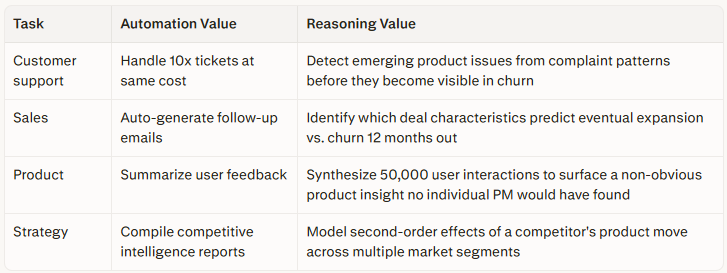
The left column is where most enterprise AI investment is going. The right column is where most of the differentiated value potentially lives.
This doesn’t mean the left column is wrong. Automation value funds the organization that can eventually capture reasoning value. But treating them as the same thing — treating AI as a cheaper, faster version of existing human labor — means building systems optimized for the wrong objective.

AI-Generated Image
4. Why Technology Revolutions Rarely Just Optimize Old Problems
This point is worth making historically because the pattern is consistent enough to count as evidence.
The steam engine’s primary impact wasn’t making existing transportation faster. It created the railway system, which enabled economic geographies that were impossible before — cities could be further from rivers, goods could move inland at scale, and labor markets could integrate across regions. The structural impact was the creation of new possibility space, not the optimization of old workflows.
The computer’s primary impact wasn’t making calculators faster. It created the software industry, which created entirely new economic categories. The spreadsheet didn’t just replace the accounting ledger — it enabled a style of financial planning that wasn’t previously possible, which changed how businesses were managed.
The internet’s primary impact wasn’t making telephone calls cheaper. It created information architectures that enabled new kinds of economic coordination — platform businesses, long-tail markets, global supply chains managed in near real-time.
In each case, the technology was initially described as an efficiency improvement to existing practices. The actual impact came from the new problem spaces the technology opened up.
The question worth asking about AI is: what problem spaces does it open that didn’t previously exist?
Here’s my working answer: AI significantly lowers the cost of reasoning about complex, information-rich problems. Problems that previously required either a team of highly-paid specialists or simply went unexamined become tractable. This isn’t just “existing analysts are faster.” It’s those problems too complex, too data-intensive, or too low-probability-of-clear-answer to be assigned to a human team, and can now be engaged with continuously.
That’s a new problem space. The economic implications are potentially large. And most enterprise AI strategies aren’t aimed at it.
5. The Four High-Value Directions Most Enterprise AI Strategies Are Missing
Given the framing above, let me be concrete about where reasoning value is actually accessible, and what the organizational preconditions for capturing it are.
Direction 1: Complex Decision Support With Simulation
Traditional enterprise decisions that involve significant uncertainty — market entry, M&A, major product pivots — are typically handled through a combination of consultants, internal analysis teams, and executive judgment. The process is slow, expensive, and limited by the cognitive bandwidth of the humans involved.
AI doesn’t replace the decision-maker’s judgment. But it can dramatically expand the scenario space the decision-maker can explore.
A retail company considering a pricing change doesn’t just need “historical analysis suggests X.” It can now run: what happens if we implement this change while a competitor is simultaneously promoting? What if demand elasticity in our highest-margin category is actually lower than historical data suggests? What’s the second-order effect on customer lifetime value if short-term conversion improves but we anchor price expectations down?
These are simulation questions. They require building a model of the business, generating scenarios, and reasoning about outcomes under uncertainty. AI doesn’t answer them definitively — the uncertainty is real — but it makes it feasible to actually examine them before deciding, rather than gesturing at them and going with gut.
The precondition: access to sufficiently clean and connected business data. Most enterprises with a mature data infrastructure can build this. Most enterprises without it can’t, and AI capability doesn’t substitute for data quality.
Direction 2: Weak Signal Detection Across Unstructured Information
Enterprises generate enormous volumes of information that currently go unanalyzed at any systematic level. Sales call transcripts. Customer service records. Email threads. Internal Slack conversations. External news and analyst reports. Partner communications.
Within this information, there are often early signals of significant developments — a shift in customer language that predates a churn wave, a competitive move being telegraphed in hiring patterns or product announcements, a supply chain risk accumulating across multiple low-priority indicators.
Humans can’t process this information at scale. So it doesn’t get processed. Problems are discovered when they become visible in structured metrics — at which point they’re already mature.
AI can change this. Not by reading every document and producing a report (that’s the automation frame), but by continuously monitoring unstructured information for pattern shifts that might indicate emerging business conditions — and surfacing them as hypotheses for human investigation before they become crises.
This is a fundamentally different use case than “summarize my emails.” It’s an organizational early warning infrastructure.
Direction 3: Cross-Dimensional Creative Synthesis
Many high-value business problems require synthesizing across domains that are organizationally siloed. A product manager making decisions about a new feature needs to hold simultaneously: user research data, competitive landscape, engineering capacity constraints, pricing model implications, customer success team feedback, and sales team objections. In practice, no individual has all this context. Decisions get made on incomplete synthesis.
AI can hold this context simultaneously and reason across it in ways that are cognitively expensive for humans. Not replacing the PM’s judgment — but giving the PM a synthesis layer that reflects the full picture rather than the subset they happened to personally encounter.
The organizational implication: the value of this capability requires breaking down the information silos that currently prevent it. AI can synthesize across domains, but only if the information from those domains is accessible and connected.
Direction 4: Continuous Operational Intelligence
The most ambitious direction, and currently the furthest from widespread deployment: AI systems that continuously observe business operations, identify deviations from expected patterns, generate hypotheses about causes, and surface both problems and potential responses — without being asked.
This is different from a dashboard. A dashboard shows you what happened. Operational intelligence tells you what’s happening, why it might be happening, and what options exist for responding.
Current limitations are real: model reliability for sustained autonomous monitoring, the data infrastructure required, the organizational processes for acting on AI-generated alerts, and the trust question of what level of autonomous action is appropriate. Most enterprises deploying agents at scale are finding, as Salesforce documented from 20,000 deployments, that the majority of operational work happens after launch — reviewing agent behavior, correcting errors, tightening constraints.
But the direction is real. The question is timing and organizational readiness.
6. Why Enterprise AI Conversations Stay Anchored to Cost Reduction
There’s a puzzle here. If the reasoning value is potentially larger than the automation value, why is most enterprise AI investment focused on the latter?
Three structural reasons, and they’re all understandable even if the aggregate effect is suboptimal.
The ROI calculation problem. “AI reduced support ticket handling time by 60%, saving approximately $2.3M annually” is a sentence a CFO can put in a budget justification. “AI helped us detect an emerging competitive threat three months earlier than we would have otherwise” is nearly impossible to quantify. Investing in automation value produces legible returns. Investing in reasoning value produces returns that are real but hard to attribute and slow to materialize.
This is a measurement problem masquerading as a priority problem. Enterprises optimize for what they can measure, and automation savings are highly measurable. Reasoning value — market opportunities identified, risks avoided, better decisions made — is diffuse and long-lagged.
The existing infrastructure pulls. Most enterprises have high sunk costs in ERP, CRM, and BI platforms. The path of least resistance for AI adoption is to connect AI capability to existing infrastructure — to make the CRM smarter, to automate workflows that already run through existing systems. This produces the “AI as software upgrade” framing because it literally is an upgrade to existing software.
Reasoning value often requires different infrastructure: better-connected data, better-quality unstructured information, better tooling for scenario modeling. Building that infrastructure from scratch competes with the shorter-path option of upgrading what already exists.
Organizational readiness. Automating a customer support workflow doesn’t require the customer support organization to change how it makes decisions. Deploying AI-generated strategic intelligence requires executives to develop new habits for consuming and acting on AI outputs — to trust it appropriately without over-trusting it, to use it as a starting point rather than an answer. That’s a harder organizational change. It requires different skills, different processes, and different governance structures.
The result is a systematic bias toward automation value even when reasoning value is larger. Enterprises will rationally make this choice given their constraints. But being aware of the bias is what allows some organizations to begin building the foundation for reasoning value while their competitors are still counting headcount saved.

AI-Generated Image
7. The Organizational Form Question Nobody Is Asking
There’s a downstream implication of the capability-expansion frame that tends to get skipped over: if AI genuinely expands what an organization can engage with, the organizational structure appropriate for that expanded capability is probably different from current structures.
The current enterprise org design is built around human cognitive constraints. Spans of control, reporting structures, information routing decisions — all calibrated to the bandwidth limitations of individual humans processing information and making decisions.
If AI expands individual cognitive bandwidth — if a product manager can now synthesize across 10x the information they previously could, if a strategist can now explore 10x more scenarios — the right organizational response isn’t “great, those people are more productive in the same roles.” It’s “what does the organization look like when the fundamental constraint of human cognitive bandwidth is relaxed?”
This is early and speculative. But it’s the more interesting question for leadership teams thinking about 5–10 year organizational design rather than next year’s cost structure.
The competitive dynamic may shift from “who has the best individual talent” to “who has built the best infrastructure for human-AI collaboration.” A smaller, well-designed team with excellent AI infrastructure may be able to engage with problems that a larger, conventionally structured team cannot. That’s a different competitive dynamic than the one most enterprises are currently optimizing for.
8. The Honest Assessment of Where We Are
I don’t want to oversell the reasoning value frame as if it’s easily accessible today. It isn’t, and the reasons are concrete.
Data quality is the first and most persistent bottleneck. Reasoning value requires AI systems to have access to connected, reliable, and sufficiently complete business information. Most enterprises have data environments that are siloed, inconsistent, and poorly governed. AI capability doesn’t fix this. In fact, it surfaces data quality problems faster — an AI system that’s producing confident-sounding wrong answers based on inconsistent data is more dangerous than a human who’d notice the inconsistency and ask questions.
Model reliability for sustained autonomous operation remains a real constraint. The current generation of models can reason impressively in bounded contexts. They’re less reliable over long time horizons, in complex multi-step agentic operations, and in domains requiring precise factual accuracy at the detail level. Deploying them for continuous operational intelligence requires governance infrastructure that most enterprises haven’t built.
Organizational trust and process integration are the most underestimated challenges. AI-generated strategic intelligence is only valuable if the organization has processes for incorporating it into decisions. This requires leaders who understand how to use AI outputs appropriately — as one input among several, not as the answer, and not dismissed because it came from a machine. Developing this organizational muscle takes time and deliberate design.
None of this negates the direction. It just means the path from “AI makes existing work more efficient” to “AI enables us to solve problems we couldn’t previously solve” runs through a set of preconditions that require active investment.
The Explanation Completes Here
The fundamental reframe this article is arguing for:
The limiting question for enterprise AI is not “which jobs can AI do” but “which problems can AI allow us to solve that we couldn’t solve before.”
The first question optimizes the current organization. The second question asks what organization becomes possible.
Automation value — faster, cheaper execution of existing processes — is real and important. It funds the organization that can build toward reasoned value. But mistaking it for the destination means spending decades making ERP faster when the actual opportunity is building organizational intelligence that simply didn’t exist before.
The pattern from previous technology revolutions is consistent: the transformative value came not from optimizing existing practices but from entering new problem spaces. Steam didn’t make horses faster. Computing didn’t make ledgers faster. AI probably won’t just make employees faster either — the more significant possibility is that it makes tractable a category of problem that was previously intractable.
Getting there requires three things most enterprise AI strategies currently underinvest in:
- Data infrastructure designed for reasoning, not just reporting — connected, high-quality, accessible to AI systems across organizational silos
- AI deployment patterns aimed at unstructured problem spaces — not just workflow automation, but continuous monitoring, scenario modeling, cross-domain synthesis
- Organizational design that captures the capability expansion, which means redesigning how decisions get made when individual cognitive bandwidth is no longer the binding constraint
The enterprise AI opportunity is not a digital replacement for the org chart. It’s a new layer of organizational capability that allows the enterprise itself to engage with problems of greater complexity, uncertainty, and scope than it could before.
The enterprises that figure this out first will have an advantage that doesn’t compress over time — because the problems they’ll be solving won’t be the kind that can be automated away.
If you’d like to show your appreciation, you can support me through:
✨ **Patreon ✨ [Ko-fi](https://ko-fi.com/jinlowmedium) ✨ [BuyMeACoffee](https://buymeacoffee.com/jinlowmedium)**
Every contribution, big or small, fuels my creativity and means the world to me. Thank you for being a part of this journey!
메타데이터
- post_id
- faea4d94e958
- slug
- the-direction-of-enterprise-ai-may-have-been-wrong-from-the-start-faea4d94e958
- url
- https://medium.com/jin-system-architect/the-direction-of-enterprise-ai-may-have-been-wrong-from-the-start-faea4d94e958
- canonical_url
- https://medium.com/jin-system-architect/the-direction-of-enterprise-ai-may-have-been-wrong-from-the-start-faea4d94e958
- author_url
- https://medium.com/@jinlow
- status
- ok
- fetched_at
- 2026-07-09 03:40:04