Day-12 : Python Has for, iter, and Generators — But You Still Need the Iterator Pattern
Part 12 of the Python Design Patterns Mastery Series (FINALE)
Day-12 : Python Has for, iter, and Generators — But You Still Need the Iterator Pattern
Part 12 of the Python Design Patterns Mastery Series (FINALE)

Imagine you’re browsing a massive library with millions of books. You don’t want to load all books into memory at once — that would crash any system. Instead, you want a smart librarian who can hand you books one at a time based on your criteria: “Give me Python books published after 2020, but skip the ones I’ve already read, and if you find any by my favorite authors, show me those first.”
The Iterator pattern is that smart librarian for your data — it gives you sophisticated, memory-efficient ways to traverse collections that go far beyond Python’s built-in for loops.
The Problem: When Simple Loops Break Down
Python’s built-in iteration is fantastic for most cases, but it has limits. Picture this scenario:

This is like trying to eat an entire buffet at once instead of taking one bite at a time. Your system gets overwhelmed, and you lose control over the process.
The Iterator pattern solves this by giving you fine-grained control over how you traverse data, when you fetch it, and how much memory you use.
Smart Librarians: Custom Iterators in Action
Let’s build that smart librarian who can handle massive datasets efficiently:

This iterator is like having a professional librarian who:
- Only brings you books when you ask for them
- Remembers exactly where you left off
- Never overwhelms you with too many books at once
- Tells you when there are no more books to see
The Magic of Generators: Python’s Secret Weapon
Python’s generators make creating iterators incredibly elegant. They’re like having that smart librarian who can instantly adapt to your changing needs:
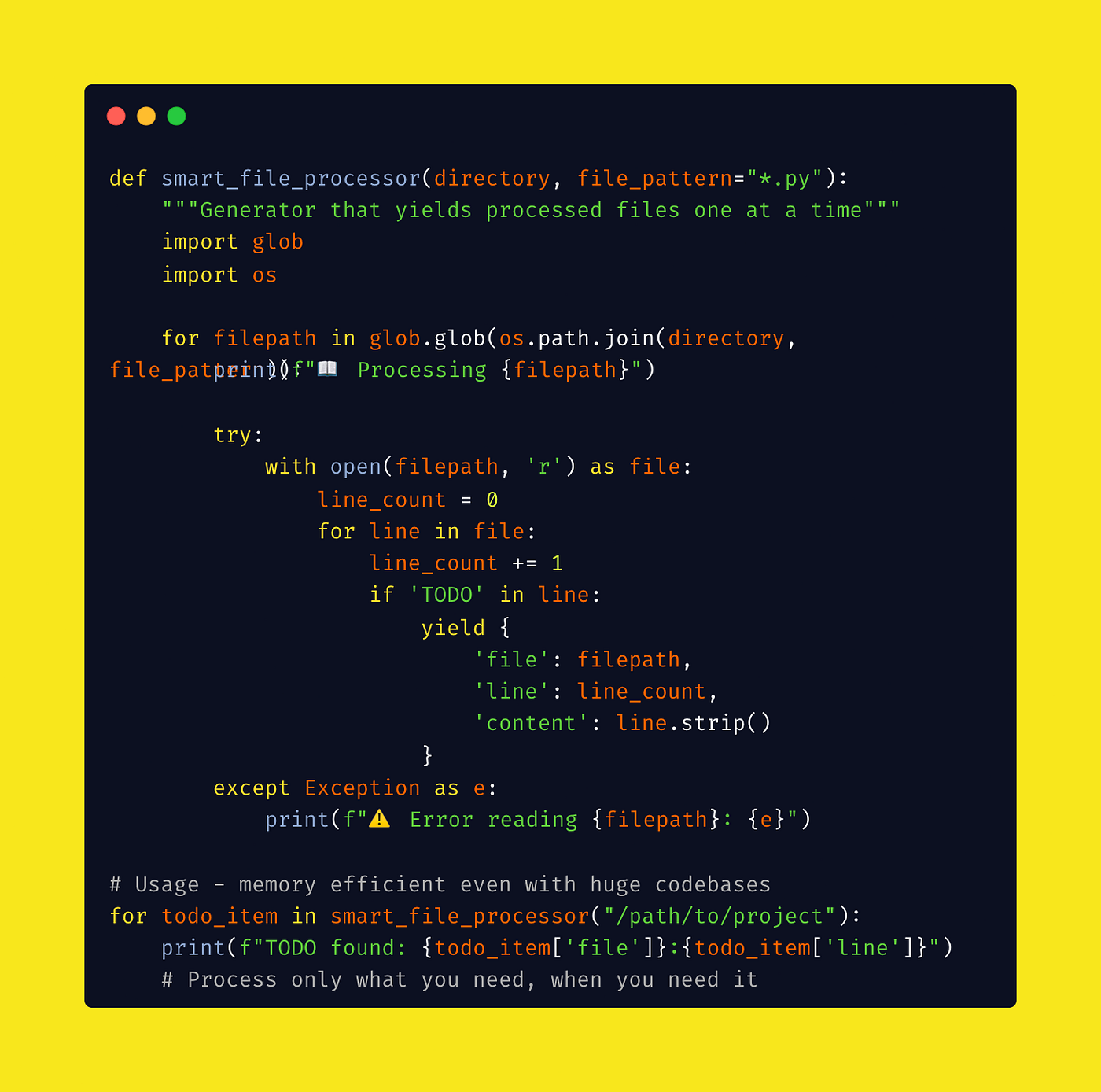
The beauty of generators is that they’re lazy — they only do work when you ask for the next item. It’s like having a chef who only cooks your meal when you’re ready to eat it, not before.
Chaining Operations: The Assembly Line Approach
One of the most powerful aspects of iterators is chaining them together, like creating an assembly line where each station adds value:

This is like having a smart factory where each workstation:
- Only operates when needed
- Passes work to the next station automatically
- Uses minimal resources
- Can be reconfigured easily
Infinite Sequences: When Data Never Ends
Sometimes you need to work with data that never ends — like sensor readings, live feeds, or mathematical sequences. Iterators handle this beautifully:

This is like having a security guard who can watch an infinite stream of camera feeds, but can immediately stop and alert you when something important happens.
Memory Efficiency: The Real Superpower
The Iterator pattern’s greatest strength is memory efficiency. Let’s see the dramatic difference:

The difference is staggering — like comparing a warehouse full of inventory to a smart catalog that orders items only when customers want them.
When to Use Iterators vs. Simple Lists
Use Iterators When:
- Processing large datasets (>100k items)
- Working with streaming or infinite data
- Memory is constrained
- You might not process all data
- Chaining multiple operations
Use Lists When:
- Small datasets (<10k items)
- Need random access to elements
- Sorting or shuffling data
- Multiple iterations over same data
- Need
len()or indexing
Real-World Example:

The Journey Complete: Your Design Pattern Mastery
Congratulations! You’ve completed all 12 design patterns in our series. From the Singleton’s controlled creation to the Iterator’s efficient traversal, you now have a complete toolkit for writing elegant Python code.
Your Pattern Arsenal:
- Singleton: Controlled object creation
- Factory: Flexible object instantiation
- Observer: Reactive event systems
- Decorator: Behavior enhancement
- Strategy: Algorithm selection
- Adapter: Interface translation
- Builder: Complex object construction
- Command: Action encapsulation
- Facade: System simplification
- State: Behavior state management
- Composite: Tree structure elegance
- Iterator: Efficient data traversal
The Iterator pattern is the perfect finale because it embodies the core philosophy of good design patterns: making complex things simple, efficient, and elegant.
Your Next Steps
Now that you have these 12 patterns in your toolkit:
- Practice: Try implementing each pattern in your current projects
- Combine: Mix patterns together (Iterator + Observer for event streams!)
- Recognize: Spot these patterns in libraries you use daily
- Share: Teach these concepts to your teammates
Remember, patterns aren’t rules — they’re tools. Use them when they solve real problems, not because you can.
The Bottom Line
The Iterator pattern transforms how you think about data processing. Instead of wrestling with memory constraints and complex loops, you get elegant, efficient, and controlled data traversal.
It’s the difference between trying to drink from a fire hose and having a smart water fountain that gives you exactly what you need, when you need it.
Your code will be more memory-efficient, more readable, and more maintainable. Your future self will thank you for choosing iterators over brute-force approaches.
This concludes our 12-day journey through Python design patterns. You’ve built a solid foundation for writing professional, maintainable code. Keep practicing, keep learning, and most importantly — keep coding!
🎉 What’s been your favorite pattern from this series? Share your design pattern success stories in the comments — let’s celebrate how far you’ve come!
메타데이터
- post_id
- ffc8b044d267
- slug
- day-12-python-has-for-iter-and-generators-but-you-still-need-the-iterator-pattern-ffc8b044d267
- url
- https://medium.com/@pritishmaheta/day-12-python-has-for-iter-and-generators-but-you-still-need-the-iterator-pattern-ffc8b044d267
- canonical_url
- https://medium.com/@pritishmaheta/day-12-python-has-for-iter-and-generators-but-you-still-need-the-iterator-pattern-ffc8b044d267
- author_url
- https://medium.com/@pritishmaheta
- status
- ok
- fetched_at
- 2026-08-18 01:56:17
