Why Your RGB Values Are Lying to You: The Case for CIELAB and CIEDE2000 in Scientific Color…
Color is one of the most intuitive yet most frequently misused measurements in science. From water-quality monitoring and food science to…
Why Your RGB Values Are Lying to You: The Case for CIELAB and CIEDE2000 in Scientific Color Analysis
Color is one of the most intuitive yet most frequently misused measurements in science. From water-quality monitoring and food science to materials research and dermatology, researchers routinely extract RGB values from images and treat them as quantitative data. The problem? RGB was never designed for that purpose.
This article explains why CIELAB (Lab*) is scientifically preferable for most quantitative color work and walks through the current gold-standard colour-difference formula — CIEDE2000 — in a form you can actually use and cite.
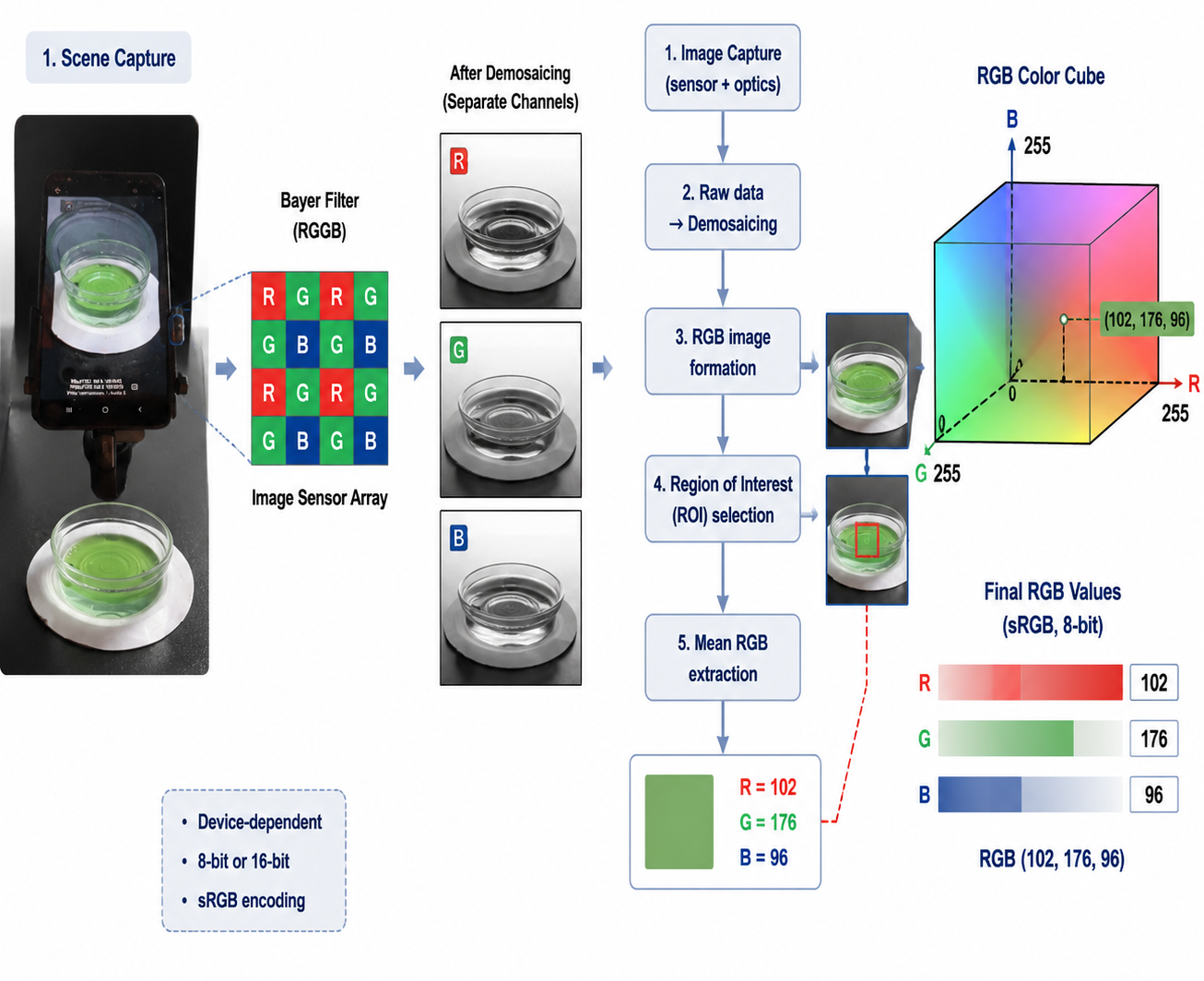
How RGB Color Values are Obtained from a Digital Image
The Fundamental Problem with RGB
RGB is a device-dependent colour space. The same physical sample can produce completely different RGB triplets depending on:
- camera sensor and model
- white-balance setting
- exposure
- ambient lighting
- gamma encoding
Equal numerical steps in RGB also do not correspond to equal perceived colour differences. A change of 10 units in the blue channel can look dramatically different from a change of 10 units in the red channel. For any study that claims reproducibility or perceptual relevance, this is a serious limitation.
Why CIELAB Solves the Problem
CIELAB (officially CIE Lab*) was designed by the Commission Internationale de l’Éclairage to be:
- Device-independent — defined relative to a standard illuminant (usually D65) and the CIE standard observer
- Approximately perceptually uniform — Euclidean distance roughly matches human perception
- Grounded in opponent — colour theory (the same red–green and yellow–blue channels the human visual system actually uses)

Conversion of Image from RGB to CIELAB Color Space

CIEDE2000 : The Current Gold-Standard Colour Difference
Simple Euclidean distance in CIELAB

- Use RGB only when the imaging system is fixed and you need raw pixel values or simple features.
- Use CIELAB (or ΔE derived from it) whenever you need device-independent, perceptually meaningful, reproducible colour metrics.
- Prefer CIEDE2000 over older ΔE formulae for any serious colour-difference work.
This is the standard recommendation in colour science and in the majority of rigorous quantitative colour studies. Switching from RGB to CIELAB is one of the simplest ways to increase the scientific credibility of image-based colour measurements.
메타데이터
- post_id
- 020b8f39a3e5
- slug
- why-your-rgb-values-are-lying-to-you-the-case-for-cielab-and-ciede2000-in-scientific-color-020b8f39a3e5
- url
- https://medium.com/@mallikagecl2025/why-your-rgb-values-are-lying-to-you-the-case-for-cielab-and-ciede2000-in-scientific-color-020b8f39a3e5
- canonical_url
- https://medium.com/@mallikagecl2025/why-your-rgb-values-are-lying-to-you-the-case-for-cielab-and-ciede2000-in-scientific-color-020b8f39a3e5
- author_url
- https://medium.com/@mallikagecl2025
- status
- ok
- fetched_at
- 2026-08-20 20:46:12