How AI Agents Can Improve Procurement and Supplier Discovery in the GCC
Procurement teams across the GCC are under pressure to move faster, source smarter, and manage more supplier complexity than ever before.
How AI Agents Can Improve Procurement and Supplier Discovery in the GCC
Procurement teams across the GCC are under pressure to move faster, source smarter, and manage more supplier complexity than ever before.
In many organizations, sourcing still depends on manual supplier searches, disconnected spreadsheets, long email threads, and internal vendor knowledge that is difficult to scale. This creates delays at the exact stage where speed and accuracy matter most: finding the right suppliers, preparing RFQs, comparing options, and making sourcing decisions.
This is where AI is starting to change procurement.
AI in procurement is not about replacing procurement teams. It is about building systems that reduce repetitive work, improve supplier search, and make sourcing workflows more structured. For businesses in the GCC — especially across construction, infrastructure, logistics, hospitality, healthcare, industrial supply, and energy-related sectors — AI can help procurement teams handle large supplier networks and complex categories more efficiently.
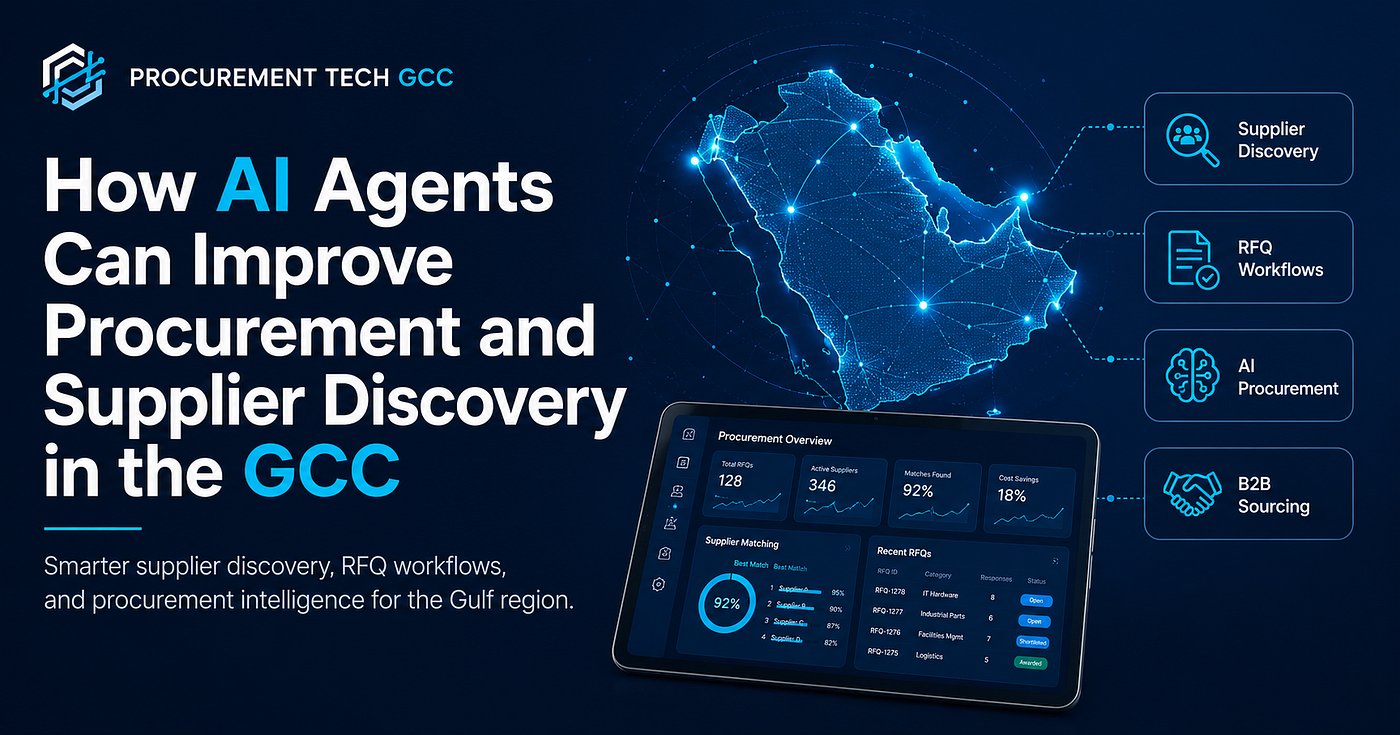
AI Agents can improve procurement and supplier discovery
Why Procurement in the GCC Is a Good Fit for AI
Procurement environments in the GCC often involve multiple supplier categories, urgent project-based requirements, local and regional sourcing needs, fragmented supplier information, repetitive RFQ processes, and limited visibility across sourcing activity.
When procurement teams depend only on manual research, they usually face the same bottlenecks:
- Too much time spent searching for vendors
- Inconsistent supplier data
- Duplicate outreach efforts
- Slow quotation cycles
- Difficulty comparing supplier options
- Limited procurement intelligence across categories
AI is useful here because these are not only search problems. They are workflow problems.
A procurement team does not simply need a list of suppliers. It needs relevant supplier options, category context, product or service fit, RFQ support, and a faster way to move from requirement to decision.
What Is an AI Procurement Platform?
An AI procurement platform combines procurement data, intelligent search, automation, and workflow logic to support sourcing decisions.
In practice, this can include:
- Supplier discovery through natural language search
- Product and service matching
- RFQ drafting support
- Supplier recommendation logic
- Quote comparison support
- Procurement data visibility
- Buyer query handling
- Category-based sourcing insights
Instead of forcing buyers to manually search different supplier websites, legacy vendor lists, or internal spreadsheets, an AI-enabled platform can help procurement teams interact with supplier data in a more structured way.
For example, a buyer should be able to search:
Find suppliers in the GCC for industrial valves with fast delivery capability.
Or:
Show service providers in Qatar for facilities management with experience in commercial projects.
That type of search experience is far more useful than a static directory because it starts with the buyer’s real requirement.
AI Agents vs Traditional Procurement Tools
Traditional procurement tools often work like record-keeping systems. They are useful for documentation, approvals, and process control, but they may not actively help the user discover better supplier options or reduce research time.
AI agents add a new layer.
Instead of only storing procurement information, they can help users interact with sourcing data more intelligently.
An AI procurement agent can support tasks such as:
- Understanding the buyer’s requirement
- Identifying relevant supplier categories
- Surfacing matching products or services
- Recommending suppliers based on context
- Supporting RFQ generation
- Answering sourcing-related questions
- Summarizing supplier options
- Improving procurement visibility across workflows
The value is not in the chatbot interface alone. The value is in the combination of AI, connected procurement data, marketplace workflows, and sourcing actions.
That distinction matters.
A generic chatbot can answer procurement questions. A procurement-specific AI agent can help buyers move through sourcing workflows with relevant supplier, product, service, and RFQ data.
Practical Use Cases for AI in Procurement
1. Supplier Discovery
AI can help buyers find suppliers faster by searching structured supplier, product, and service data instead of relying on disconnected manual research.
This is especially useful when buyers know what they need but do not know which suppliers are relevant.
2. Product and Service Search
Procurement teams often search by product need, service requirement, industry category, or project type. AI-assisted search can improve discoverability across supplier profiles, catalogs, and service listings.
3. RFQ Creation Support
RFQ preparation can be repetitive. AI can help structure buyer requirements, summarize specifications, and support request-for-quotation workflows.
This does not remove buyer control. It simply helps teams prepare clearer sourcing requests faster.
4. Supplier Matching
Instead of showing a long undifferentiated supplier list, an AI layer can help surface suppliers based on category fit, geography, availability, relevance, or sourcing context.
5. Procurement Intelligence
AI can help organize procurement data so buyers can understand sourcing patterns, supplier availability, category demand, RFQ activity, and procurement workflows more clearly.
6. Buyer Query Handling
AI interfaces can help answer common buyer questions, making procurement systems easier to use for sourcing teams, business users, and procurement stakeholders.
7. Supplier Recommendations
When procurement systems are connected to real supplier and marketplace data, AI can support better shortlisting and recommendation logic.
Why the Data Layer Matters More Than the Interface
A common mistake is to think AI procurement is just a new chatbot placed on top of an old system.
In reality, the usefulness of AI depends heavily on the data underneath it.
If a system does not have structured supplier, product, service, category, and RFQ data, the AI layer cannot provide meaningful procurement support. It may still answer general questions, but it will not be operationally useful for sourcing.
A useful AI procurement workflow should be connected to:
- Supplier profiles
- Product catalogs
- Service listings
- Category taxonomy
- RFQ workflows
- Procurement activity data
- Buyer and supplier interactions
Without this foundation, the AI experience becomes generic.
With this foundation, the platform becomes much more useful because the AI layer can support real procurement tasks instead of only providing general information.
What This Means for GCC Businesses
For GCC businesses, procurement digitization is no longer just about replacing paper-based workflows or moving approvals online. The next step is creating sourcing systems that help teams move faster, discover suppliers better, and make more informed decisions.
This is especially relevant in a region where companies often source across Qatar, UAE, Saudi Arabia, Oman, Kuwait, and Bahrain.
Regional procurement introduces more complexity, more supplier variation, and more demand for fast discovery. AI-assisted procurement can help reduce that complexity when it is built on top of real marketplace and sourcing workflows.
One example of this direction is iProcure.ai’s work around an **AI procurement platform in GCC**, where supplier discovery, marketplace workflows, and procurement intelligence can be supported through AI-assisted interfaces.
What Procurement Teams Should Look For
When evaluating AI procurement tools, businesses should look beyond the word “AI” and ask practical questions:
- Is the platform connected to real supplier data?
- Can buyers search products, services, and suppliers naturally?
- Does it support RFQ workflows?
- Can it help with supplier discovery and shortlisting?
- Is the system useful for local and regional sourcing?
- Does it improve visibility across procurement activity?
- Does it reduce manual work without removing buyer control?
The strongest AI procurement systems will not only answer questions. They will help procurement teams move from search to sourcing action.
Final Thoughts
AI procurement is still evolving, but the direction is clear.
The most useful systems will not simply automate forms or add chat to legacy workflows. They will help procurement teams search better, discover suppliers faster, structure RFQs more efficiently, and interact with sourcing data in a more intelligent way.
For GCC businesses, this is a meaningful shift.
Procurement teams are managing more categories, more suppliers, and faster requirements. AI-assisted procurement can help reduce manual effort and improve sourcing quality — not by replacing buyers, but by making their workflows more effective.
FAQ
What is AI in procurement?
AI in procurement uses intelligent systems to support supplier search, sourcing decisions, RFQ workflows, supplier matching, and procurement insights.
Can AI replace procurement teams?
No. AI supports procurement teams by reducing repetitive work, improving information access, and helping buyers make faster sourcing decisions.
Why is AI useful in GCC procurement?
GCC businesses often manage complex sourcing requirements across multiple industries, supplier categories, and regional markets. AI can help organize supplier information and improve sourcing workflows.
What makes an AI procurement platform useful?
Its usefulness depends on whether it is connected to real supplier, product, service, and RFQ data — not just a front-end chatbot.
How can AI agents support supplier discovery?
AI agents can understand buyer requirements, identify relevant categories, surface matching suppliers, and help procurement teams move faster from search to shortlist.
If you are researching how AI, supplier discovery, and RFQ workflows are evolving in the GCC, it is worth following how procurement platforms are combining marketplace data with AI-assisted sourcing interfaces.
메타데이터
- post_id
- 03ea8490868d
- slug
- how-ai-agents-can-improve-procurement-and-supplier-discovery-in-the-gcc-03ea8490868d
- url
- https://medium.com/@bigtradertechnologies/how-ai-agents-can-improve-procurement-and-supplier-discovery-in-the-gcc-03ea8490868d
- canonical_url
- https://medium.com/@bigtradertechnologies/how-ai-agents-can-improve-procurement-and-supplier-discovery-in-the-gcc-03ea8490868d
- author_url
- https://medium.com/@bigtradertechnologies
- status
- ok
- fetched_at
- 2026-06-09 15:37:30



