How Digital Coupons Travel from a Grocery Store Website to the Checkout Register
Introduction
How Digital Coupons Travel from a Grocery Store Website to the Checkout Register
Introduction
Most shoppers don’t think much about digital coupons.
They open a grocery store app, browse through available offers, tap a button to clip a coupon, and later see the discount automatically applied at checkout.
The process feels almost effortless.
In fact, it has become so common that many customers simply expect it to work every time.
What most people never see is the amount of technology working behind the scenes to make that happen.
A single digital coupon may travel through multiple systems before it reaches the checkout register. Customer loyalty platforms, promotion engines, product databases, pricing systems, and point-of-sale applications must all work together within seconds to ensure the correct discount is applied to the correct customer.
After spending years working with enterprise retail systems, I have always found digital coupons to be one of the best examples of how complex technology can remain completely invisible to customers.
Let’s take a look at what actually happens behind the scenes.
The Journey Begins with a Single Click
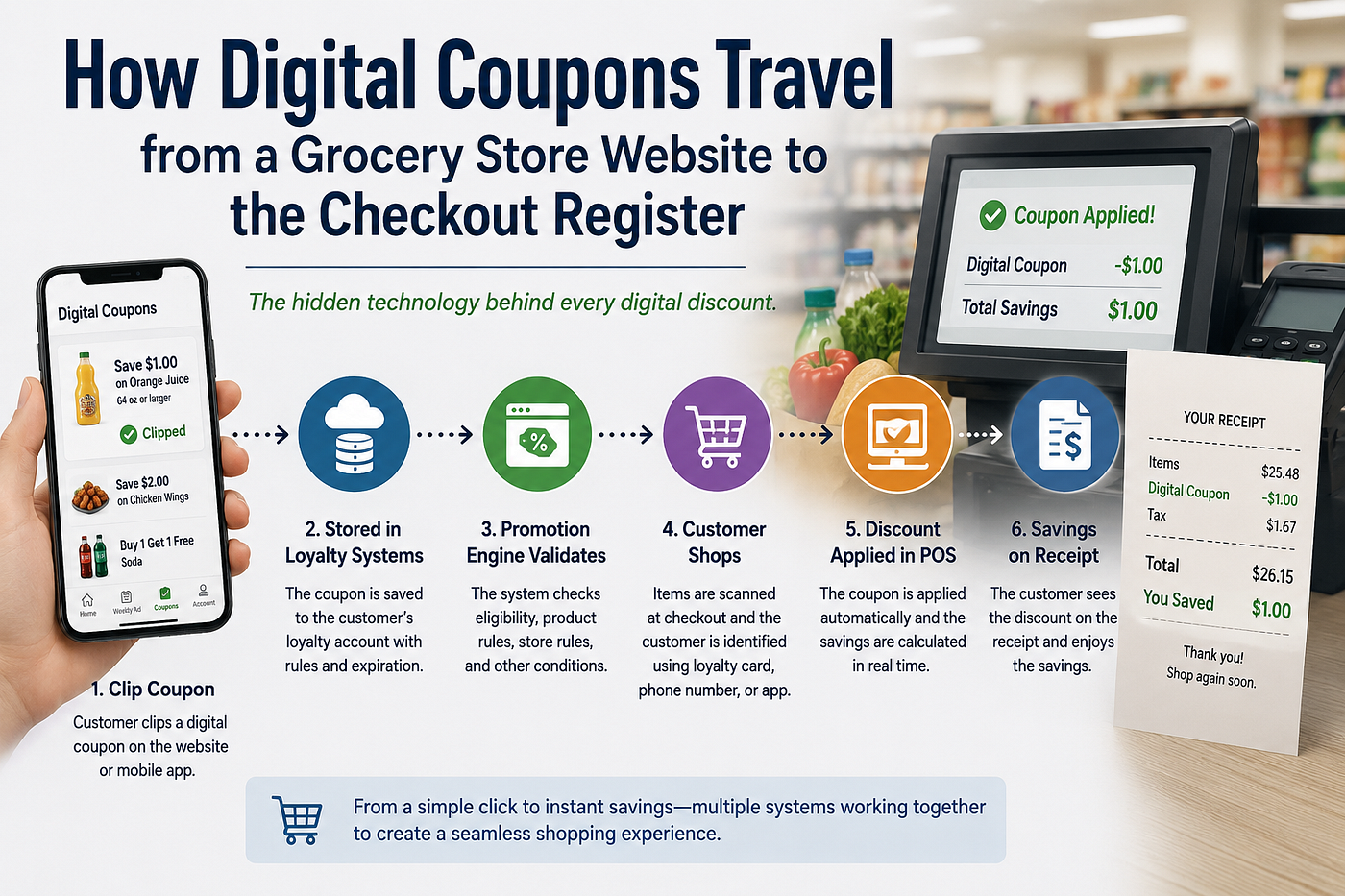
Everything starts when a customer logs into a grocery store website or mobile application and decides to clip a coupon.
Perhaps the offer provides one dollar off a bottle of juice. Maybe it offers a discount on a family pack of chicken wings. Sometimes it may provide bonus rewards points for purchasing specific products.
When the customer clicks the “Clip Coupon” button, the retailer records that action and associates the coupon with the customer’s loyalty account.
At this stage, no discount has been applied.
The retailer is simply recording that the customer is now eligible to use that offer during a future purchase.
The process sounds simple, but this information must be stored accurately because it could be needed hours, days, or even weeks later when the customer finally visits the store.
Storing the Customer’s Eligibility
Once a coupon is clipped, loyalty systems take over.
These systems maintain information about customer accounts and the offers associated with them. They remember which coupons were selected, when they were activated, when they expire, how many times they can be used, and which products qualify for the discount.
For large retailers, this is not a small task.
Millions of customers may be clipping coupons every week while thousands of promotions remain active at the same time.
The loyalty platform acts as a central memory system, ensuring that every customer’s selected offers remain available whenever they decide to shop.
The coupon now sits quietly in the customer’s digital wallet, waiting for the right transaction.
Shopping Begins
Several days later, the customer visits the store.
Products are scanned one by one as they move through checkout.
At this point, the register knows what products are being purchased, but it may not yet know who the customer is.
Without customer identification, the system cannot determine which digital coupons belong to the transaction.
This is why loyalty identification is such an important step.
The customer may scan a loyalty card, enter a phone number, or use a barcode from the retailer’s mobile application.
Once that happens, the register can connect the shopping basket to the customer’s account.
Now the real work begins.
Finding the Right Coupons
As soon as the customer is identified, the checkout system begins searching for eligible offers.
Many shoppers assume the system simply checks whether a coupon exists and immediately applies it.
The reality is far more complicated.
The promotion engine must first verify that the customer actually clipped the coupon. It then checks whether the offer has expired, whether it has already been redeemed, and whether the purchased products satisfy all promotion requirements.
Even a simple coupon often contains multiple business rules.
Some promotions require customers to purchase a minimum quantity. Others apply only to specific product sizes, brands, or store locations. Some promotions can be combined with other discounts, while others cannot.
All of these rules must be evaluated within seconds while the customer is standing at the register.
Product Qualification Is More Complex Than It Looks
One of the biggest challenges in retail systems is determining whether products qualify for a promotion.
Imagine a coupon that offers savings on selected beverages.
A customer may believe any beverage should qualify, but the retailer may have very specific rules defining exactly which products are eligible.
The system must compare the scanned products against promotion definitions maintained in product databases. It needs to determine whether the correct brand, package size, quantity, and product category have been purchased.
This process becomes even more complicated when promotions involve multiple products or combinations of products.
What appears to be a simple discount on a receipt may actually require dozens of validation checks behind the scenes.
Calculating the Discount
After qualification has been confirmed, the system calculates the savings.
This is another area where complexity often hides beneath the surface.
Many customers receive multiple discounts during a single transaction. They may qualify for a weekly sale price, a digital coupon, loyalty rewards, and even manufacturer-sponsored offers.
The promotion engine must determine which discounts apply, the order in which they should be processed, and whether any restrictions prevent certain offers from being combined.
Small mistakes in these calculations can have significant consequences.
Applying an incorrect discount may create customer dissatisfaction. Failing to apply a valid discount can result in customer service calls, refunds, and loss of trust.
Because of this, retailers spend a significant amount of effort validating promotion logic before new offers are released.
Real-Time Communication Between Systems
One interesting aspect of modern retail systems is that the checkout register does not always make promotion decisions on its own.
Many retailers rely on multiple backend services that provide customer information, loyalty balances, promotion eligibility, and reward calculations.
When a transaction occurs, these systems often communicate with each other in real time.
The customer may not notice anything unusual, but behind the scenes, multiple applications are exchanging information and validating business rules almost instantly.
The success of the transaction depends on all of these systems working together seamlessly.
The Discount Appears on the Receipt
After all validations are complete, the discount is finally applied.
The customer sees a reduced total and a savings line printed on the receipt.
This is the moment that matters most to shoppers.
They are not concerned about loyalty databases, promotion engines, or product hierarchies.
They simply want to know whether the coupon worked.
If the expected savings appear, the experience feels effortless.
Ironically, the more successful the technology is, the less customers think about it.
Why Digital Coupons Are Challenging to Test
From a software testing perspective, digital coupon functionality is one of the most challenging areas of retail technology.
A single promotion may contain numerous business rules, eligibility conditions, product relationships, and redemption requirements.
Testers must verify that discounts apply correctly for different customers, different stores, different product combinations, and different transaction scenarios.
What works perfectly for one customer may fail for another because of subtle differences in account settings, purchase history, or basket contents.
This is why promotion testing often requires extensive planning, detailed validation, and careful analysis of edge cases.
The goal is simple: ensure that every eligible customer receives the correct discount every time.
Conclusion
The next time you clip a digital coupon and see the discount appear automatically at checkout, remember that a great deal of technology helped make that moment possible.
What appears to be a simple customer convenience is actually the result of multiple enterprise systems working together in real time. Loyalty platforms, promotion engines, pricing services, product databases, and checkout applications all play an important role in delivering a seamless shopping experience.
Most customers will never think about the journey a digital coupon takes before reaching the register.
As someone who has spent years around enterprise retail systems, I find that fascinating.
The best technology often goes completely unnoticed.
And that is usually a sign that it is working exactly as intended.
메타데이터
- post_id
- 0b100339e3fa
- slug
- how-digital-coupons-travel-from-a-grocery-store-website-to-the-checkout-register-0b100339e3fa
- url
- https://medium.com/@rajeshkumar1980/how-digital-coupons-travel-from-a-grocery-store-website-to-the-checkout-register-0b100339e3fa
- canonical_url
- https://medium.com/@rajeshkumar1980/how-digital-coupons-travel-from-a-grocery-store-website-to-the-checkout-register-0b100339e3fa
- author_url
- https://medium.com/@rajeshkumar1980
- status
- ok
- fetched_at
- 2026-06-24 04:09:36