DEUTZ TCD 3.6 Error Codes: The Ones Worth Checking First
When a DEUTZ TCD 3.6 starts throwing fault codes, I don’t read them like random numbers on a screen. I sort them by system first. Air side…
DEUTZ TCD 3.6 Error Codes: The Ones Worth Checking First
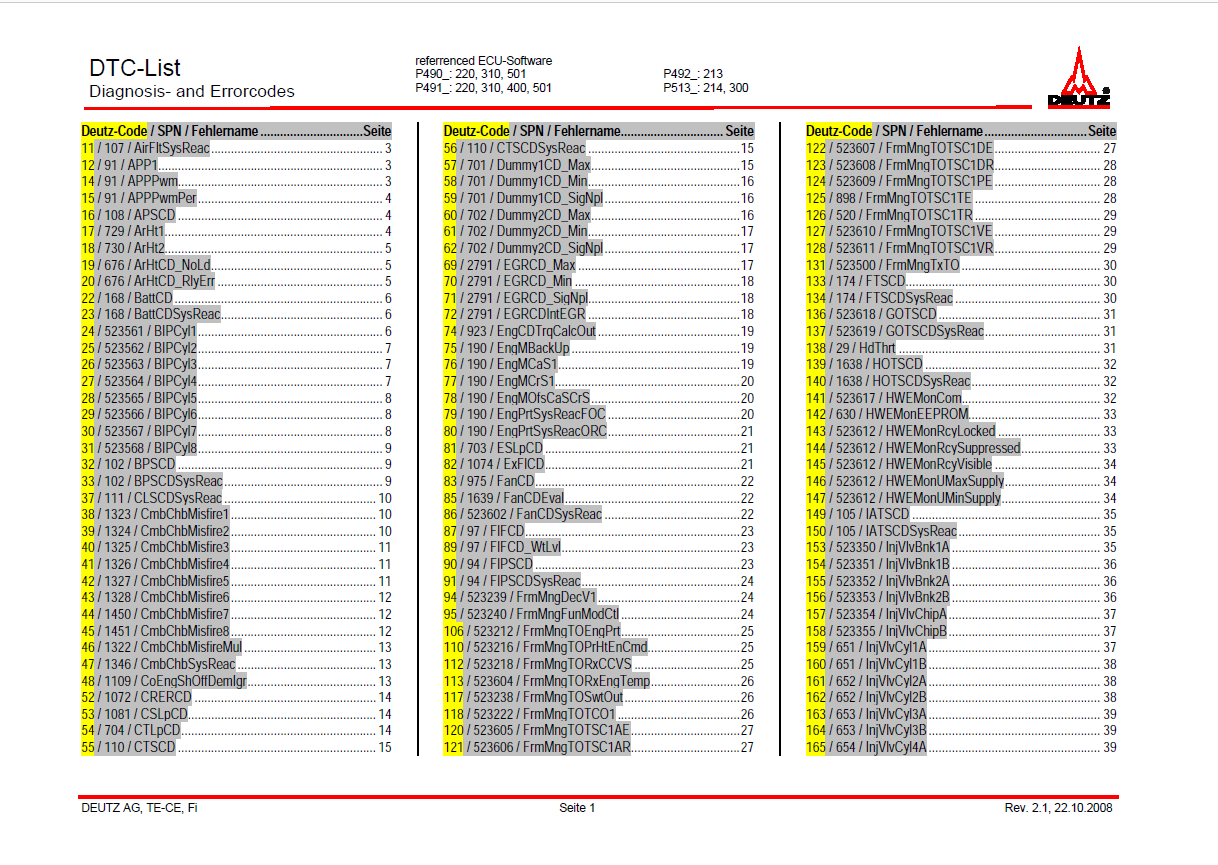
When a DEUTZ TCD 3.6 starts throwing fault codes, I don’t read them like random numbers on a screen. I sort them by system first. Air side. Throttle side. Fuel side. Oil side. CAN side. That’s usually how you stop wasting time and get pointed at the real problem faster. This DTC list is built the same way, and once you see the pattern, the codes start making a lot more sense.
Start with the easy wins: air and throttle codes
A few of the most practical codes in this list are right up front.
- 11 / AirFltSysReac = air filter differential pressure above target range. Usually that means a clogged air filter, bad sensor, or damaged wiring. The ECU can trigger a warning or even power reduction.
- 12 / APP1 = analog accelerator pedal sensor 1 out of range or implausible compared to the second pedal signal. The system can switch to a substitute value or limp-home behavior.
- 14 / APPPwm = digital accelerator pedal PWM signal defective or implausible.
- 15 / APPPwmPer = accelerator pedal PWM frequency out of range.
- 16 / APSCD = ambient air pressure sensor out of range or implausible compared with charge air pressure. The sheet says this can force a substitute value, and the listed action is basically ECU replacement if the sensor logic in the ECU is bad.
That’s a good reminder right there: not every “engine won’t respond right” complaint is fuel. Sometimes it’s the pedal signal lying to the ECU.
Preheat and air heater faults are usually wiring, relay, or valve trouble
If you’re chasing cold-start issues or preheat faults, this manual gives you a pretty clear trail.
- 17 / ArHt1 = air heater relay current drain out of range. Think broken wire, short, bad relay, or damaged cable.
- 18 / ArHt2 = air heater magnet valve current drain out of range. Usually valve fault or wiring fault.
- 19 / ArHtCD_NoLd = relay energized, but no feedback on the sense line. That points more toward bad relay feedback, wrong wiring, or a bad preheat component.
- 20 / ArHtCD_RlyErr = relay not energized, but voltage still shows up on the sense line. That smells like a relay stuck on, wrong wiring, or a bad preheat component.
If I saw these in the yard, I’d check the cabling and relay logic before I started blaming the engine itself.
Battery voltage codes matter more than guys think
Low voltage and unstable supply can make a diesel act downright stupid.
- 22 / BattCD = battery voltage measured by the ECU is out of range. The fault sheet lists bad battery, too much voltage, high contact resistance, damaged wiring, overloaded electrical system, bad parametering, or ECU trouble as possible causes.
- 23 / BattCDSysReac = same basic battery voltage problem, but now the ECU is applying a system reaction.
A weak battery or ugly connection can make you chase fake sensor faults all day. I’d always clean up the power side before going deep.
Coolant temperature faults can be either a sensor lie or a real overheating problem
These two are worth separating.
- 55 / CTSCD = coolant temp sensor voltage out of range, or the temp reading is implausible compared with oil temp or CAN data. That usually means sensor, wiring, or signal issue.
- 56 / CTSCDSysReac = coolant temp actually above target range with ECU system reaction. The listed reasons include low coolant fill, clogged or damaged cooling system, dropped-out cooling compressor, bad sensor, or damaged cable.
So yeah, don’t treat 55 and 56 the same. One can be a sensor problem. The other can be a real heat problem.
Common rail and fuel metering codes are the ones that can turn into shutdown trouble fast
This is where the list gets serious.
- 178 / MeUnCDSCBat = fuel metering unit outlet valve current too high, with a short to battery listed as a likely cause.
- 179 / MeUnCDSCGnd = same metering unit fault family, but now it’s short to ground.
- Both 178 and 179 can trigger a warning where the rail pressure relief valve opens, and the sheet notes the warning lamp can come on 15 seconds before shutoff.
- 208 / PRVMon = rail pressure relief valve is open, forced open, or failed to force open. Possible causes include low operating voltage, bad rail pressure sensor, bad fuel metering unit, bad relief valve, or air in the fuel system. The manual says this can lead to engine shutoff in about 5 minutes.
- 209 / RailCD = rail pressure sensor voltage out of range. This one can also push the system toward opening the relief valve and shutting the engine off in about 5 minutes.
- 215 / RailMeUn4 = rail pressure above the absolute target range. The listed causes include FCU power supply issues, metering unit sticking open, clogged restriction, excessive low-side pressure, or disturbed fuel system.
- 216 / RailMeUn7 = rail pressure implausible compared with the fuel metering unit setpoint.
- The list also includes a wider rail pressure family under 210–216 and 245, so if you’re chasing a common-rail issue, don’t stop after just one code name.
If you’re getting DEUTZ rail pressure codes, don’t just swap the sensor and hope. Check metering unit, voltage, air in fuel, low-side pressure, relief valve, then work your way forward.
Oil pressure and oil temperature codes deserve respect
These are the codes I don’t like ignoring.
- 196 / OPSCD = oil pressure sensor signal out of range, or oil pressure value via CAN is implausible. The manual points to sensor, wiring, or CAN bus trouble.
- 197 / OPSCD1 = oil pressure calculated by the ECU is implausibly low.
- The list continues with 198 / OPSCDSysReacHi and 199 / OPSCDSysReacLo, so there’s a full oil-pressure reaction family in this document.
- 203 / OTSCDSysReac = oil temperature above target range with ECU system reaction. The possible causes include low oil volume, disturbed oil circuit, bad sensor, or damaged wiring, and the repair actions include checking oil level, oil loop, cooling system, and sensor.
- The manual also lists 240–243 for oil level faults, so if the machine is throwing pressure and level complaints together, you need to look at the whole lubrication side, not just one sender.
CAN communication faults can send you chasing ghosts if you ignore the network
This DTC list has a solid chunk of CAN-related faults, and they matter.
- 95 / FrmMngFunModCtl = missing FunModCtl CAN message.
- 106 / FrmMngTOEngPrt = missing Engine Protection CAN message.
- 110 / FrmMngTOPrHtEnCmd = missing Preheat and Engine Command CAN message.
- The repair actions for those faults all point you back to CAN bus cabling, polarity, short circuits, power interruption, protocol checks, and functional range testing.
- The list also includes 192 / NetMngCANAOff, 193 / NetMngCANBOff, and 194 / NetMngCANCOff, which tells you straight up that CAN network faults are a real part of the diagnostic picture here.
That’s why a machine can feel like it has three bad sensors when really the network is the thing falling apart.
Don’t forget the injector families
This DEUTZ list also tracks injector-related problems by cylinder and by valve family.
- 24–31 cover begin-of-injection faults by cylinder.
- 153–175 cover injector valve bank and cylinder faults, plus InjVlvErrDet.
So if the machine is missing, smoking, running rough, or setting cylinder-specific faults, the list is already split up in a way that helps you narrow down which cylinder or injector circuit to test first.

Final word
If I had to sum this one up shop-style, I’d say it like this: On a DEUTZ TCD 3.6, the fault code usually tells you which system is mad before it tells you which part is bad.
So when you see a code, sort it first:
- 11–20 = intake, throttle, preheat
- 22–23 = battery voltage
- 55–56 = coolant temperature
- 95 / 106 / 110 / 192–194 = CAN communication
- 178–179 / 208–216 = fuel metering and rail pressure
- 196–203 = oil pressure and oil temperature
- 24–31 / 153–175 = injector families
If you need the proper service manual, workshop manual, parts manual, or operator manual to trace these codes the right way, go to:
**https://machinecatalogic.com/**
A good manual will save you more time than guessing ever will.
메타데이터
- post_id
- 0d5e36adafd6
- slug
- deutz-tcd-3-6-error-codes-the-ones-worth-checking-first-0d5e36adafd6
- url
- https://medium.com/@machinecatalogic/deutz-tcd-3-6-error-codes-the-ones-worth-checking-first-0d5e36adafd6
- canonical_url
- https://medium.com/@machinecatalogic/deutz-tcd-3-6-error-codes-the-ones-worth-checking-first-0d5e36adafd6
- author_url
- https://medium.com/@machinecatalogic
- status
- ok
- fetched_at
- 2026-07-08 05:22:04