What is Mass? and… what is Higgs?
Mass is not a substance. It is the elastic toll paid by trapped energy. And the Higgs field is not molasses — it is the cosmic vibration of…
What is Mass? and… what is Higgs?
Mass is not a substance. It is the elastic toll paid by trapped energy. And the Higgs field is not molasses — it is the cosmic vibration of the entire Mesh.
By Alex Bertran August 2026
1. The Flaw in the Textbook Narrative
If you ask a physicist what mass is, they will likely hand you a circular definition: “Mass is a measure of inertia,” or “Mass is the resistance to acceleration.”
If you press further and ask why particles have mass, they will point to the Higgs mechanism. They will tell you that after the Big Bang, a ubiquitous scalar field froze into the universe like a cosmic molasses. Particles like quarks and electrons drag through this field, gaining effective mass based on how strongly they interact with it. Photons, they say, pass through without friction, remaining massless.
It is a clever mathematical patch, but mechanically, it raises more questions than it answers:
Why does a fundamental field act like a viscous fluid?
Why are there 19 free parameters determining these interactions?
What is the physical substrate that actually holds this field?
In the Cosmic Mesh framework, mass is not a substance, and the Higgs field is not molasses. Mass is a mechanical reaction, and the Higgs is the acoustic resonance of space itself.
2. Spacetime Is an Elastic Solid
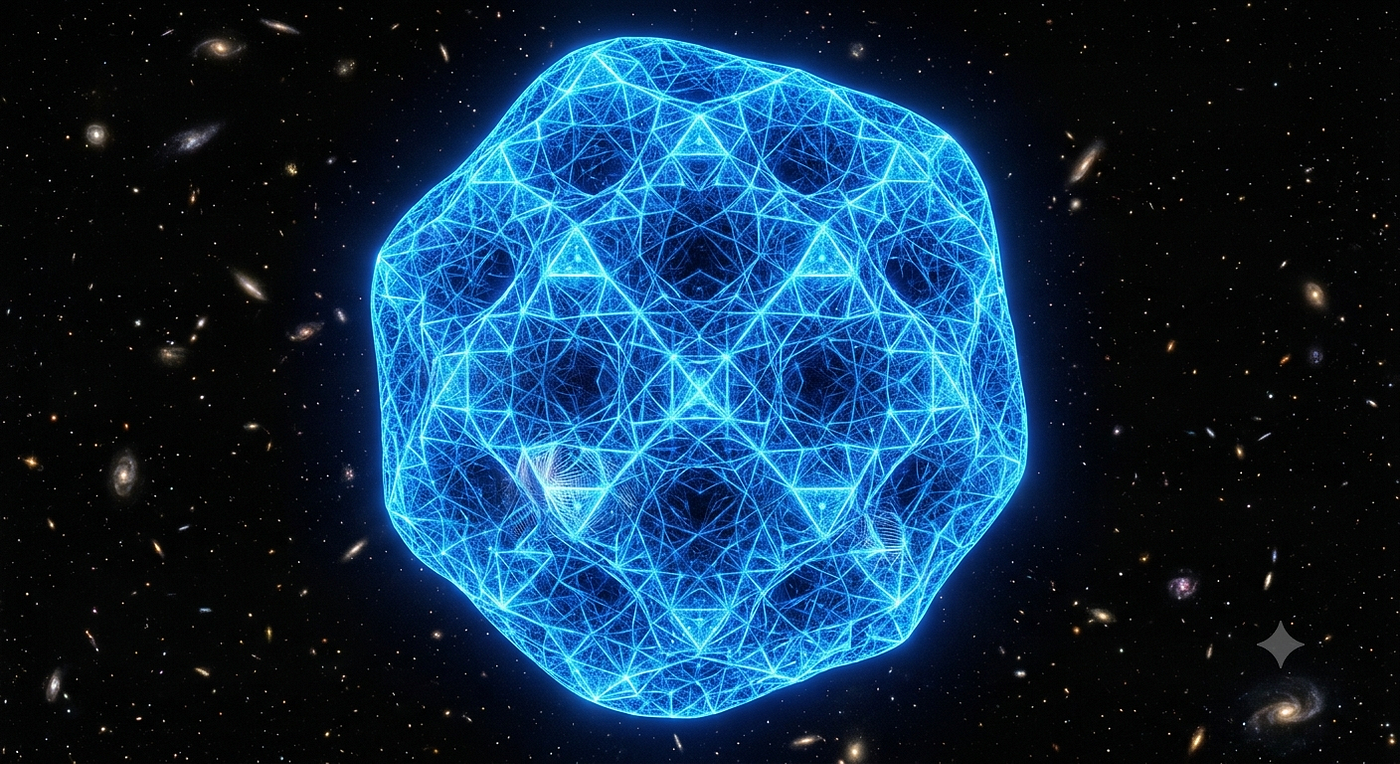
To understand mass, we must first abandon the idea that spacetime is empty. Space is a three-dimensional, self-similar lattice of unbreakable elastic tetrahedra at the Planck scale.
This Mesh is under immense background tension. It is not a fluid; it is a rigid, chiral, elastic solid.
Energy can exist in this substrate in two distinct states:
- Free Waves (Light): Pure transverse shear vibrations that travel across the tetrahedra with zero volumetric change (ψ=0). Because they do not deform the volume of the lattice cells, they experience zero elastic impedance (Zmesh=0). They have no mass and no proper time.
- Trapped Waves (Particles): Standing waves trapped inside topological defects or knots. These trapped vibrations force the local tetrahedral cells to undergo cyclical volumetric contraction and expansion (ψ>0). This is valid for the electron. For muon and tau it is a similar process.
3. Mass Is the Effort of “Breathing”
Consider the simplest particle in nature: the electron.
The electron is not a solid sphere. It is a single, localized standing wave trapped within a fundamental tetrahedral cavity. To host this energy, that single tetrahedron is forced to cycle through periodic expansion and contraction. It is forced to breathe.
However, the surrounding Mesh is not passive — it is stiff and pre-stressed. Forcing a tetrahedral cell to continuously alter its volume against the rigid elastic background requires continuous mechanical work.
Mass is not a property inside the electron; it is the elastic impedance (Zmesh) offered by the Mesh as the cell breathes against the background grid.
*The electron (whos mass is me≈0.511 MeV) does not possess mass as an intrinsic property. It has mass because it is a standing wave trapped in a topological cavity, and that cavity is embedded in an elastic medium. 0.511 MeV is the precise elastic toll that the Mesh charges for keeping that vibration confined — the cost of forcing a fundamental tetrahedral cell to breathe against the stiffness of the universe. Mass is not something the electron has. It is something the Mesh does to the electron.*
4. The Muon and Tau: Mass from Travelling Torsion
The electron is not the only particle. There are two heavier copies: the muon and the tau. Why are they heavier?
Because they do more than just breathe.
The electron is static: it is the breathing of a single tetrahedron. But the muon and tau are standing waves trapped inside knots that are being carried by travelling torsion.
A knot is a cluster of twisted tetrahedra, torsioned. When that cluster is part of a Weyl Curvature Imprint (WCI) — a travelling wave of fossil torsion at macro scale — the shape of the knot moves. The standing wave trapped inside it moves with it, like a surfer riding a wave. The tetrahedra themselves do not travel; only the pattern of torsion does.
Every time the torsion transfers from one cluster to the next, the trapped wave must pay a toll. That toll is mass. The muon pays a higher toll because it involves a larger cluster (the first coordination shell, 12 neighbours). The tau pays an even higher toll because it involves an even larger cluster (5 tetrahedra, dragging the second shell of 42 neighbours).
The electron, by contrast, is static breathing. It pays only the base impedance of the Mesh.
This is why the muon is 206 times heavier than the electron, and the tau is 16.8 times heavier than the muon. It is not a mystery. It is the cost of moving through the Mesh.
5. What Is the Higgs?
This brings us to the ultimate question: if mass is the elastic resistance to local breathing, what is the Higgs field?
The Higgs field is the background vibration of the entire Mesh.
Imagine a giant, heavy bronze bell hanging in the dark. If you strike it, the bell does not vibrate randomly; it rings at a specific, fundamental frequency dictated by its geometry, elasticity, and tension.
The Higgs Boson (≈125 GeV) is not a particle flying through space. It is the fundamental acoustic mode — the collective volumetric ringing — of the entire cosmic Mesh when excited by high-energy collisions.
In the Standard Model, the Higgs field has a vacuum expectation value of about 246 GeV — a constant background energy that fills all of space. This is not a particle. It is the state of the vacuum itself. This is not the total energy of the universe; it is the energy per unit volume.
In the Mesh, we hypothesize that this unit volume is the tetrahedron — the fundamental cell of the lattice. The vacuum expectation value is the elastic tension of a single tetrahedron.
The Higgs boson, with a mass of about 125 GeV, is an excitation of that background — a ripple in the field. The ratio **mH/v≈1/2** is not a coincidence. In the Standard Model, it is a consequence of the shape of the Higgs potential.
In the Mesh, the vacuum expectation value is the elastic tension of the lattice. The Higgs boson is the fundamental vibrational mode of that lattice — the sound of the bell. The factor 1/2 is not a mystery. It is a direct consequence of elasticity: in any elastic system, the energy of a fundamental mode is half the energy of the background deformation. The bell rings at half the tension of the string. The Mesh is a solid, and solids obey this rule.
The Higgs boson is often called the ‘giver of mass.’ In the Mesh framework, this is a misconception. The Higgs does not give mass. It is the fundamental vibration of the Mesh itself — the sound of the bell. Mass is not a gift from the Higgs. It is the toll the Mesh charges for moving through it. The Higgs is the medium; mass is the cost of travelling through that medium.
6. Why the Photon Has No Mass and No Time
This framework solves the photon-matter dichotomy with transparent mechanical logic:
- The Photon: A transverse wave with ψ=0. It does not alter the cell volume, so it does not couple to the global volumetric ringing of the bell. It pays zero impedance (Zmesh=0). Thus: Zero Mass, Zero Proper Time.
- The Electron: A monopolar volumetric wave (ψ>0). It directly deforms the cell volume, coupling to the bell’s global tone. It pays a non-zero elastic toll (Zmesh>0). To move, it must un-knot and re-knot cell by cell across discrete time intervals (τcrack). Thus: Non-zero Mass, Non-zero Proper Time.
Time itself is not a mystical fourth dimension; it is the unavoidable internal processing cost of matter forcing the elastic Mesh to reconfigure its geometry.
7. Conclusion: The Ringing Universe
The Standard Model needed 19 arbitrary parameters and a magical molasses to explain mass because it treated spacetime as an empty stage and particles as point-like actors.
In the Cosmic Mesh:
- Light is free energy travelling through the Mesh — it is not the Mesh itself, but a vibration that propagates through it.
- Matter is energy trapped in topological knots — standing waves anchored to the Mesh.
- Mass is the elastic toll the Mesh charges for keeping that energy trapped, and for carrying it through travelling torsion.
- The Higgs is the sound of the entire Mesh ringing — its fundamental collective vibration.
We do not live in a void filled with particles. We live inside a giant, pre-stressed elastic machine — and everything we call matter is just the harmony of a bell that has been ringing since the Great Unknotting.
📚 For the Full Theory
This article is a simple introduction. For the full mathematical framework, including the discrete tetrahedral Mesh, the Jussà-Vila Ansatz, and the Scale Bridge Hypothesis, see:
THE BREATHING UNIVERSE: A Torsional Solid Machine Replacing dark matter with Weyl Curvature Imprints and dark energy with topological elastic pressure.
Article “The Cosmic Mesh: the Fundamental Substrate of Reality” at MEDIUM
Quantum Mechanics: The Interpretation of Barcelona
Mechanical derivation of the fine-structure constant DOI: 10.5281/zenodo.19063834
Written by Alex Bertran
Independent researcher at the Institut d’Astrofísica de Badalona (IABDN).
alex.bertran@iabdn.cat
Sci-Fi book: “El Universo Herido”
메타데이터
- post_id
- 16e3a32ef70e
- slug
- what-is-mass-and-what-is-higgs-16e3a32ef70e
- url
- https://medium.com/@abertranp_39945/what-is-mass-and-what-is-higgs-16e3a32ef70e
- canonical_url
- https://medium.com/@abertranp_39945/what-is-mass-and-what-is-higgs-16e3a32ef70e
- author_url
- https://medium.com/@abertranp_39945
- status
- ok
- fetched_at
- 2026-08-09 05:37:53