Data Reduction Techniques in Data Mining
What is Data Reduction?
Data Reduction Techniques in Data Mining
What is Data Reduction?
Data Reduction is a process that reduced the volume of original data and represents it in a much smaller volume.
► It maintains the integrity of the data while reducing.
► The time required for data reduction should not overshadow the time saved by data mining on the reduced data set.
► Data reduction does not affect the result obtained from data mining.
► Data reduction increases the efficiency of data mining.
Why Data Reduction?
► Huge amount of data is being created day by day.
► Development of big data platform.
► Poor performance of old algorithms.
► Most of the data mining algorithms are column wise implemented.
► Pushed for data reduction procedures.
Data Reduction techniques can be applied to obtain a reduced representation of dataset, that is smaller in volume and maintains the integrity of original data.
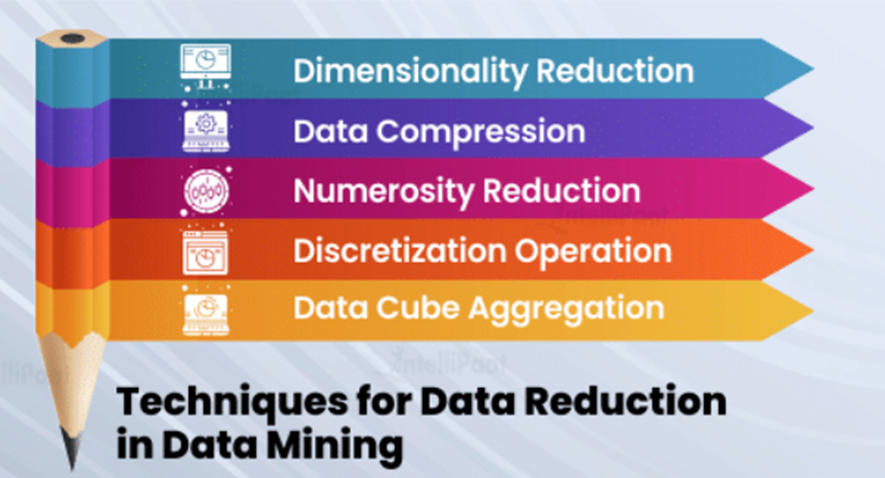
Dimensionality Reduction:-
It is the process of reducing the number of variables on attributes under consideration.
Methods in dimensionally reduction includes:
1.Wavlet transforms
2. Principal component analysis
Both transforms or project original data into Small Space.
3. Attribute subset selection
Irrelevant, weakly relevant, redundant attributes or dimensions detected and removed.
Example:

Data Compression:-
Data compression is applied so as to obtain reduced or compressed representation of original data.
If original data can be reconstructed from the compressed data without any information loss, then the data reduction is lossless. If we can reconstruct only an approximation of original data, then the reduction is called lossy.

Example:

Data is “compressed” from their original sizes to smaller sizes so that more data can be stored and data transmission is easier.
Numerosity Reduction:-
Numerosity reduction techniques replace the original data volume by alternative, smaller forms of data representation.
Methods of Numerosity reduction are
► Parametric
► Non parametric
parametric methods used to estimate the data, so data parameters need to be stored instead of actual data.
Eg: Regression, log-Linear models.
Non parametric methods for storing reduced representations of the data.
Eg: histograms, clustering, Sampling, datacube aggregation
Example:

Discretization Operation:-
The method of data discretization is used to transform continuous qualities into data with intervals. We use labels for short periods of time to replace several of the attribute’s unchanging values. This implies that mining results are presented in a clear and intelligible manner.
Here are the two types of Discretization Operation:
Top-down discretization: Also known as splitting, is the process of initially considering one or a few locations (referred to as breakpoints or split points) to divide the entire set of attributes and then repeating this procedure until the conclusion.
Bottom-up discretization: If all the constant values are first treated as split points, some of them can be eliminated by combining the nearby values in the interval. Bottom-up discretization is the name of that procedure.
Example:

Data Cube Aggregation:-
This technique is used to aggregate (combine) data in a simpler form. So we can summarize the data in such a way that the data is used as result.
Example:

Advantages of Data Reduction:
Improved Efficiency: Reducing data size leads to faster processing and analysis, saving time and resources.
Easier Storage: Smaller datasets require less storage space, making data management more cost-effective.
Better Visualization: Reduced data size allows for more accessible data visualization, helping in pattern recognition.
Disadvantages of Data Reduction:
Information Loss: Aggregation and summarization may lead to the loss of some fine-grained details, which could be essential in specific cases.
Selecting Appropriate Techniques: Choosing the right reduction techniques requires domain knowledge and can be challenging.
Complexity: Implementing reduction techniques adds complexity to the data mining process.
메타데이터
- post_id
- 177f12ea1f6c
- slug
- data-reduction-techniques-in-data-mining-177f12ea1f6c
- url
- https://medium.com/@vennalacherukuri/data-reduction-techniques-in-data-mining-177f12ea1f6c
- canonical_url
- https://medium.com/@vennalacherukuri/data-reduction-techniques-in-data-mining-177f12ea1f6c
- author_url
- https://medium.com/@vennalacherukuri
- status
- ok
- fetched_at
- 2026-07-21 20:37:53



