Federated Learning: Collaborative AI Without the Data Sharing
Sharing personal data for model training is a sensitive matter!!!
Federated Learning: Collaborative AI Without the Data Sharing

Image source: techstrong.ai
Sharing personal data for model training is a sensitive matter!!!
Introduction
The digital age is overflowing with data. Yet, this data-driven revolution presents a crucial challenge: balancing the immense potential of data with the critical need for privacy.
Traditional centralized approaches to training AI models often require aggregating sensitive data in a single location. This raises concerns about data security, user privacy, and data governance.
Enter *Federated Learning** — a paradigm shift in artificial intelligence that addresses these challenges head-on. Federated Learning offers a way to train powerful models collaboratively without ever moving the data from its source. This approach not only enhances privacy but also unlocks the potential of diverse and distributed datasets.
(* original work by H. Brendan McMahan et al.)
What is Federated Learning?
Federated Learning flips the script (not totally) on traditional AI training. Instead of bringing all the data to the model, we bring the model to the data! (sounds flip hmm!).
It’s a decentralized approach where multiple devices (like smartphones, sensors, or even hospitals) collaboratively train a shared AI model without ever exposing their raw data. Think of it like this:Traditional AI training: It’s like asking everyone to mail their most prized possessions to a central location to build a giant, collective collection. Risky (scary for me), right?
Federated Learning: This is more like everyone keeping their valuables safe at home or devices while sharing instructions on how to identify valuable patterns. No risky data sharing needed!
Real-World Applications: Where Federated Learning Excels
Homebrew
Federated Learning isn’t just a theoretical concept; it’s actively shaping industries and offering tangible benefits in various domains. Let’s explore some key areas where Federated Learning is making a real-world impact:
- Healthcare: Medical data is highly sensitive. Sharing it between institutions raises significant privacy concerns, hindering research and collaboration. Hospitals can collaboratively train AI models on their combined datasets without sharing patient records. This enables improved diagnosis of rare diseases, personalized treatment recommendations, faster drug discovery.
- Mobile Devices: Mobile devices are data-rich, but collecting this data centrally raises privacy concerns and can be bandwidth-intensive. our phone can locally train models on your usage patterns, contributing to global model improvements without sending your raw data. This enables your keyboard gets better at predicting your next word, discover apps tailored to your interests without compromising your data.
- IoT and Edge Computing: IoT devices generate vast amounts of data. Centralizing this data for analysis is often impractical due to bandwidth limitations, latency, and privacy concerns. Devices can process data locally and contribute to a shared model, enabling predictive maintenance by analyzing sensor data from machines in real-time, improving autonomous navigation by learning from the experiences of vehicles on the road without requiring constant data uploads, optimizing traffic flow, energy consumption, and public safety through distributed intelligence.
Workflow of FL
Phase 1: Setup

Flower: FL Framework
Model Initialization, This process begins with a central server that initializes a global model. This model can be entirely untrained or pre-trained on a publicly available dataset. After that initialization, The server selects a group of eligible clients (devices) to participate in the training round. Selection criteria might include factors like device availability, connectivity, and battery life.
Phase 2: Local Training

Flower: Fl Framework
The server sends a copy of the current global model to each selected client. Each client trains the received model on its local data. This training process involves updating the model’s parameters to minimize errors on the client’s specific dataset. Importantly, the raw data never leaves the client’s device. After training, each client computes a model update. This update encapsulates the changes made to the model’s parameters during local training.
Phase 3: Aggregation and Improvement

Flower: FL Framework
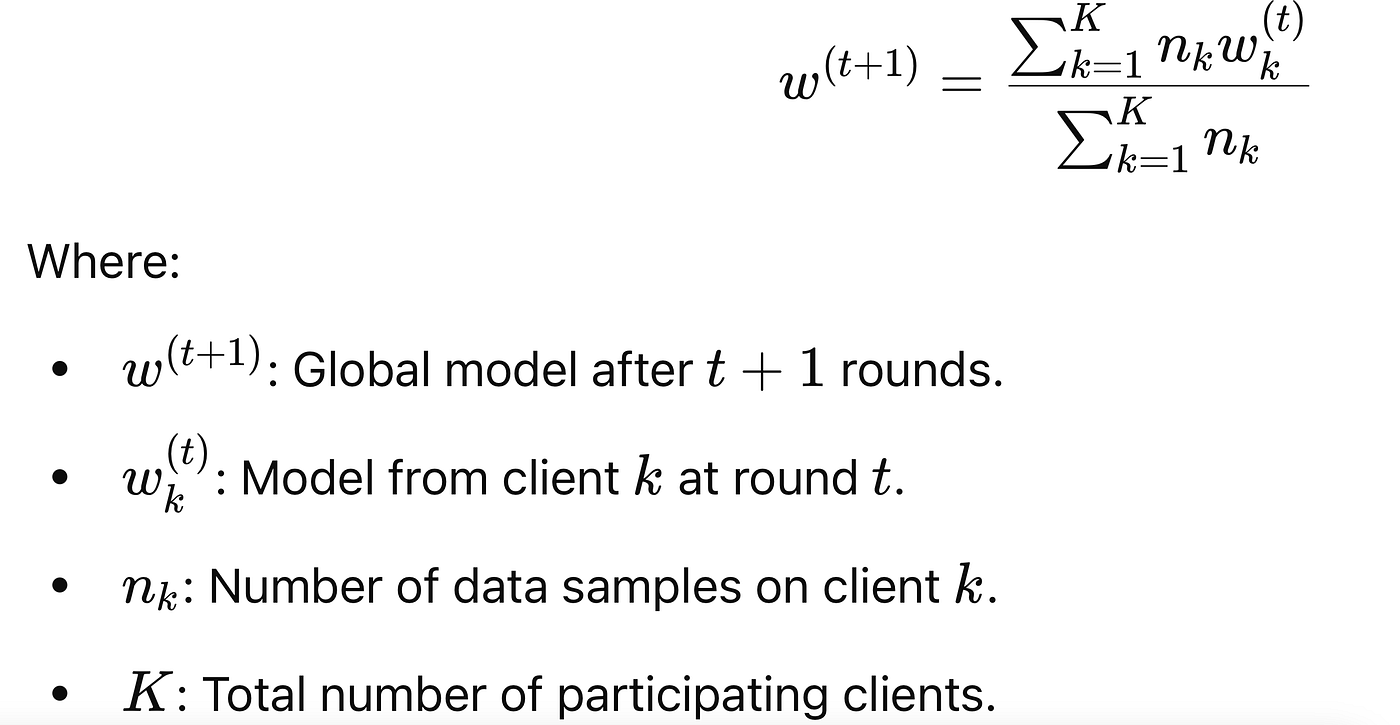
Clients send their model updates back to the server. These updates are typically encrypted to ensure privacy during transmission. The server receives model updates from all participating clients. It then uses a secure aggregation algorithm (often Federated Averaging) to combine these updates into a new global model. This aggregation process aims to preserve the learnings from individual clients while creating a model that generalizes well across all data distributions.
The server updates the global model with the aggregated knowledge. The process repeats from Phase 2 (Local Training) for multiple rounds. The global model gradually improves with each iteration, becoming more accurate and robust. Training continues until the global model reaches a satisfactory performance level or a predetermined stopping criterion is met.
The Hurdles on the Path to FL

makeameme.org
- Communication Bottlenecks: Communication bottlenecks arise when sending model updates between numerous devices, especially over unreliable networks. This is especially challenging with large models and resource-constrained devices like smartphones. Potential solutions include compression techniques (quantization, sparsification), local updates (multiple training rounds before sending updates), and device scheduling (selecting devices with good connectivity and resources).
- Data Heterogeneity: Data heterogeneity, where devices have diverse data distributions, challenges federated learning. For instance, a language model trained on teen text messages differs from one trained on business emails. Solutions include robust aggregation algorithms, personalized federated learning, and data augmentation to increase data diversity.
- Security and Privacy: Federated Learning shares sensitive information (model updates), making it vulnerable to malicious attacks. Malicious actors can poison the global model by sending corrupted updates or snoop on sensitive information from encrypted updates. Solutions include robust aggregation techniques like secure multi-party ordifferential privacy to protect against malicious updates and data leakage. Device verification ensures only trusted devices participate in training. Differential privacy adds noise to model updates to make it harder to infer sensitive information.
- System Heterogeneity: Federated learning faces challenges due to diverse devices and OSs. Potential solutions include: Abstracting device heterogeneity and managing diverse client environments. Resource-Adaptive Training: Adjusting training workload based on device capabilities for effective participation.
Types of Federated Learning
1. Horizontal Federated Learning (HFL):
- Definition: Data on different clients shares the same feature space but belongs to different samples (rows).
- Example: Hospitals in different cities collaboratively train a model on patient records with the same attributes (e.g., age, blood pressure).
- Key Use Case: Model training across devices with similar data types (e.g., mobile keyboards).
2. Vertical Federated Learning (VFL):
- Definition: Data on different clients has the same samples (rows) but different feature spaces (columns).
- Example: A bank and an e-commerce platform collaboratively train a model. The bank has financial data, while the e-commerce platform has shopping preferences for the same customers.
- Key Use Case: Cross-organization collaboration where data is complementary.
3. Federated Transfer Learning (FTL):
- Definition: Data on different clients differs in both feature space and sample space.
- Example: A retail company and a weather service collaborate to predict sales trends by transferring knowledge between disparate datasets.
- Key Use Case: Scenarios with limited overlapping data between parties.

image’s text in English: Enough for today.
This is just the beginning of our exploration of Federated Learning! In our next posts, we’ll dive deeper into the fascinating world of FL algorithms. We’ll break down the math behind these algorithms, explore the challenges they face, and show you how to code them up. We’ll talk about popular algorithms like Federated Averaging (FedAvg) and its variations, as well as more advanced approaches. Get ready for practical coding examples, comparisons, and a thorough look at how Federated Learning is changing the game of Artificial Intelligence. Stay tuned for an exciting learning journey! #secure_ai
Resources you can explore for more
메타데이터
- post_id
- 28a8cc68ecff
- slug
- federated-learning-collaborative-ai-without-the-data-sharing-28a8cc68ecff
- url
- https://medium.com/@rjsandeepkumawat/federated-learning-collaborative-ai-without-the-data-sharing-28a8cc68ecff
- canonical_url
- https://medium.com/@rjsandeepkumawat/federated-learning-collaborative-ai-without-the-data-sharing-28a8cc68ecff
- author_url
- https://medium.com/@rjsandeepkumawat
- status
- ok
- fetched_at
- 2026-07-31 23:37:08