Open Source LLM Platforms in 2026: Ollama, OpenRouter, Groq, NVIDIA NIM — Which One Should You Use?
“In 2026, open-source models have caught up with GPT-4 on most tasks. The question is no longer which model — it’s which platform to run it…
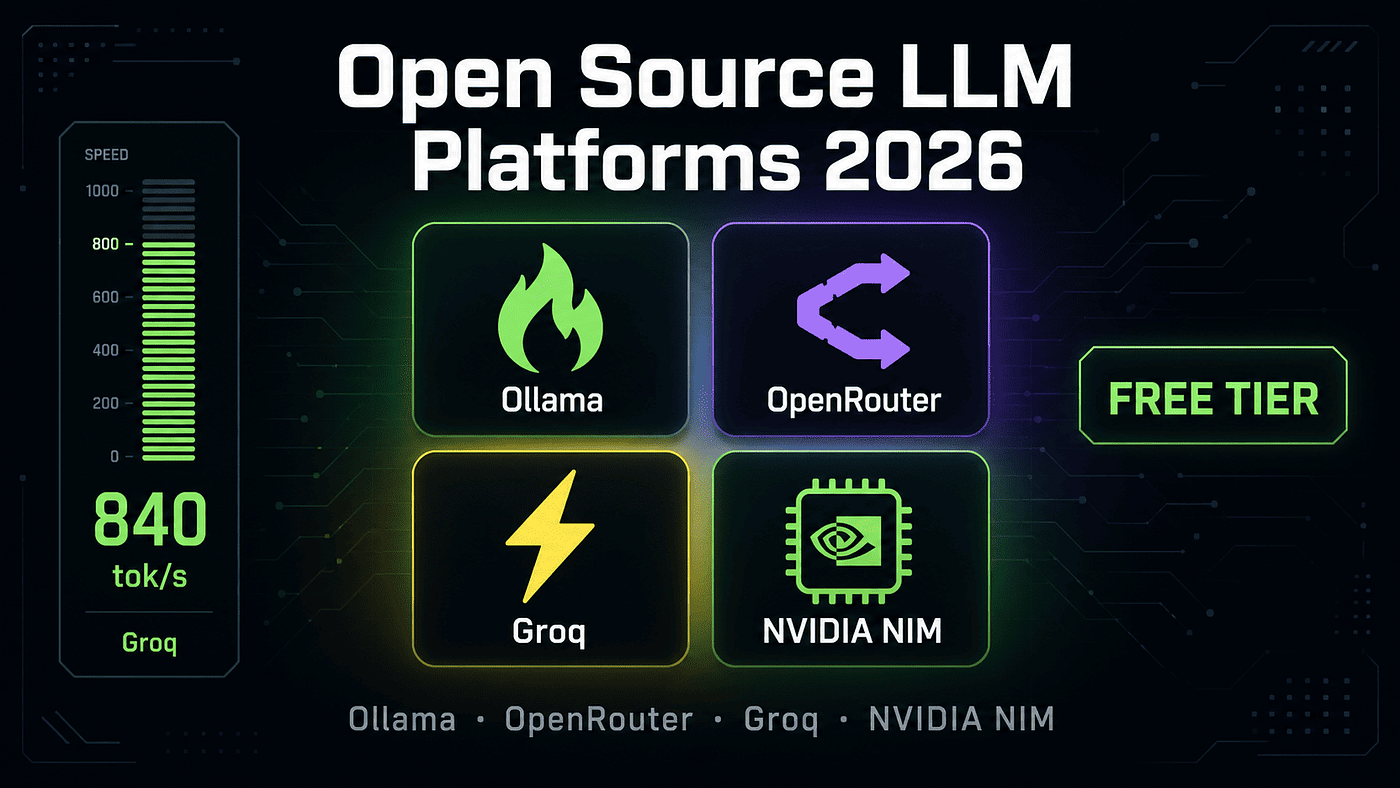
Open Source LLM Platforms in 2026: Ollama, OpenRouter, Groq, NVIDIA NIM — Which One Should You Use?
“In 2026, open-source models have caught up with GPT-4 on most tasks. The question is no longer which model — it’s which platform to run it on. And several of the best options are completely free.”
Two years ago, running an open-source LLM meant provisioning a server, installing CUDA, managing Python dependencies, and hoping your GPU didn’t run out of VRAM mid-inference. The results were inconsistent, the setup was painful, and the maintenance overhead was real.
The landscape in 2026 looks completely different.
Models from Google (Gemma 4), Meta (Llama 4), Alibaba (Qwen3), and Microsoft (Phi 4) now match or exceed proprietary models for most practical tasks. And crucially, there are now a dozen platforms that let you access these models via OpenAI-compatible APIs — without touching a single server yourself. Some of them are genuinely free with rate limits that are more than enough for serious development.
This article is a practical guide to the major platforms — from local self-hosting to cloud APIs with generous free tiers — with real code examples and a decision framework for choosing the right one for your use case.
Four Categories of LLM Platforms
Before getting into individual platforms, it helps to understand the categories:
Self-Hosted (Local) — You download the model weights and run them on your own hardware. Completely free, completely private, but requires adequate hardware.
Managed API (Cloud) — The platform runs the model, you call an endpoint. Some are free within rate limits, others are pay-per-token. Zero infrastructure work.
AI Gateway — An abstraction layer over multiple providers. One API key routes to hundreds of models from dozens of providers.
Specialized Platform — Custom hardware (LPUs, WSEs) optimized for a specific capability, usually raw inference speed or a particular model category.
1. Ollama — The Standard for Local Self-Hosting
ollama.com | Free (self-hosted)
Ollama is the de facto standard for running LLMs on your local machine. One command, the model runs and exposes an OpenAI-compatible REST API at http://localhost:11434. No accounts, no API keys, no per-token billing.
Available models include Gemma 4, Qwen3, Llama 4, Phi 4, Mistral, DeepSeek R1, and dozens more — updated regularly as new models are released.
Strengths:
- Zero cost, no per-token charges ever
- Complete privacy — data never leaves your machine
- Works fully offline
- OpenAI-compatible API — drop-in replacement for any OpenAI integration
- No rate limits — send as many requests as your hardware can handle
Limitations:
- Requires adequate hardware (8GB RAM minimum, more is better)
- Speed is entirely hardware-dependent
- You manage your own model updates
Code Example
# Pull and run a model
ollama pull qwen3:4b
ollama run qwen3:4b

# OpenAI-compatible API is immediately available at:
# http://localhost:11434/v1
// PHP/Laravel integration — identical to OpenAI SDK usage
$client = OpenAI::factory()
->withBaseUri('http://localhost:11434/v1')
->withApiKey('ollama') // any non-empty string works
->make();
$response = $client->chat()->create([
'model' => 'qwen3:4b',
'messages' => [
['role' => 'user', 'content' => 'Explain the repository pattern in Laravel']
],
]);
echo $response->choices[0]->message->content;Best for: Local development, privacy-sensitive projects, teams with no API budget, offline environments.
2. OpenRouter — One API Key, 300+ Models
openrouter.ai | Free tier (30+ free models) + pay-as-you-go
OpenRouter is the most popular AI gateway — a single API key gives you access to over 300 models from 50+ providers. GPT-4o, Claude Sonnet, Llama 4, DeepSeek R1, Qwen3, Gemma 4 — all accessible from the same endpoint. Switching models means changing one string.
Free models on OpenRouter (April 2026):
- DeepSeek R1 — strong reasoning, chain-of-thought
- Llama 3.3 70B — Meta, solid general purpose
- Qwen3 235B — Alibaba’s largest model, free
- Gemma 4 27B — Google DeepMind, multimodal
- Mistral Small — European alternative
- 25+ additional free models
Rate limit: ~20 RPM per free model. Sufficient for development workflows.
Strengths:
- One API key for everything — GPT-4o, Claude, Llama, all of them
- Free tier covers genuinely capable models (not just tiny ones)
- Automatic fallback routing when a provider is down
- Real-time per-request cost logging
- Model diversity for evaluation and A/B testing
Limitations:
- Free tier reliability is inconsistent — timeouts happen
- 5% platform fee on paid tier on top of provider costs
- Provider routing isn’t always transparent
- The same model can cost 3–7x more depending on which provider OpenRouter routes to
Code Example
// Using the free DeepSeek R1 model
$response = Http::withHeaders([
    'Authorization' => 'Bearer ' . env('OPENROUTER_API_KEY'),
    'HTTP-Referer'  => config('app.url'),
    'X-Title'       => config('app.name'),
])->post('https://openrouter.ai/api/v1/chat/completions', [
    'model'    => 'deepseek/deepseek-r1:free',
    'messages' => [
        ['role' => 'user', 'content' => 'Review this code for security issues...']
    ],
]);

// Change the model parameter to switch providers instantly - no other code changes
// 'meta-llama/llama-3.3-70b-instruct:free'
// 'google/gemma-4-27b-it:free'
// 'qwen/qwen3-235b-a22b:free'
Real-World Use Case: A/B Testing Models
<?php

class ModelComparisonService
{
    private array $models = [
        'deepseek/deepseek-r1:free',
        'meta-llama/llama-3.3-70b-instruct:free',
        'google/gemma-4-27b-it:free',
    ];

    public function compareResponses(string $prompt): array
    {
        $results = [];

        foreach ($this->models as $model) {
            $start = microtime(true);
            $response = Http::withHeaders([
                'Authorization' => 'Bearer ' . env('OPENROUTER_API_KEY'),
            ])->post('https://openrouter.ai/api/v1/chat/completions', [
                'model'    => $model,
                'messages' => [['role' => 'user', 'content' => $prompt]],
            ]);
            $results[$model] = [
                'response'      => $response->json('choices.0.message.content'),
                'latency_ms'    => round((microtime(true) - $start) * 1000),
                'prompt_tokens' => $response->json('usage.prompt_tokens'),
                'total_tokens'  => $response->json('usage.total_tokens'),
            ];
        }

        return $results;
    }
}
Run the same prompt against three models, compare quality and latency, and make data-driven decisions about which model fits your use case — all free, all from one endpoint.
Best for: Rapid prototyping, model evaluation and A/B testing, developers who want broad model access without managing multiple API keys.
3. Groq — The Fastest Inference Available
groq.com | Free tier + pay-as-you-go
Groq uses a custom LPU (Language Processing Unit) designed from the ground up for LLM inference. The speed difference versus GPU-based providers is not incremental — it’s categorical.
Benchmark speeds (April 2026):
- Llama 3.1 8B: 840 tokens/second
- Llama 4 Scout: 594 tokens/second
- Llama 3.3 70B: 315 tokens/second
For context, GPT-4o at OpenAI averages 80–120 tokens/second. Groq is 3–7x faster on comparable models.
Free tier:
- ~30 RPM on Llama 3.3 70B
- ~1M tokens/day on 8B models
- No credit card required
- Supports Llama, Qwen, Mistral
Strengths:
- Speed is genuinely transformative for real-time applications
- Generous free tier, no card required
- OpenAI-compatible API
- Very low time-to-first-token
Limitations:
- Open-weight models only — no GPT-4, Claude, or Gemini
- Rate limits are tighter on the free tier than Cerebras
- Model selection is narrower than OpenRouter or Together AI
Code Example
// Groq — identical API signature to OpenAI
$client = OpenAI::factory()
    ->withBaseUri('https://api.groq.com/openai/v1')
    ->withApiKey(env('GROQ_API_KEY'))
    ->make();

$response = $client->chat()->create([
    'model'       => 'llama-3.3-70b-versatile',
    'messages'    => [
        ['role' => 'system', 'content' => 'You are a helpful PHP and Laravel developer.'],
        ['role' => 'user',   'content' => 'Explain the difference between interface and abstract class in PHP'],
    ],
    'temperature' => 0.7,
    'max_tokens'  => 1024,
]);

echo $response->choices[0]->message->content;
Real-World Use Case: Real-Time Streaming Chat
<?php

namespace App\Http\Controllers;

use Illuminate\Http\Request;

class StreamingChatController extends Controller
{
    public function stream(Request $request)
    {
        $request->validate(['message' => 'required|string']);
        $client = OpenAI::factory()
            ->withBaseUri('https://api.groq.com/openai/v1')
            ->withApiKey(env('GROQ_API_KEY'))
            ->make();

        return response()->stream(function () use ($client, $request) {
            $stream = $client->chat()->createStreamed([
                'model'    => 'llama-3.3-70b-versatile',
                'messages' => [
                    ['role' => 'user', 'content' => $request->input('message')]
                ],
            ]);
            foreach ($stream as $response) {
                $text = $response->choices[0]->delta->content ?? '';
                if ($text) {
                    echo "data: " . json_encode(['text' => $text]) . "\n\n";
                    ob_flush();
                    flush();
                }
            }
            echo "data: [DONE]\n\n";
        }, 200, [
            'Content-Type'      => 'text/event-stream',
            'Cache-Control'     => 'no-cache',
            'X-Accel-Buffering' => 'no',
        ]);
    }
}
At 840 tokens/second, streaming feels essentially instantaneous. This is what makes Groq the right choice for voice AI, real-time coding assistants, and any application where response latency is felt by the user.
Best for: Real-time chat, voice AI, applications where response speed is felt by users, any use case involving Llama or Qwen without the local hardware requirement.
4. NVIDIA NIM — 91 Free Models Including Domain Specialists
build.nvidia.com/models | Free tier (91 models) + Enterprise
NVIDIA NIM (NVIDIA Inference Microservices) is the most distinctive platform on this list. Beyond general-purpose LLMs, NIM hosts specialized models for specific scientific and technical domains that aren’t available anywhere else.
Model categories on NVIDIA NIM:
- Language Models — Llama 4, Nemotron (NVIDIA’s own), Mistral, Qwen3
- Vision Models — image and video understanding
- Biology & Chemistry — drug discovery, protein structure prediction
- Safety Models — NeMo Guardrails for AI safety and alignment
- Embedding Models — NV-EmbedQA, retrieval-optimized models
- Speech — text-to-speech and speech recognition
All 91 free endpoint models run on NVIDIA A100/H100 hardware — enterprise-grade inference without enterprise pricing.
Strengths:
- Broadest model category coverage of any platform
- Domain-specialist models unavailable elsewhere
- High-quality embedding models, free
- NVIDIA’s own Nemotron models (open-weight, NVIDIA Open License)
- OpenAI-compatible API
Limitations:
- Free tier has stricter rate limits than Groq or Cerebras
- Some models require enterprise approval
- UI is more complex for individual developers
- Clearly optimized for enterprise workflows
Code Example
// NVIDIA NIM — OpenAI-compatible
$client = OpenAI::factory()
    ->withBaseUri('https://integrate.api.nvidia.com/v1')
    ->withApiKey(env('NVIDIA_NIM_API_KEY'))
    ->make();

// Run Llama 4 via NIM
$response = $client->chat()->create([
    'model'    => 'meta/llama-4-scout-17b-16e-instruct',
    'messages' => [
        ['role' => 'user', 'content' => 'Analyze this contract for risk factors...']
    ],
]);

// Or use NVIDIA's own Nemotron model
$embedding = $client->embeddings()->create([
    'model' => 'nvidia/nv-embedqa-e5-v5',
    'input' => 'Text to embed for RAG pipeline',
]);
Real-World Use Case: RAG Pipeline With NVIDIA Embeddings
<?php

namespace App\Services;

class NvidiaRagService
{
    private $nimClient;

    public function __construct()
    {
        $this->nimClient = OpenAI::factory()
            ->withBaseUri('https://integrate.api.nvidia.com/v1')
            ->withApiKey(env('NVIDIA_NIM_API_KEY'))
            ->make();
    }

    public function embedDocuments(array $texts): array
    {
        $response = $this->nimClient->embeddings()->create([
            'model' => 'nvidia/nv-embedqa-e5-v5',
            'input' => $texts,
        ]);
        return collect($response->embeddings)
            ->pluck('embedding')
            ->toArray();
    }

    public function queryWithContext(string $question, array $contextDocs): string
    {
        $context = implode("\n\n", $contextDocs);

        $response = $this->nimClient->chat()->create([
            'model'    => 'meta/llama-4-scout-17b-16e-instruct',
            'messages' => [
                [
                    'role'    => 'system',
                    'content' => 'Answer questions based only on the provided context.',
                ],
                [
                    'role'    => 'user',
                    'content' => "Context:\n{$context}\n\nQuestion: {$question}",
                ],
            ],
        ]);

        return $response->choices[0]->message->content;
    }
}
Best for: Enterprise teams, projects requiring domain-specialist models (biology, chemistry, safety), RAG pipelines that need high-quality embeddings, developers exploring NVIDIA’s Nemotron lineup.
5. The Free Tier Stack: Cerebras + SambaNova + Groq
Three platforms — Cerebras, SambaNova, and Groq — run custom silicon optimized for inference speed. Each has a generous free tier. Run all three simultaneously and you get 3–4 million free tokens per day without spending a dollar.
Cerebras
inference.cerebras.ai | 1 million tokens/day free
Cerebras uses the Wafer-Scale Engine (WSE) — a single chip larger than a standard semiconductor wafer. The result is the highest batch processing throughput of any platform.
- 1M tokens/day free — the most generous raw capacity on any free tier
- ~60K tokens/minute throughput
- Access to Qwen3 235B (one of the largest models available anywhere for free)
- Best for: batch processing, dataset pipelines, synthetic data generation
SambaNova
sambanova.ai | Free tier available
- Inference speed approaching Groq (294 vs 315 tokens/second)
- Access to DeepSeek R1, which Groq doesn’t offer for free
- Best for: reasoning-heavy tasks, developers who need DeepSeek R1 without paying
The Full Free Stack
Cerebras: 1M tokens/day    — batch processing, Qwen3 235B
Groq:     ~1M tokens/day   — real-time, Llama 3.3 70B
Google AI Studio: 1,500 req/day — multimodal, Gemini Flash
NVIDIA NIM: 91 free models — domain specialists, embeddings
─────────────────────────────────────────────────────────
Total: 3–4M free tokens/day
Provider Rotator With Automatic Fallback
<?php

class LlmProviderRotator
{
    private array $providers = [
        'groq'      => [
            'base_uri' => 'https://api.groq.com/openai/v1',
            'key_env'  => 'GROQ_API_KEY',
            'model'    => 'llama-3.3-70b-versatile',
        ],
        'cerebras'  => [
            'base_uri' => 'https://api.cerebras.ai/v1',
            'key_env'  => 'CEREBRAS_API_KEY',
            'model'    => 'qwen3-32b',
        ],
        'sambanova' => [
            'base_uri' => 'https://api.sambanova.ai/v1',
            'key_env'  => 'SAMBANOVA_API_KEY',
            'model'    => 'DeepSeek-R1-Distill-Llama-70B',
        ],
    ];

    public function send(string $prompt, string $preferred = 'groq'): string
    {
        $config = $this->providers[$preferred];
        try {
            $client = OpenAI::factory()
                ->withBaseUri($config['base_uri'])
                ->withApiKey(env($config['key_env']))
                ->make();
            $response = $client->chat()->create([
                'model'    => $config['model'],
                'messages' => [['role' => 'user', 'content' => $prompt]],
            ]);
            return $response->choices[0]->message->content;
        } catch (\Exception $e) {
            // Rate limited - fall back to the next provider
            $remaining = array_diff_key($this->providers, [$preferred => null]);
            if (empty($remaining)) {
                throw $e;
            }
            return $this->send($prompt, array_key_first($remaining));
        }
    }
}
When Groq’s rate limit is hit, the request falls back to Cerebras. If Cerebras is also throttled, it falls back to SambaNova. All free. No manual intervention needed.
6. Together AI — The Deepest Open-Source Model Catalog
together.ai | $1 free credit + pay-as-you-go from $0.03/M tokens
Together AI hosts the widest selection of open-source models on a single platform — Llama, DeepSeek, Qwen, Mistral, GLM, Kimi, and smaller community models that aren’t available through the speed-focused platforms.
Strengths:
- Batch API at 50% discount
- On-demand GPU deployment (A100 at $2.90/hr, H100 at $4.00/hr)
- Fine-tuning support
- Startup Accelerator Program: $50K in credits for accepted startups
- Pricing starts at $0.03/M tokens for small models
Best for: Teams evaluating many open-source models, fine-tuning workflows, batch jobs that need dedicated GPU capacity.
7. Cloudflare Workers AI — Inference at the Edge
developers.cloudflare.com/workers-ai | Free tier: 10,000 “neurons”/day
Cloudflare runs inference at their edge network — 300+ locations globally. Inference runs at the server closest to the user. No cold starts, ever.
Strengths:
- Zero cold start latency — models are always warm
- Genuinely low latency at the network edge
- Native integration with Cloudflare Workers, Pages, R2
- Supports text generation, translation, speech-to-text
Best for: Applications where user-facing latency is critical, teams already in the Cloudflare ecosystem, edge AI use cases like translation and classification.
8. Hugging Face Inference API — The Model Ecosystem
huggingface.co | Free tier + Pro at $9/month
Hugging Face is GitHub for AI models — 500,000+ models available. The Inference API lets you call any of them via HTTP.
Strengths:
- Access to fine-tuned models for highly specific tasks that don’t exist elsewhere
- Serverless Inference with auto-scaling
- Dedicated Endpoints for production deployment with SLA
- The best option when you need something that isn’t in the mainstream catalog
Best for: Research, specialized fine-tuned models, deployment of models unavailable on other platforms.
Quick Decision Guide
Need complete privacy and zero cost? → Ollama — local, offline, unlimited
Need the most free models without managing multiple keys? → OpenRouter — 30+ free models, one API key
Need the fastest responses? → Groq — 840 tokens/second, no contest
Need the highest free daily token capacity? → Cerebras — 1M tokens/day free
Need domain-specialist models (biology, chemistry, safety)? → NVIDIA NIM — 91 free models, widest category coverage
Need the deepest open-source model catalog? → Together AI or Hugging Face
Need the lowest user-facing latency? → Cloudflare Workers AI — inference at the edge
One Codebase, Any Provider
The most important structural decision you can make: write your LLM integration against an abstraction, not a specific provider. All platforms listed here are OpenAI-compatible, which makes this straightforward.
<?php

namespace App\Services;

use Illuminate\Support\Facades\Http;

class UnifiedLlmService
{
    private array $providers = [
        'ollama'     => ['base' => 'http://localhost:11434/v1',            'key' => 'ollama',                          'model' => 'qwen3:4b'],
        'openrouter' => ['base' => 'https://openrouter.ai/api/v1',        'key_env' => 'OPENROUTER_API_KEY',          'model' => 'deepseek/deepseek-r1:free'],
        'groq'       => ['base' => 'https://api.groq.com/openai/v1',      'key_env' => 'GROQ_API_KEY',                'model' => 'llama-3.3-70b-versatile'],
        'nvidia_nim' => ['base' => 'https://integrate.api.nvidia.com/v1', 'key_env' => 'NVIDIA_NIM_API_KEY',          'model' => 'meta/llama-4-scout-17b-16e-instruct'],
        'cerebras'   => ['base' => 'https://api.cerebras.ai/v1',          'key_env' => 'CEREBRAS_API_KEY',            'model' => 'qwen3-32b'],
    ];

    public function chat(
        string $message,
        string $provider = null,
        string $model = null,
        string $systemPrompt = null
    ): string {
        $name   = $provider ?? config('ai.default_provider', 'ollama');
        $config = $this->providers[$name];
        $key    = isset($config['key']) ? $config['key'] : env($config['key_env']);
        $messages = [];

        if ($systemPrompt) {
            $messages[] = ['role' => 'system', 'content' => $systemPrompt];
        }

        $messages[] = ['role' => 'user', 'content' => $message];

        $response = Http::withHeaders([
            'Authorization' => "Bearer {$key}",
            'Content-Type'  => 'application/json',
        ])->post($config['base'] . '/chat/completions', [
            'model'    => $model ?? $config['model'],
            'messages' => $messages,
        ]);

        return $response->json('choices.0.message.content', '');
    }
}
In .env:
# Local development — free, private, no rate limits
AI_DEFAULT_PROVIDER=ollama

# Cloud development - free models via OpenRouter
AI_DEFAULT_PROVIDER=openrouter

# Production - fastest responses
AI_DEFAULT_PROVIDER=groq
One line change. Zero refactoring. The same application code runs against Ollama locally, OpenRouter for cloud testing, and Groq in production — without touching a single class.
Wrapping Up
The open-source LLM ecosystem in 2026 has eliminated the trade-off between capability and cost. You no longer have to pay premium prices to use frontier-class models — the infrastructure has democratized to the point where 3–4 million free tokens per day is achievable by stacking free tiers.
The practical starting recommendations:
- Local development → Ollama with
qwen3:4borgemma4:e4b - Free cloud inference → OpenRouter (variety) or Groq (speed)
- Maximum free capacity → Stack Cerebras + Groq + Google AI Studio
- Domain specialists → NVIDIA NIM (91 free models, biology/chemistry/safety)
- Production → Evaluate Together AI or a dedicated provider based on latency and cost requirements
The key insight that ties all of this together: every platform on this list exposes an OpenAI-compatible API. Write your code once, point it at Ollama during development, and switch to any cloud provider in production by changing two environment variables.
// The same two lines work against every platform in this article
$client = OpenAI::factory()
    ->withBaseUri(env('LLM_BASE_URI'))
    ->withApiKey(env('LLM_API_KEY'))
    ->make();
The best AI models in the world are available, accessible, and mostly free. Pick your platform and build.
메타데이터
- post_id
- 2f11c7ba60bc
- slug
- open-source-llm-platforms-in-2026-ollama-openrouter-groq-nvidia-nim-which-one-should-you-use-2f11c7ba60bc
- url
- https://medium.com/codex/open-source-llm-platforms-in-2026-ollama-openrouter-groq-nvidia-nim-which-one-should-you-use-2f11c7ba60bc
- canonical_url
- https://medium.com/codex/open-source-llm-platforms-in-2026-ollama-openrouter-groq-nvidia-nim-which-one-should-you-use-2f11c7ba60bc
- author_url
- https://medium.com/@developerawam
- status
- ok
- fetched_at
- 2026-06-09 15:37:30