State Ownership: The Most Important Angular Architecture Decision Nobody Talks About
Most State Problems Aren’t Really State Problems
State Ownership: The Most Important Angular Architecture Decision Nobody Talks About
Most State Problems Aren’t Really State Problems

When Angular developers discuss state management, the conversation usually focuses on tools.
Should we use:
- Signals?
- NgRx?
- Signal Store?
- Component Store?
- RxJS Services?
These are important discussions.
But they’re not the first question we should ask.
Before choosing a tool…
We need to answer a much more important question.
Who actually owns this state?
**Not a Member? Read for FREE here.**
State Doesn’t Become Complex By Itself
Imagine a simple customer page.
CustomerComponentInitially, it owns:
- Selected customer
- Search text
- Loading indicator
Everything feels natural.
The state lives exactly where it’s used.
No confusion.
No architecture debates.
Then The Application Grows
Now another feature needs customer information.
Reports.
Orders.
Billing.
Notifications.
Soon multiple features depend on the same data.
Developers begin moving state upward.
Sometimes into:
CustomerServiceSometimes into:
Global StoreSometimes…
Into both.
That’s where confusion begins.
Sharing State Is Easy
Owning State Is Hard
It’s simple to expose a signal.
Or a store.
Or an observable.
The difficult question is:
Which feature should be responsible for changing it?
Ownership isn’t about who can read the state.
Ownership is about who is allowed to modify it.
Think About A Bank Account
Many systems need to know your account balance.
That doesn’t mean every system can change it.
The Banking system owns the balance.
Everyone else consumes it.
Angular state works exactly the same way.
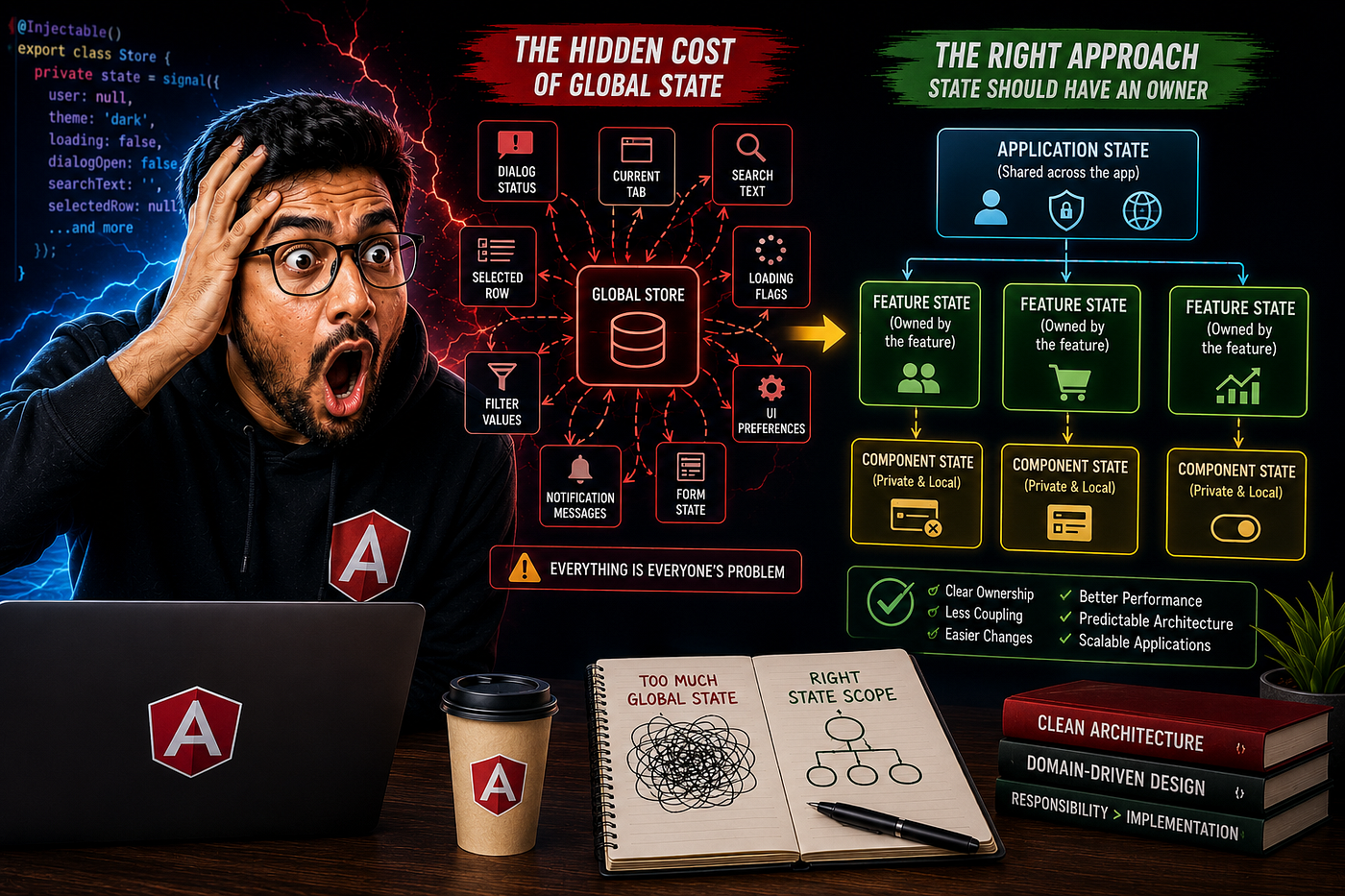
The Customer Feature Owns Customer State
Imagine this:
Customer Feature

• Customer List
• Selected Customer
• Customer Details
• Customer Filters
All of this belongs together.
Orders can read customer information.
Reports can display it.
But neither feature should own it.
Ownership stays with the Customer feature.
Global State Isn’t Shared Ownership
One of the biggest misconceptions in Angular architecture:
“If it’s in the global store…
Everyone owns it.”
No.
A global store is only a storage mechanism.
Ownership still belongs to one feature.
The architecture should make that obvious.
Signals Don’t Solve Ownership
Signals answer:
How does state update?
They don’t answer:
Who controls the update?
That’s still an architectural decision.
The same is true for:
- NgRx
- Signal Store
- Component Store
- RxJS
The tool doesn’t decide ownership.
Your architecture does.
Poor Ownership Creates Hidden Coupling
Imagine five features updating the same state.
Soon developers become afraid to change it.
Why?
Because nobody knows who really owns it anymore.
The architecture loses clarity.
Not because of Angular.
Because of unclear responsibility.
Great Teams Protect Ownership
Large Angular teams usually establish simple rules.
Customer Team owns customer state.
Orders Team owns order state.
Billing Team owns billing state.
Other features consume public contracts.
Not internal implementation.
The architecture becomes predictable.
A Practical Rule
Whenever you create state, ask:
If this state changes…
Which feature is responsible?
Not:
Which feature needs it?
Those are very different questions.
Final Thoughts
State management is one of Angular’s most discussed topics.
But architecture begins long before choosing a library.
It begins by defining ownership.
Because ownership determines:
- Who can change state.
- Who guarantees consistency.
- Who is responsible when something breaks.
Tools change every few years.
Ownership principles don’t.
Great Angular architecture isn’t built by choosing the perfect state library.
It’s built by making ownership impossible to misunderstand.
Connect with Me
If you enjoyed this post and would like to stay updated with more content like this, feel free to connect with me on social media:
- Twitter : Follow me on Twitter for quick tips and updates.
- LinkedIn : Connect with me on LinkedIn
- YouTube : Subscribe to my YouTube Channel for video tutorials and live coding sessions.
- Dev.to : Follow me on Dev.to where I share more technical articles and insights.
- WhatsApp : Join my WhatsApp group to get instant notifications and chat about the latest in tech
Email: Email me on dipaksahirav@gmail.com for any questions, collaborations, or just to say hi!
I appreciate your support and look forward to connecting with you!
메타데이터
- post_id
- 2fbb91d5f56b
- slug
- state-ownership-the-most-important-angular-architecture-decision-nobody-talks-about-2fbb91d5f56b
- url
- https://medium.com/angular-engineering/state-ownership-the-most-important-angular-architecture-decision-nobody-talks-about-2fbb91d5f56b
- canonical_url
- https://medium.com/angular-engineering/state-ownership-the-most-important-angular-architecture-decision-nobody-talks-about-2fbb91d5f56b
- author_url
- https://medium.com/@dipaksahirav
- status
- ok
- fetched_at
- 2026-07-09 08:02:55