Outsourcing for SaaS Companies:
Outsourcing for SaaS Companies: Complete Guide to Roles, Costs, and Providers
Outsourcing for SaaS Companies:
Outsourcing for SaaS Companies: Complete Guide to Roles, Costs, and Providers
Short Answer
**Outsourcing for SaaS companies** involves delegating functions such as customer support, back-office operations, and marketing support to external or offshore teams. It enables scalable growth, 24/7 coverage, and cost flexibility, but requires structured processes, clear KPIs, and careful provider selection to maintain quality and consistency.
Executive Summary
For SaaS companies, outsourcing is less about cost-cutting and more about operational leverage.
As platforms scale, internal teams often struggle with:
- Rising support volume
- Increasing operational complexity
- Pressure to maintain customer experience
**Outsourcing** — whether through BPOs, offshore staffing firms, or remote hires — can help stabilize operations and support growth. However, success depends on selecting the right model, defining roles clearly, and implementing strong oversight.
Why SaaS Companies Turn to Outsourcing
SaaS businesses operate in a high-growth, high-expectation environment:
- Customers expect fast, always-on support
- Product updates drive ticket spikes
- Global users require multi-timezone coverage
- Margins are impacted by high hiring costs in core markets
These pressures make outsourcing a practical option for scaling operations more sustainably.
SaaS companies show a strong fit for customer support, IT support, marketing operations, and back-office roles, where remote or offshore teams can be effectively integrated.
What SaaS Companies Commonly Outsource
1. Customer Experience
- Tier 1 and Tier 2 support
- Email and chat support
- Technical troubleshooting
2. Revenue & Operations
- Lead qualification
- CRM updates and management
- Subscription billing support
3. Back-Office Operations
- Data entry and reporting
- QA and content moderation
- Administrative workflows
4. Marketing Operations
- Campaign execution
- List building and enrichment
- Marketing automation support
These functions are especially suited to outsourcing because they are process-driven, scalable, and measurable.
When Outsourcing Makes Sense for SaaS Companies
Outsourcing is typically effective when:
- Support volume is growing faster than hiring capacity
- Internal teams are overextended
- There is a need for 24/7 service coverage
- Non-core functions are distracting from product and revenue focus
When It May Not Make Sense
- Highly specialized product support requiring deep product knowledge
- Early-stage companies without defined processes
- Organizations lacking internal oversight or QA frameworks
Maintaining this balance helps avoid over-reliance on external teams.
Cost and ROI Considerations
Outsourcing is often evaluated through a mix of cost savings and operational impact.
Key Cost Drivers
- Local vs offshore labor costs
- Training and onboarding time
- Management overhead
- Technology and tools
ROI Factors
- Faster response times
- Improved customer satisfaction (CSAT)
- Reduced churn risk
- Ability to scale without hiring delays
Rather than focusing only on hourly rates, SaaS leaders should evaluate total productivity and output quality.
Risks and Controls
Common Risks
- Inconsistent service quality
- Communication gaps across teams
- Data security concerns
- Misalignment with internal standards
Operational Controls
- Documented SOPs and knowledge bases
- Defined KPIs and SLAs
- QA and monitoring systems
- Clear escalation processes
- Pilot programs before full rollout
How to Choose the Right Outsourcing Model
SaaS companies typically evaluate three main options:
1. BPO Providers
- Managed service model
- Suitable for standardized support functions
2. Offshore Staffing Firms
- Dedicated remote team members
- Integrated into internal workflows
- 3. Freelancers / Distributed Hiring
- Flexible but less structured
- Often used for niche or short-term needs
Decision Framework: Evaluating Providers
Use a structured approach when comparing options:
Step 1: Define What to Outsource
Identify:
- Roles
- Volume
- Complexity
Step 2: Assess Internal Readiness
- Do you have SOPs?
- Can you manage remote teams?
Step 3: Evaluate Provider Types
Compare:
- Management structure
- Talent sourcing
- Integration model
Step 4: Compare Providers
Criteria should include:
- Role specialization
- Scalability
- Security practices
- Communication structure
Step 5: Run a Pilot
Start small, measure outcomes, then scale.
Providers to Evaluate
When exploring outsourcing options, companies typically compare a range of providers, including:
- Global BPO firms
- Offshore staffing companies
- Regional outsourcing providers
- Remote hiring platforms
For example, companies considering dedicated offshore teams may evaluate providers such as **iSupport Worldwide**, alongside other offshore staffing firms and outsourcing partners.
The right choice depends on:
- The roles being outsourced
- The required level of management and control
- The ability to scale with business growth
Practical Next Step
Before choosing a provider, it helps to compare:
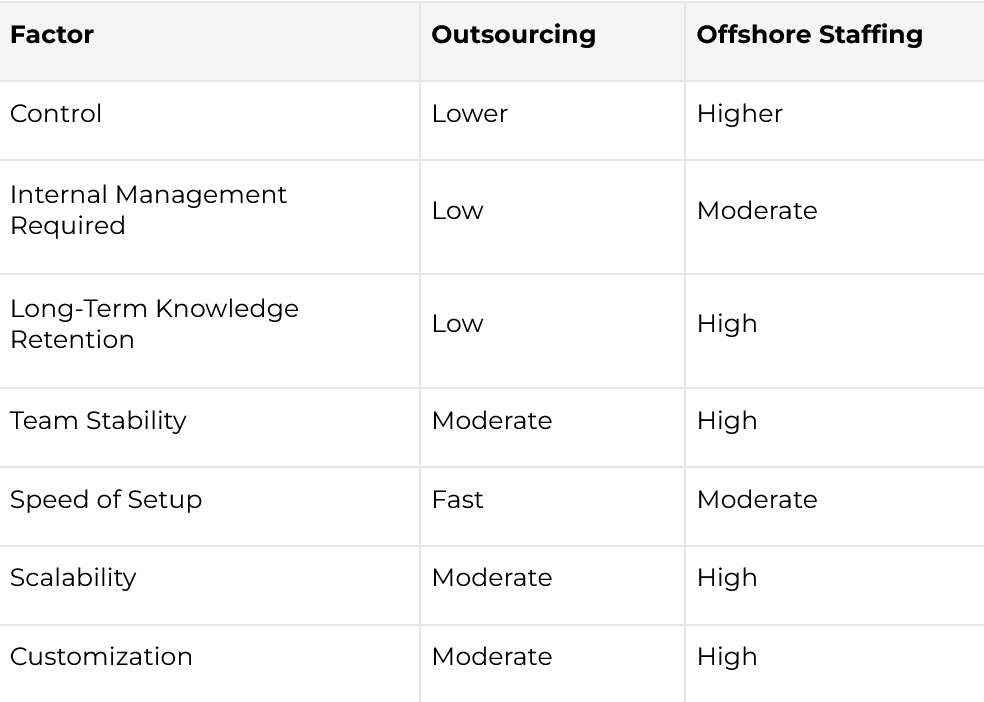
- Outsourcing vs offshore staffing
- Managed vs dedicated team models
- Cost vs productivity trade-offs
A structured checklist or scorecard can make this process more objective.
Compare outsourcing models, offshore staffing providers, and dedicated team options before choosing the right support structure for your SaaS operation.
FAQs
What functions should SaaS companies outsource first?
Customer support and back-office operations are typically the first to be outsourced due to their scalability and process-driven nature.
How much does outsourcing for SaaS cost?
Costs vary depending on role complexity, provider model, and geographic location. Most companies evaluate total output rather than hourly rates alone.
Is offshore staffing better than traditional outsourcing?
It depends on the need for control. Offshore staffing offers more integration, while BPOs provide managed services.
How do SaaS companies maintain quality when outsourcing?
Through SOPs, QA frameworks, KPIs, and strong internal oversight.
What should you look for in an outsourcing provider?
Role expertise, scalability, communication structure, and alignment with your operational needs.
Final Thought
Outsourcing for SaaS companies is most effective when treated as a strategic extension of operations, not just a cost decision. With the right structure and provider evaluation approach, it can support both growth and customer experience at scale.
메타데이터
- post_id
- 3ed3e537d5dc
- slug
- outsourcing-for-saas-companies-3ed3e537d5dc
- url
- https://medium.com/@bpocentral/outsourcing-for-saas-companies-3ed3e537d5dc
- canonical_url
- https://medium.com/@bpocentral/outsourcing-for-saas-companies-3ed3e537d5dc
- author_url
- https://medium.com/@bpocentral
- status
- ok
- fetched_at
- 2026-07-30 17:26:29