Only In Pieces: An Intersectional Story
I stood at the bus stop while the dawn began to break. The morning was cold. The air felt crisp, and the wind pushed. A few feet away, I…
Only In Pieces: An Intersectional Story
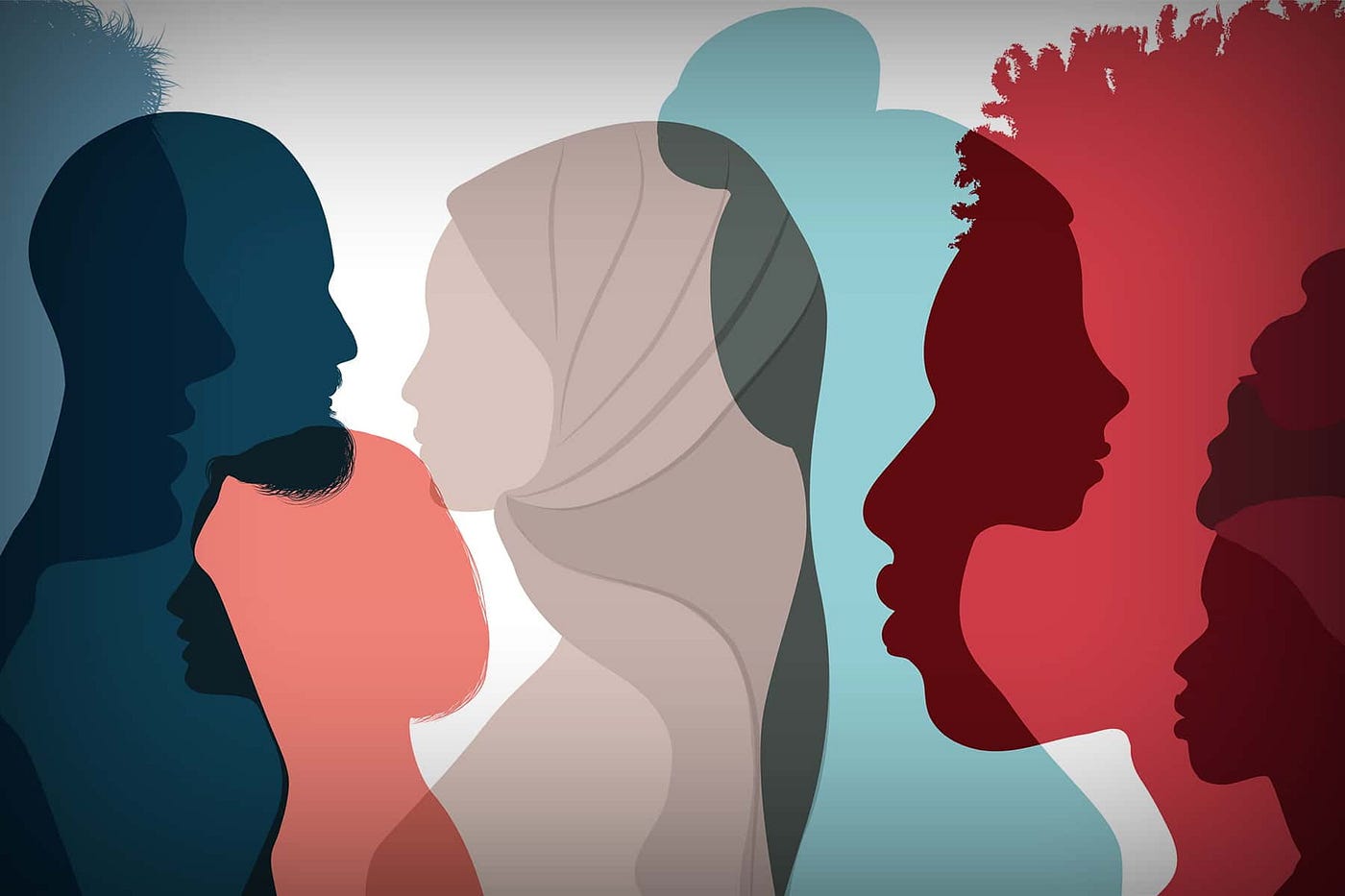
I stood at the bus stop while the dawn began to break. The morning was cold. The air felt crisp, and the wind pushed. A few feet away, I saw a woman straining to balance two overflowing grocery bags while leaning heavily on a cane. I was half-awake watching the streetlights flicker out one by one. I could tell that every movement for her was harder than the last, and the plastic bags were just weighing her down and slicing into her hands. Standing there and seeing the woman adjust her weight and dignity, I realized that the battle she was fighting was not just physical, but something deeper that I could not identify yet. The graphic novel Gender by Meg-John Barker reminds us that gender norms influence not just our behavior but also how we see the worth of others, and what I see in front of me illustrates the truth. This story begins with that interaction, with a woman named Amina, to investigate how many identities, gender, color, class, ability, and nationality, collide in ordinary spaces, generating an image that questions what we see, who we ignore, and why those margins matter.
Being Unaware
As the bus sped around the corner, I could see Amina struggling to grab something in her coat pocket. Something that looked like a card slid from her grasp and fell to the pavement. She began to bend and reach for it, but before she could, I stepped forward and grabbed the bus pass for her.
“Are you okay, Ma’am?” I asked, holding the card out to her.
“Yes, my hands just aren’t cooperating today”, she replies with a soft laugh. As she speaks to me, she’s shifting her weight onto her cane, clearly struggling. The morning light was faint, but I could still notice the shaking of her fingers and the tightening of her jaw. The heavy plastic grocery bags hanging from her wrists left visibly painful red impressions.
At first, I was blind to the nonphysical aspects of her pain. I saw the disability-the slow mobilization, the guarded steps, and the negotiation with her body that every motion required. But when she raised her head, more features came into view: the cadence of her voice that flowed like a song, the headscarf tucked low against the wind, and the weariness that pooled in the places just behind her eyes. Their combination felt like a narrative I did not yet know how to read. This is when I realized that we tend to hang onto the most visible trait and mistake it for the entirety. Barker writes in Queer, “identities are unstable and context-based” (Barker 47). Identity is not fixed or singular, and after watching Amina, I saw how quickly a single characteristic, her disability, could overshadow everything else. Jordan-Zachery writes that intersectional research warns against “collapsing groups into monolithic categories”(Jordan-Zachery 209), but that was exactly the trap my mind almost went into, perceiving her as only disabled, only foreign, and only exhausted.
It was almost like she could read my mind. She smiled at me softly, as though she was forgiving me for a thought I hadn’t spoken. The bus doors opened, pushing out warm air onto our faces, and she swept her arm for me to step ahead of her. I waited, letting her go first. As we boarded, I realized that this small, fleeting moment was becoming the beginning of something larger I needed to understand.
Realizing and Understanding
When we get on the bus, we start a brief talk. As time passes, Amina begins to share aspects of her life with me. Her accent lends her phrases a gentle rise and fall. Her narrative emerged gradually, not all at once, but in fragments. She informed me she worked evenings as a caregiver for an elderly guy who required 24-hour care.
“I walk home after,” she explained, “Buses stop running late, and taxis…” she shrugged.
When I asked how long she had been in the country, her expression dimmed. She had told me that she’s been here for three years and quietly adds that she doesn’t have her papers yet. She continues to say, “I left home because being who I am was too dangerous.”
The context of what she was saying was never explained, but it didn’t need to be. It was in the space between us; Amina is queer. She had to leave her home because this single aspect of her identity could be the difference between life and death for her.
Her cane banged lightly against the floor when the bus passed over a pothole. She went for it quickly, wincing when her fingers failed to wrap around the handle on the first attempt. She told me that her disability was caused by an injury she sustained while traveling outside of her own country, but she didn’t go into detail. I detected both anguish and pride in the way she spoke, as if she were carrying the weight of multiple histories at once. Listening to her made me realize how impossible it would be to define her using only one identity: a disabled, immigrant, queer woman, or Muslim. Each component influenced the others, resulting in a life lived at the crossroads of boundaries she had never chosen.
The bus started to come to a stop, and I found myself noticing how Amina occupies her seat, as if she were making herself smaller. It wasn’t until then that I understood the full weight of her story began to settle on me. Each part of herself: her queerness, disability, undocumented status, faith, and her work were all interconnected. They intertwined with one another, shaping her life in ways I had never had to think about. Her sexuality places her in danger, and she’s a Muslim woman navigating a country that often misunderstands people who look like her. She’s an undocumented immigrant moving through the world with the constant fear of being asked for papers she didn’t have, and to add to that, her disability carries memories of the journey that brought her here, and she works a job that society barely notices.
Crenshaw’s comments stuck with me: immigrant women face “layered vulnerability” (Crenshaw 1991) when policies fail to account for the interconnections of gender, race, nationality, and sexuality. Sitting next to Amina, I could see exactly what she had in mind. The regulations she slid under, the institutions she worked under, were not designed with her in mind. And when laws fail to reflect intersectional realities, they “produce undesirable outcomes” (Crenshaw 1991) such as Amina’s daily fear of deportation, limited work protections, inaccessibility, and the potential of violence for simply being who she is.
I believe that’s when I discovered how relevant feminist and queer theory were at the time. Barker’s Gender reminds us that gender norms intersect with race and religion to determine who is valued, whereas Queer demonstrates how queerness breaks out of the boxes that society tries so hard to fit people into. Amina was a living example of this disruption — someone whose very being violated the world’s neatly drawn lines. As I watched her silently stare out the window, it seemed to me that intersectionality was not some abstract concept; it was her reality unfolding.
Seeing Beyond the Surface
A week later, Amina and I meet outside the apartment complex where she works at night. The high-rise is in disrepair, with paint fading in wide stripes and corridors smelling faintly of antiseptic and wet carpets. Amina invites me inside to meet the man she cares for, who is lying in a badly torn recliner. As she knelt to adjust his blanket, his eyes shifted to mine before he said matter-of-factly,
“You people know how to work hard. You must be grateful for jobs like this.”
Amina maintained a low expression and a tight smile, almost as if she agreed. At this moment, I realize how her experience is mediated by her race, class position, and status as an immigrant every moment she is here. Immigrant women are caught in devalued labor because their identity is never considered nuanced, according to Crenshaw’s warning: “Immigrant women are trapped in devalued labor because systems do not recognize complexities of their identity.”
Amina lives this moment quietly each night she comes to this dimly lit room.
Walking home afterwards, the power of what I had just witnessed lingered with me. Amina was not just being underpaid, she was stuck inside a “matrix of domination” as described by author Patricia Hill Collins — the interlocking system for deciding whom to protect and whom to exploit. She was undocumented and at risk for wage fraud; her disability limited job options, distant from immigrant groups, to whom she otherwise could have reached out for help or solidarity, because of her queerness and female identity, made caregiving work feel expected, natural even. All aspects of her identity overlapped with institutions: immigration laws, medical systems, and labor markets that were blind to her full existence. Watching Amina move through all these systems opened my eyes to the reality that she was struggling not against one barrier but many, layered so intricately that to move forward on one front meant slipping further into others.
And just as we were approaching the corner where our ways parted, Amina stopped to readjust her bags for her cane to support her properly. The streetlight cast shadows and gold alternately on her face.
“Do you ever feel seen?” I blurted out impulsively.
A soft exhalation escaped her lungs. “Only in pieces, never entirely,” she replied.
We stood there for a moment, the hum of the city buzzing around us, and I felt the sting of her words in my chest. It became apparent that intersectionality was much more than simply pointing to oppressions; one had to recognize the role we all have to each other. “Liberation implies a goal where no one is oppressed,” wrote the Combahee River Collective: “we need not concentrate on each form of oppression alone but may move to act for total liberation.” Amina’s experience expressed this perfectly. As she disappeared into the distance, a small but resolute figure marching steadily through the flickering lamp light, I knew that hearing her story was just the start of what being in solidarity meant.
Work Cited
Al-Faham, Hajer, Angelique M. Davis, and Rose Ernst. “Intersectionality: From Theory to Practice.” Annual Review of Law and Social Science, vol. 15, 2019, pp. 247–265.
*Queer: A Graphic History*. Icon Books, 2016.
Sexuality: A Graphic Guide. Icon Books, 2021.
Author Bio
I’m Jeniah. I am a young Black woman who has a family filled with strong immigrant women. To understand intersectionality is to understand them and the things they go through in life, seen and unseen. Learning and understanding this topic and the subtopics that go along with it has opened my eyes to the difficulties minority women, and to add, ones with extra hardships, face every day. I hope that this story sheds light on these struggles.

메타데이터
- post_id
- 4f69c0f3acfc
- slug
- only-in-pieces-an-intersectional-story-4f69c0f3acfc
- url
- https://medium.com/@longswje/only-in-pieces-an-intersectional-story-4f69c0f3acfc
- canonical_url
- https://medium.com/@longswje/only-in-pieces-an-intersectional-story-4f69c0f3acfc
- author_url
- https://medium.com/@longswje
- status
- ok
- fetched_at
- 2026-07-28 18:04:44



