The Geometry of Meaning: How Vector Databases Are Powering the AI Revolution
From Shazam to RAG: A complete guide to understanding, building, and scaling with the “memory” of modern artificial intelligence.
The Geometry of Meaning: How Vector Databases Are Powering the AI Revolution
From Shazam to RAG: A complete guide to understanding, building, and scaling with the “memory” of modern artificial intelligence.
A smartphone captures a brief, noisy audio clip of a song playing in a crowded cafe, and within seconds, Shazam identifies the exact track. This magic isn’t driven by simple keyword matches or file name lookups, but by translating complex audio waves into mathematical coordinates and projecting them into a continuous vector space where similar concepts naturally converge.
While traditional relational databases excel at exact string matching, they are “structurally blind” to this form of semantic similarity. This gap has birthed the vector database — a specialized infrastructure engineered to store and query high-dimensional embeddings that capture the very essence of context and meaning.
In this guide, we will break down this complex technology into seven simple parts, moving from the basic “Why” to the production realities of building global-scale AI.
1. The Core Problem (The “Why”)
The nature of data has shifted; it is no longer confined to neat rows and columns. Unstructured data — social media posts, images, and audio — is growing in volume, yet traditional relational databases are labor-intensive to prepare for AI workloads.
Traditional search relies on discrete tokens like keywords; a search for “smartphone” will only retrieve results containing that exact term. In contrast, AI requires semantic search, which understands that “cellphone” or “mobile device” are conceptually related even if the exact words do not match. Vector databases solve this by representing data points as dense vectors where each dimension represents a learned characteristic, allowing machines to evaluate human intent rather than just spelling.
2. Foundations: Data as Numbers
To an AI, meaning is geometric.
- What is a Vector? Simply put, a vector is an ordered list of numbers representing coordinates in a multi-dimensional space.
- What is an Embedding? An embedding is a special kind of vector generated by a machine learning model to represent complex data (text, images, audio) in a way that captures its meaning.
The history of representing meaning has evolved through two major eras:
- Static Embeddings (e.g., Word2Vec, 2013): These models assigned one fixed vector to each word. However, they were context-agnostic; the word “run” (a sprint) was identical to “run” (a computer program), leading to “polluted” semantic spaces.
- Context-Sensitive Transformer Embeddings (e.g., BERT/GPT, 2018+): Modern architectures use self-attention mechanisms to shift a word’s vector based on the surrounding text. This allows the database to distinguish between “man bites dog” and “dog bites man”.
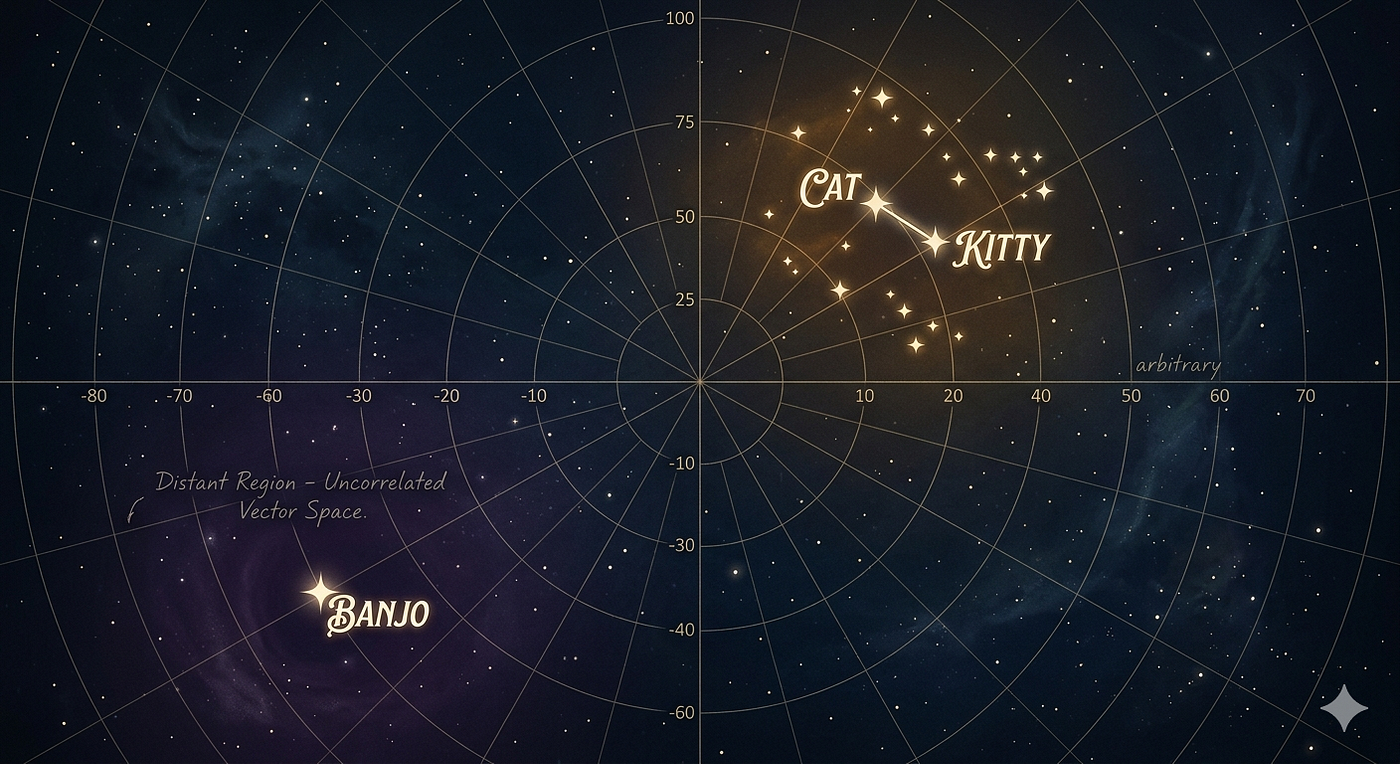
A vector database is a system built specifically to store, manage, and retrieve these high-dimensional embeddings. Unlike a simple vector library (like Meta’s FAISS), a full database provides:
- Persistence: Storing millions or billions of vectors long-term on disk.
- CRUD Operations: The ability to Create, Read, Update, and Delete vectors easily.
- Metadata Filtering: Combining search by “meaning” with search by “facts” (e.g., “find similar documents created in the last month”).
4. Search Mechanics & Math
Once data is transformed into coordinates, similarity is measured using distance metrics. The golden rule is to use the metric that matches the one used to train your embedding model.
- Cosine Similarity: Measures the angle between vectors, ignoring their scale. This is the standard for Natural Language Processing (NLP) because it recognizes that a short paragraph and a long document share the same semantic direction.
- Euclidean Distance (L2): Measures the straight-line distance between two points. It is sensitive to scale and primarily used in image recognition.
- Dot Product: Multiplies corresponding elements to account for both alignment and magnitude. It is often the fastest to compute and is the preferred choice for massive recommendation engines.
5. Indexing & Architecture
Searching a billion vectors using a brute-force “flat” scan would be catastrophically slow. Vector databases use Approximate Nearest Neighbor (ANN) algorithms to trade a tiny fraction of accuracy for massive speed gains.
- HNSW (Hierarchical Navigable Small World): The “gold standard” for in-memory search. It builds a multi-layered graph where queries start at a sparse top layer and “hop” through progressively denser layers to find the target.
- IVF (Inverted File Index): Partitions the vector space into clusters. At search time, the system only scans the clusters closest to the query, potentially ignoring 97% of the data.
- Product Quantization (PQ): A compression technique that can reduce memory footprints by up to 97%, allowing billions of vectors to fit on standard hardware.
- DiskANN: A paradigm shift that serves high-recall queries directly from SSDs rather than RAM. It uses the Vamana graph structure to index a billion points on a single workstation with limited RAM.

HNSW highway vs. IVF honeycomb
6. Primary Use Cases
Vector databases have graduated from research labs to the core of the enterprise AI stack.
- Retrieval-Augmented Generation (RAG): The backbone of modern AI assistants. Instead of fine-tuning models, RAG retrieves relevant facts from a vector database to ground the LLM’s response in reality, reducing hallucinations.
- Recommendation Engines: E-commerce sites use vectors to represent user preferences, surfacing “more like this” results within milliseconds.
- Anomaly Detection: By representing “normal” behavior as vectors, systems can identify outliers in real-time to signal fraud or equipment failure.
7. Production Realities & Evaluation
A fierce architectural debate currently divides engineering teams: Should you use a purpose-built vector store or extend your existing database?
The Case for Relational (pgvector): For teams already running PostgreSQL, the pgvector extension is often the best choice for datasets under 10 million vectors. It eliminates the “sync pipeline” headache, allowing you to store a document and its embedding in the same table and the same transaction.
The Case for Specialized Stores (Qdrant, Pinecone, Milvus): Specialized databases are necessary for billion-scale datasets or when massive multi-tenant isolation is required. They offer advanced features like filterable HNSW, which ensures metadata filters are applied during the graph traversal for maximum precision.
Conclusion: Designing for the Semantic Era
Building with vector databases is no longer just about understanding the “geometry of meaning”; it’s about engineering systems that can navigate that geometry at scale. Whether you are prototyping locally with Chroma or deploying a distributed Milvus cluster, the ability to store and query context-aware embeddings is what defines the next generation of intelligent software.
메타데이터
- post_id
- 71a82d6d6299
- slug
- the-geometry-of-meaning-how-vector-databases-are-powering-the-ai-revolution-71a82d6d6299
- url
- https://medium.com/@rajkamalgopinath_66861/the-geometry-of-meaning-how-vector-databases-are-powering-the-ai-revolution-71a82d6d6299
- canonical_url
- https://medium.com/@rajkamalgopinath_66861/the-geometry-of-meaning-how-vector-databases-are-powering-the-ai-revolution-71a82d6d6299
- author_url
- https://medium.com/@rajkamalgopinath_66861
- status
- ok
- fetched_at
- 2026-08-19 05:11:59




