Why DSPM Testing Fails Without Realistic Data
1. Hook (Intro)
Why DSPM Testing Fails Without Realistic Data
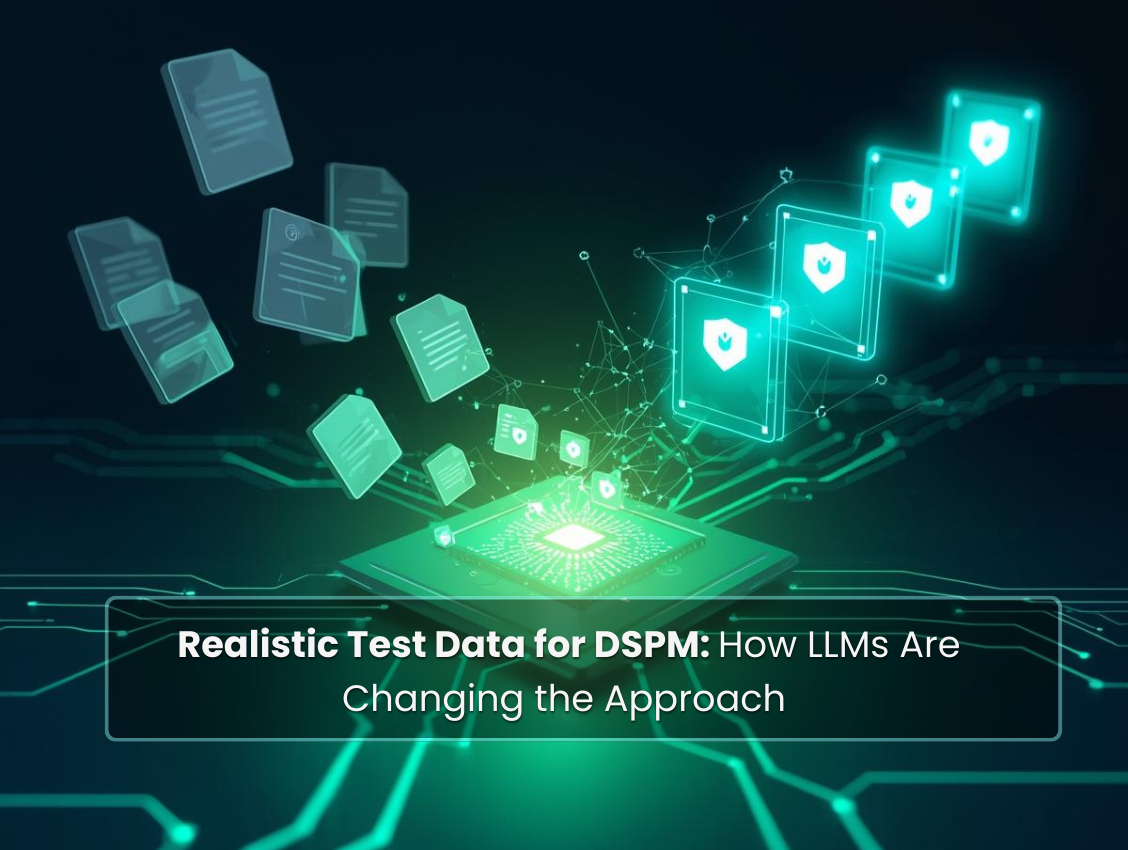
How LLMs are helping security teams test data exposure risks without using real customer information
1. Hook (Intro)
Your DSPM platform promises to find sensitive data before attackers do.
But how do you know it actually works?
If your testing data looks nothing like production data, the answers you get may be misleading.
2. Insight (Overview)
Data Security Posture Management, or DSPM, has become one of the most important security disciplines in modern organizations. Its purpose is straightforward. Discover where sensitive data exists, determine who can access it, identify exposures, and enforce security policies.
On paper, that sounds simple.
In reality, validating whether a DSPM platform can do these things accurately is surprisingly difficult.
The challenge is not the DSPM technology itself. The challenge is the data used to test it.
Security teams need realistic environments to validate classification engines, exposure analysis workflows, and policy enforcement mechanisms. These systems must encounter sensitive information in the same way they would in production.
There is one major problem.
Using actual customer or production data for testing introduces significant compliance, privacy, and security risks. In many organizations, it is strictly prohibited.
As a result, teams often rely on synthetic datasets generated through traditional approaches. Unfortunately, most of these datasets fail to reflect how sensitive information appears in real environments.
The result is a dangerous gap between testing and reality.
A DSPM platform may perform perfectly during validation but miss critical exposures once deployed in production.
The issue is not a lack of testing.
It is a lack of realistic testing.
This challenge is becoming more important as organizations generate larger volumes of data across cloud environments, SaaS platforms, collaboration tools, and business applications. Sensitive information no longer lives neatly inside structured databases. It appears inside documents, spreadsheets, support tickets, emails, logs, and countless other formats.
Testing needs to evolve to reflect that reality.
3. Example
Imagine a security team preparing to deploy a new DSPM solution across its cloud environment.
The objective is simple. Validate whether the platform can identify sensitive customer information, detect excessive permissions, and flag policy violations.
The team begins with traditional synthetic data generation.
Thousands of records are created. Names, phone numbers, addresses, and account numbers are populated into structured database fields.
The tests look successful.
The DSPM platform identifies nearly every record.
The problem appears later.
In production, sensitive information is not limited to database tables. Customer details are embedded inside PDF reports, shared spreadsheets, support tickets, internal documents, and free-text comments.
Many of these files contain context that traditional generators cannot reproduce.
As a result, classification accuracy drops. Certain exposures are missed. Security teams discover blind spots that never appeared during testing.
Now imagine the same scenario using an LLM-driven test data framework.
Instead of generating isolated values, the system creates realistic documents, reports, emails, spreadsheets, and datasets containing context-aware sensitive information.
Relationships between entities are preserved.
Business language feels authentic.
Exposure scenarios resemble real-world environments.
The DSPM platform is no longer testing pattern recognition alone. It is testing its ability to understand sensitive information as it actually exists.
That difference changes everything.
The validation becomes more meaningful. Detection accuracy improves. Teams gain confidence before deployment rather than learning painful lessons afterward.
4. Why LLMs Are Changing the Approach
Traditional synthetic data generators focus on structure.
LLMs focus on context.
That distinction is critical.
Large Language Models understand relationships, language patterns, and business scenarios. They can generate realistic content while ensuring no actual customer data is used.
Instead of simply creating values that match a format, they can simulate how information naturally appears across systems.
A customer complaint can contain personally identifiable information.
An internal report can reference financial data.
A spreadsheet can include employee records alongside operational notes.
This level of realism allows DSPM teams to evaluate detection logic, exposure analysis, and policy enforcement under conditions that closely resemble production environments.
The goal is not to create more data.
The goal is to create better data.
Data that challenges the system in meaningful ways.
Data that helps uncover weaknesses before attackers or auditors do.
5. Looking Ahead
As DSPM platforms continue to mature, testing requirements will become more sophisticated.
Organizations will need datasets specifically designed to evaluate false positives and false negatives.
Testing will expand across additional file formats and data repositories.
Scenario-based validation will become increasingly important as environments grow more complex.
The future of DSPM testing will focus on realism, repeatability, and scale.
LLMs provide a practical path toward all three.
They allow teams to safely generate context-rich datasets that mimic real-world environments without introducing compliance concerns.
That combination is difficult to achieve through traditional approaches.
6. Key Benefits
- More realistic security validation LLM-generated data reflects how sensitive information actually appears across modern environments.
- Reduced compliance and privacy risks Teams can test thoroughly without exposing real customer or production data.
- Greater confidence before deployment DSPM platforms are evaluated against realistic scenarios instead of simplified test datasets.
7. CTA
This story highlights why realistic test data is becoming essential for DSPM success, but it only scratches the surface.
To explore the architecture, workflow, and design principles behind LLM-driven DSPM test data generation, read the full blog on our website.
Because protecting sensitive data starts with testing your security tools against data that looks and behaves like the real thing.
메타데이터
- post_id
- 75d8c32891ce
- slug
- why-dspm-testing-fails-without-realistic-data-75d8c32891ce
- url
- https://medium.com/@neovasolutions/why-dspm-testing-fails-without-realistic-data-75d8c32891ce
- canonical_url
- https://medium.com/@neovasolutions/why-dspm-testing-fails-without-realistic-data-75d8c32891ce
- author_url
- https://medium.com/@neovasolutions
- status
- ok
- fetched_at
- 2026-06-15 20:49:13