🔥 How Event-Driven Systems Fix Microservice Failures
(A complete 2025 guide with clear explanations and real-world patterns)
🔥 How Event-Driven Systems Fix Microservice Failures
🔥 How Event-Driven Systems Fix Microservice Failures
(A complete 2025 guide with clear explanations and real-world patterns)
⭐ Introduction
If you’ve built microservices using REST, you already know the pain:
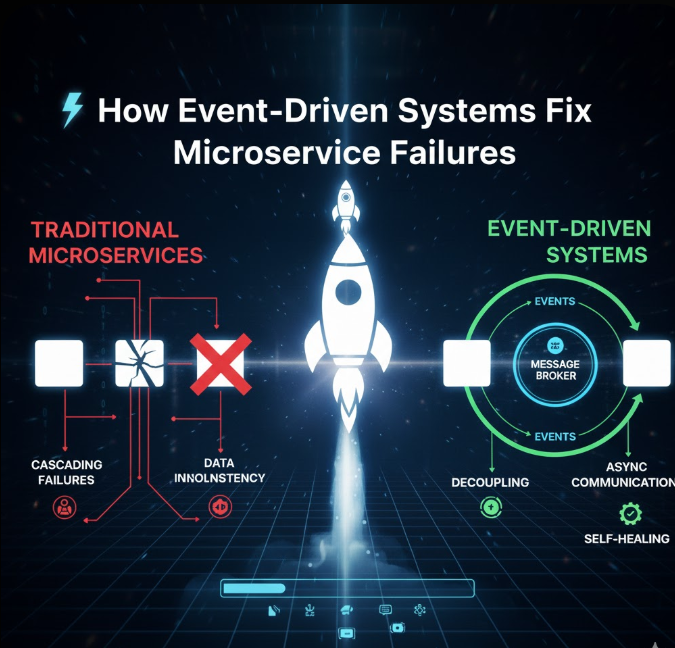
- One service goes down → everything breaks.
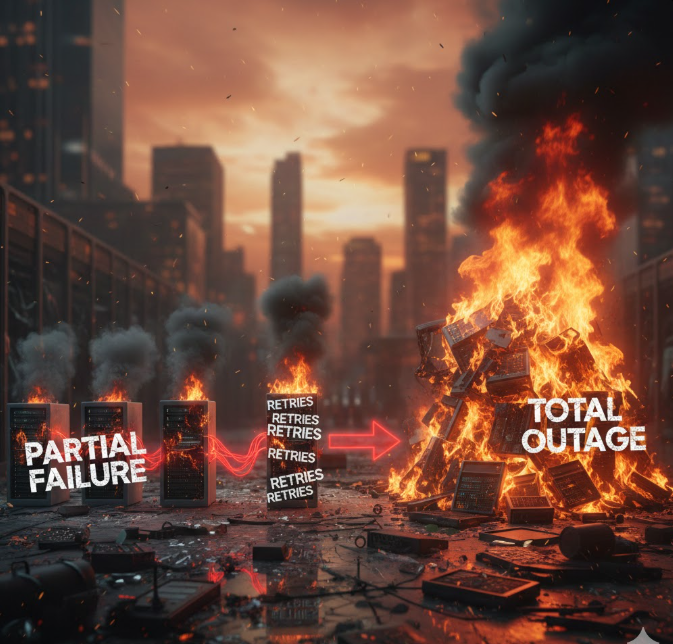
- Retries cause cascading failures.
- Synchronous APIs create tight coupling.
- Slow downstream calls → thread exhaustion.
- Partial failures create inconsistent data.
By 2025, companies like Netflix, Uber, DoorDash, and Stripe have moved away from REST-first microservices toward Event-Driven Architectures (EDA) — because events naturally absorb failures instead of propagating them.
In this article, we’ll break down exactly how event-driven systems solve microservice failure problems — with examples, diagrams (text-based), and real Spring Boot patterns.
🔥 1. Failure Problem: Synchronous Dependency Chain
Rest Microservices Work Like This:
Service A -> Service B -> Service C -> DatabaseIf B is slow, then A is slow. If B is down, then A is down. If C is overloaded, the whole chain collapses.
This is the classic domino effect.
❌ REST = Tight Coupling
Every request requires:
- open sockets
- thread blocking
- timeouts
- synchronous waits
Even if only one dependency is failing, the entire user request fails.
✅ How Events Fix It: Decoupling Through Messaging
Event-driven architecture replaces the chain with asynchronous communication:
Service A --> Kafka Topic --> Service B
Service C <-- Kafka Topic <-- Service B
There is no synchronous dependency.
✔ Decoupled
A doesn’t wait for B. B doesn’t wait for C.
✔ Services work at their own speed
They consume events when ready.
✔ No cascading failures
Because nobody is waiting for anybody else.
🔥 2. Failure Problem: Service Outages Break the Flow
REST problem:
- If Payment Service is down
- Order Service can’t place orders
- Users get errors
❌ REST = Hard dependency
POST /order -> fails if payment-service is offline✅ How Events Fix It: Durable Queues
With Kafka (or Pulsar, RabbitMQ, NATS JetStream):
- Events are stored
- Services consume them when they come back online
Example:
Order Service publishes:
kafka.send("order-created", new OrderCreatedEvent(orderId));Payment service could be:
- restarted
- deploying
- unreachable
- crashed
Still:
🎉 Event is not lost 🎉 Order flow resumes automatically 🎉 No user errors
🔥 3. Failure Problem: Retries = Cascading Failures
REST microservices use:
- retry()
- exponential backoff
- circuit breakers
But at scale, retries look like:
Failures → retries → more failures → thread exhaustion → system collapse❌ Retry storms kill microservices
✅ How Events Fix It: Retry Without Pressure
If payment fails, the consumer retries asynchronously:
@KafkaListener(topics = "order-created")
public void process(OrderCreatedEvent event) {
    try {
        payment.charge(event.orderId());
    } catch (Exception e) {
        // push back to retry-topic
        kafka.send("order-retry", event);
    }
}
Retry queue benefits:
✔ No pressure on the producer ✔ No retry traffic storm ✔ No user-facing errors ✔ No thread exhaustion
This is fault isolation → retries affect only one service.
🔥 4. Failure Problem: Inconsistent State Across Services
Example:
- Payment succeeds
- Notification fails
- Inventory partially updates
- Services lose sync
REST sagas are painful.
✅ How Events Fix It: Event-Carried State Transfer
Each service publishes its own state changes:
Order -> OrderCreated
Payment -> PaymentCompleted
Inventory -> InventoryReserved
Shipping -> ShippingScheduled
A consumer rebuilds the state:
@KafkaListener(topics = "payment-completed")
public void updateView(PaymentCompleted event) {
    viewRepository.markPaid(event.orderId());
}
This ensures:
✔ Consistency ✔ Replayability ✔ Audit logs ✔ Fully traceable events
If a service fails, replay restores the state.
🔥 5. Failure Problem: Long-Running Processes Break Easily
REST microservices fail on:
- timeouts
- cron jobs
- scheduled tasks
- manual retry logic
- complex workflows
✅ How Events Fix It: Workflow Engines (Temporal, Cadence)
Temporal workflows survive:
✔ service crashes ✔ network failures ✔ database restarts ✔ workflow restarts ✔ infinite retries
Example: Temporal Workflow
@WorkflowInterface
public interface OrderWorkflow {
    @WorkflowMethod
    void process(String orderId);
}
Workflow survives failure:
- Pause workflows
- Resume later
- Retries built-in
- Durable event history
Event-driven workflows eliminate entire categories of failures.
🔥 6. Failure Problem: Slow Services Slow Down the System
In REST:
- slow payment → slow order
- slow inventory → slow shipping
Everything becomes synchronous.
✅ How Events Fix It: Backpressure + Consumer Scaling
Slow consumer? No problem.
Kafka + Spring Boot allows scaling:
Consumer Group: payment-service
  - payment-1
  - payment-2
  - payment-3
Add instances → throughput increases.
The system self-heals by autoscaling consumers, not by adding retries.
🔥 7. Failure Problem: One Bad Service = Entire System Down
REST:
Service A → B → C → D
If C fails → entire chain fails
✅ How Events Fix It: Failure Containment Zones
Events isolate failures:
Order Service
   ↳ publishes events
Payment Service
   ↳ consumes only payment events
Shipping Service
   ↳ consumes only shipping events
If Payment crashes:
✔ Order still works ✔ Inventory still works ✔ Shipping still works
Only one domain is affected.
🚀 Final Summary: Why Event-Driven Systems Win
Event-driven microservices fix failures by design:

Event-driven systems turn failures into contained, recoverable events instead of system-wide outages.
메타데이터
- post_id
- 9aa61b048e24
- slug
- how-event-driven-systems-fix-microservice-failures-9aa61b048e24
- url
- https://medium.com/@gangoladeepa/how-event-driven-systems-fix-microservice-failures-9aa61b048e24
- canonical_url
- https://medium.com/@gangoladeepa/how-event-driven-systems-fix-microservice-failures-9aa61b048e24
- author_url
- https://medium.com/@gangoladeepa
- status
- ok
- fetched_at
- 2026-07-18 12:15:57