Exploring PVDF-HFP as a Solid-State Electrolyte for Enhanced LTO Battery Performance
How can the step towards more power be taken more carefully and effectively? Careful evaluation of our options so let’s evaluate PVDF-HFP!
Exploring PVDF-HFP as a Solid-State Electrolyte for Enhanced LTO Battery Performance
Introduction
With the increasing demand for high-performance and safer lithium-ion batteries, researchers are exploring solid-state electrolytes (SSEs) as a promising alternative to liquid electrolytes. Among various SSE candidates, PVDF-HFP stands out due to its advantageous properties. It enhances lithium-ion transport by reducing crystallinity while maintaining mechanical flexibility and electrochemical stability. This article explores the potential of PVDF-HFP as an SSE for LTO-based batteries, its manufacturing process, and the challenges that must be overcome to make it a viable industrial solution.
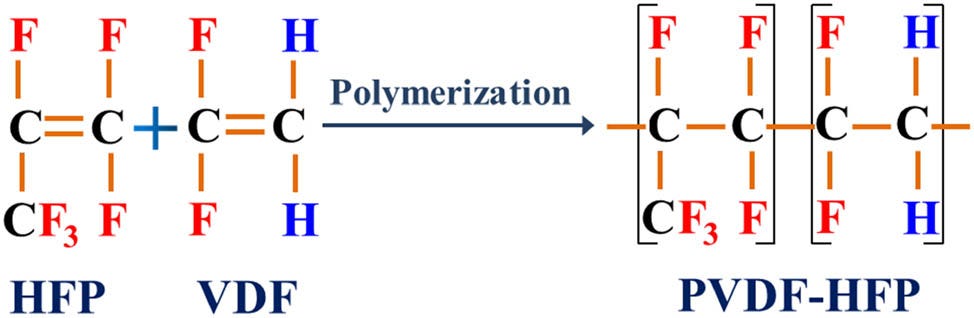
image of the synthesis of HFP and VDF to make PVDF-HFP
Keywords:
- polymerization= any process in which relatively small molecules, called monomers, combine chemically to produce a very large chainlike or network molecule, called a polymer.
- Crystallinity = refers to the degree of structural order in a solid. In a crystal, the atoms or molecules are arranged in a regular, periodic manner.
- Thermoplastic=Thermoplastics are polymers that can be softened through heating before being processed and then left to cool and harden.
- Dielectric constant=The dielectric constant of a substance or material is a measure of its ability to store electrical energy.
- Electrolyte = Electrolytes are substances that have a natural positive or negative electrical charge when dissolved in water.
- Ionic mobility = In gaseous electric conduction, the average velocity with which a given ion drifts through a specified gas under the influence of an electric field of unit strength.
- Volatile= Volatility is a material quality which describes how readily a substance vaporizes.
- Hydrophilicity= refers to the ability of a material to absorb, swell, or dissolve in water.
- Casting= Casting is a manufacturing process in which a liquid material is usually poured into a mold, which contains a hollow cavity of the desired shape, and then allowed to solidify.
- Non solvent = a substance incapable of dissolving a given component of a solution or mixture.
- Solvent = able to dissolve other substances.
- Demixing = Demixing is the unintended separation of the substances in a mixture.
- Supercritical fluid = A supercritical fluid is a substance at a temperature and pressure above its critical point, where distinct liquid and gas phases do not exist, but below the pressure required to compress it into a solid.
What is PVDF-HFP
PVDF has 3 different phases with PVDF-HFP being one of them. With a molecular formula of (-CH2CF2-)x[-CF2CF(CF3)-]y it stands for Poly(vinylidene fluoride-co-hexafluoropropylene) and it is a copolymer through the polymerisation[1] of the units PVDF and HFP.

HFP is a gas which is colourless, odourless and very slightly soluble in water. Its presence benefits the overall polymers through:
- Reducing the crystallinity[2] of the PVDF which increases amorphous(without a clearly defined shape or form) regions leading to better Li-ion transport.
- Enhancing flexibility which means that cracking is less likely to occur with the electrolyte film being more flexible
PVDF is a thermoplastic[3] which is highly unreactive with a whitish/translucent appearance and an insolubility towards water. It contributes to the overall PVDF-HFP polymer through:
- Enhancing the dissociation of lithium salts which then improves the ionic conductivity and this is due to the high dielectric constant [4] ranging from 8–10
- Bringing more stability when against high voltage cathodes such as LMNO(lithium manganese nickel oxide) due to its excellent electrochemical and chemical stability.
- Providing mechanical integrity to the electrolyte [5] film as it provides strong mechanical properties
- Contributing to low ionic mobility [6] at room temperature due to its high crystallinity of about 50%
Manufacturing process
There are various ways to make PVDF-HFP however one of the most common manufacturing processes involved which will be observed and reviewed in this article is the process of phase inversion more specifically looking into phase inversion through immersion precipitation.
“Phase inversion is a demixing process in which initially homogeneous polymer solution is transformed from a liquid state to a solid state in a controlled manner”(Aijaz et al., 2023)

phase inversion process
The process of immersion precipitation from a manufacturing point of view looks like such:
- Polymer Solution Preparation:
- At this point the homogeneous polymer solution is formulated through dissolving the polymer into a volatile [7] solvent.
- The polymer concentration can range from 15–25% in order to balance the viscosity and film-forming capability. Additives may also be added to regulate pore size and hydrophilicity[8].
- When it comes to the raw materials usually used for this process such as polymers and solvents they are generally available in bulk quantities at reasonable prices meaning that the process so far is seemingly cost effective.
- Casting and Film Formation:
- Casting[9] and film formation is the next step with the solution being cast onto a support by making use of a doctor blade in order to achieve uniform thickness (50–300 μm).
- Evaporation time occurs before immersion and it’s controlled by both ambient humidity and temperature which has an effect on the skin layer density. The longer the evaporation the further the solvent content is reduced at the surface promoting skin formation.
- Immersion in a Non-Solvent Bath:
- The cast film is then immersed in a nonsolvent[10] bath (usually water) and the triggered phase separation from this solvent-nonsolvent exchange is what’s defined as the stage of the immersion into a coagulation bath.
- Phase separation leads to skin formation where at the film-bath interface a rapid solvent[11] depletion elevates polymer concentration inducing gelation and forming a dense skin layer.
- Meanwhile beneath the skin slower demixing[12] allows liquid-liquid phase separation which creates interconnected pores. Processes such as this and drying processes require specific temperature control which can be very energy intensive when done at larger scales leading to an increase in costs.
- Analogy: This process is similar to dropping hot wax into cold water; the outer layer solidifies rapidly, forming a dense shell, while the inner portion cools more gradually, leading to a more porous structure.
- Washing and Annealing:
- After the forming of the skin and substructure, what’s remaining is for the newly created membranes to get washed to remove the residual solvents and annealed in order to improve the mechanical stability.
- Trying to maintain a consistent membrane quality at a larger scale will require more sophisticated monitoring equipment which automatically means an increase in overall costs for this process
Overall despite the few challenges within the process of PVDF-HFP it is relatively an easy and pretty convenient process to carry out at an industrial scale arguably. The main concern or focus should be on the requirement of extensive monitoring systems in order to meet all specific conditions required for chemicals to react in an expected way to lead to the formation of the polymer.
It’s important to consider as without the right condition unexpected reactions occur which whilst at a surface level means money lost and the necessary polymer not being formed, when looking at the big picture this would lead to massive waste of chemicals as once reacted they can’t be reused or reversed in a way in order to make them react correctly and even if it was an option it would be too expensive and a hassle that can be easily ignored.
With 400 million tonnes of hazardous waste already out in the world on a yearly basis, the more precaution that can be taken against more chemicals turning into waste the better the overall environmental situation can become.
Challenges in LTO Batteries
While PVDF-HFP shows promise as a solid-state electrolyte for LTO batteries, one major hurdle remains: interface compatibility.
There are various novel ways being suggested on how to tackle this issue however the main focus within this article will be on the surface modification of LTO electrodes with our focus from the electrolyte being shifted away. Making modifications to the surface of LTO electrodes can lead to better electrolyte-wetting properties and reduce unwanted side reactions. Main method for this to occur is coating with carbon coating,Al2O3(aluminium oxide) and Li3PO4 (lithium phosphate) coatings being the more well known options. But what actually goes on when coatings are applied? Why the sudden improvement?
Focusing on carbon coatings in particular they enhance the electronic conductivity of LTO particles(Li4Ti5O12). This is because they reduce the charge transfer resistance meaning that the electrons have more ease in their movement between LTO particles and the current collector. A study on LTO/rGO nanocomposites noticed a reduction in charge transfer resistance, which was attributed to the high conductivity of reduced graphene oxide (rGO) (Mokaripoor et al., 2024).
Similarly, carbon-coated LTO composites synthesized via a one-pot method showed higher electronic conductivity and lithium diffusion coefficients, leading to better electrode kinetics (Ding et al., 2021). The carbon coating also acts as a conductive network which makes electron transport easier, just like when hinges of a door can move more easily when oil is coated on them. In a study using supercritical fluids[13] to create a thin carbon layer on LTO, the coated material demonstrated high discharge capacities at various rates, clearly showcasing improved electron mobility (Hong et al., 2016).
Comparison with Traditional LTO Electrolytes
We have observed what PVDF-HFP is and its potential to become a new option as an electrolyte for LTO despite some of the challenges it faces; however how does it compare to the current status quo within the LTO battery scene? This is what the focus for this section of the article will be. The traditional electrolyte in LTO cathode batteries mainly consists of:
- Lithium salt(LiPF6):

Lithium Salt being made
- This is the primary component of the electrolyte and it is responsible for providing the required ionic conductivity. The most widely used salt is Lithium hexafluorophosphate(LiPF6) due to having a high ionic conductivity and compatibility with various solvents. However at high temperatures it can decompose which brings safety concerns about its usage.
- The lithium salt is typically sourced from high-purity chemical suppliers and during the manufacturing process it is dissolved in the organic solvent under controlled conditions. The high purity chemical it is sourced from is quite expensive due to fluorine processing and purification.
- Additionally an environmental issue comes with the difficulty of recycling the lithium which increases the cost of safe disposal making it a less attractive thing to do when handling the material. With battery recycling involving complex processes (hydrometallurgical or pyrometallurgical) it is not always an economically viable action to take after a battery has run its purpose.
2. Organic solvent (Carbonate-Based, Nitrile-Based, Sulfone-Based):

solvents examples
- The organic solvent is a medium for dissolving the lithium salt and allows ion transport.
- Solvents are selected based on different factors such as boiling points, viscosity, and ability to form a stable SEI layer. These solvents can be beneficial as they have a low water content which reduces unwanted side reactions in batteries and they have a good conductivity which helps in efficient ion transport. However similarly to lithium salt there are issues when it comes to getting organic solvent recycled which makes it difficult to reclaim.
3. Additives:

additives in the making
- These are incorporated into the electrolyte to improve specific properties such as rate capability , high temperature performance and cycling stability. There are different types of additives such as the Solid electrolyte interphase(SEI) forming additives which help to form a stable SEI layer on the surface of the electrode reducing parasitic reactions and improving cycling stability. Other additives include moisture-removing additives, and oxidation resistance additives.
- During the manufacturing process both solvents and additives are added on to the lithium salt solution in order to ensure uniform mixing and the best performance.
- The final electrolyte solution gets filtered in order to remove impurities and be certain of high purity. Finally after all of this the electrolyte gets tested for different factors such as its ionic conductivity, compatibility with LTO cathode and anode materials, and its electrochemical stability.
Overall conclusion

made using napkin.ai
PVDF-HFP has a high potential of enhancing the energy density of LTO batteries, however challenges like the interface compatibility need to be addressed in order for it to be adopted at a larger scale. Luckily advances in techniques for modifying surfaces such as carbon coatings offer viable solutions to improving the electrolyte-electrode interactions. With research constantly progressing PVDF-HFP could lead the way for a safer , high energy density battery which powers the next generation of renewable energy storage and electric vehicles. Further innovation in both manufacturing processes and materials science will be key in making such solutions industrially possible.
About the Author
A female student based in the UK, London currently studying physics, maths and btec computing A levels. Passionate about tackling climate change through tech and exploring various new technologies by venturing in various projects in order to get more of an idea of how to help the world.
Always eager for intentional meet ups with other experts in STEM fields.
Feel free to connect with me:https://www.linkedin.com/in/stephanie-ogburie/
References
- https://www.sigmaaldrich.com/GB/en/substance/polyvinylidenefluoridecohexafluoropropylene123459011170?srsltid=AfmBOordsrZmGIDODRP4mm9CEUx59PH1IfrGITGmof7XBTKfTZVKVPpo
- https://pubmed.ncbi.nlm.nih.gov/38533021/
- https://patents.google.com/patent/US20040171776A1/en
- https://en.wikipedia.org/wiki/Polyvinylidene_fluoride
- https://www.aidic.it/cet/19/73/001.pdf
- https://www.sciencedirect.com/topics/engineering/phase-inversion(about phase inversion)
- https://www.ecetoc.org/wp-content/uploads/2021/10/JACC-048.pdf
- Frontiers in Materials — Role of Electrolytes in the Stability and Safety of Lithium Titanate Batteries: https://www.frontiersin.org/journals/materials/articles/10.3389/fmats.2020.00186/full
- US Patent and Trademark Office — Electrolyte for LTO Type Lithium Ion Batteries: https://patents.google.com/patent/US20180269528A1/en
- WIPO PatentScope — Electrolyte for LTO Type Lithium Ion Batteries: https://patentscope.wipo.int/search/en/detail.jsf?docId=WO2017049471
- Wikipedia — Lithium-titanate battery: https://en.wikipedia.org/wiki/Lithium-titanate_battery
- EV Lithium Charger — Learn about Lithium Titanate LTO Battery: https://www.evlithiumcharger.com/News/learn-about-lithium-titanate-lto-battery.html
- ABB Library — Characteristics of LTO Batteries White Paper: https://library.e.abb.com/public/ebb77b12020a400e9a908dbbcd12b64e/Characteristics of LTO Batteries White Paper_20240229_af_20240229_1109_af_DIGITAL.pdf?x-sign=OwIyIq7RwGbbmOMmAjabIa4ISOhmnk4rn7qFvS6aDQ1wGDKJsp2iMhZsNEGJDt3U
- Harvard Abstracts — Role of Electrolytes in the Stability and Safety of Lithium-Titanate Batteries: https://ui.adsabs.harvard.edu/abs/2020FrMat...7..186G/abstract
- https://www.sciencedirect.com/science/article/pii/S2211379717300736#:~:text=Conductive carbon coating at the surface of the LTO reduces,area of the resultant material.
- https://www.businesswaste.co.uk/your-waste/hazardous-waste/hazardous-waste-facts/#:~:text=More than 400 million tonnes of hazardous waste are produced,is generated around the world
- https://onlinelibrary.wiley.com/doi/full/10.1002/cey2.604
- https://news.metal.com/newscontent/102206108/lithium-salt-prices-soar-trading-still-needs-to-be-cautious
- “Environmental Impacts of Lithium-Ion Batteries” — Nature Sustainability (2021)
- “Electrolyte Decomposition and its Effects on Lithium-Ion Battery Performance” — Journal of Power Sources (2020)
- “The Economic Viability of Lithium Recycling” — Journal of Cleaner Production (2022)
- International Energy Agency (IEA) — Global EV Outlook (2023)
- U.S. Department of Energy — Lithium Battery Recycling R&D Report (2023)
- Benchmark Mineral Intelligence — Lithium Market Forecast (2024)
- BloombergNEF — Battery Metals Outlook (2023)
- Mokaripoor, E., Kazeminezhad, I., & Daneshtalab, R. (2024). Effect of rGO on electrochemical behavior of Li4Ti5O12 as an anode material for Li-ion batteries. Materials Today Communications. https://doi.org/10.1016/j.mtcomm.2024.108209
메타데이터
- post_id
- 9c1f09f0c0b1
- slug
- exploring-pvdf-hfp-as-a-solid-state-electrolyte-for-enhanced-lto-battery-performance-9c1f09f0c0b1
- url
- https://medium.com/@ogburiestephanie/exploring-pvdf-hfp-as-a-solid-state-electrolyte-for-enhanced-lto-battery-performance-9c1f09f0c0b1
- canonical_url
- https://medium.com/@ogburiestephanie/exploring-pvdf-hfp-as-a-solid-state-electrolyte-for-enhanced-lto-battery-performance-9c1f09f0c0b1
- author_url
- https://medium.com/@ogburiestephanie
- status
- ok
- fetched_at
- 2026-07-27 08:50:10