What if Othello had a Plus One?
In Conversation with William Shakespeare
FROM THE MIND OF THE BARD
What if Othello had a Plus One?
In Conversation with William Shakespeare
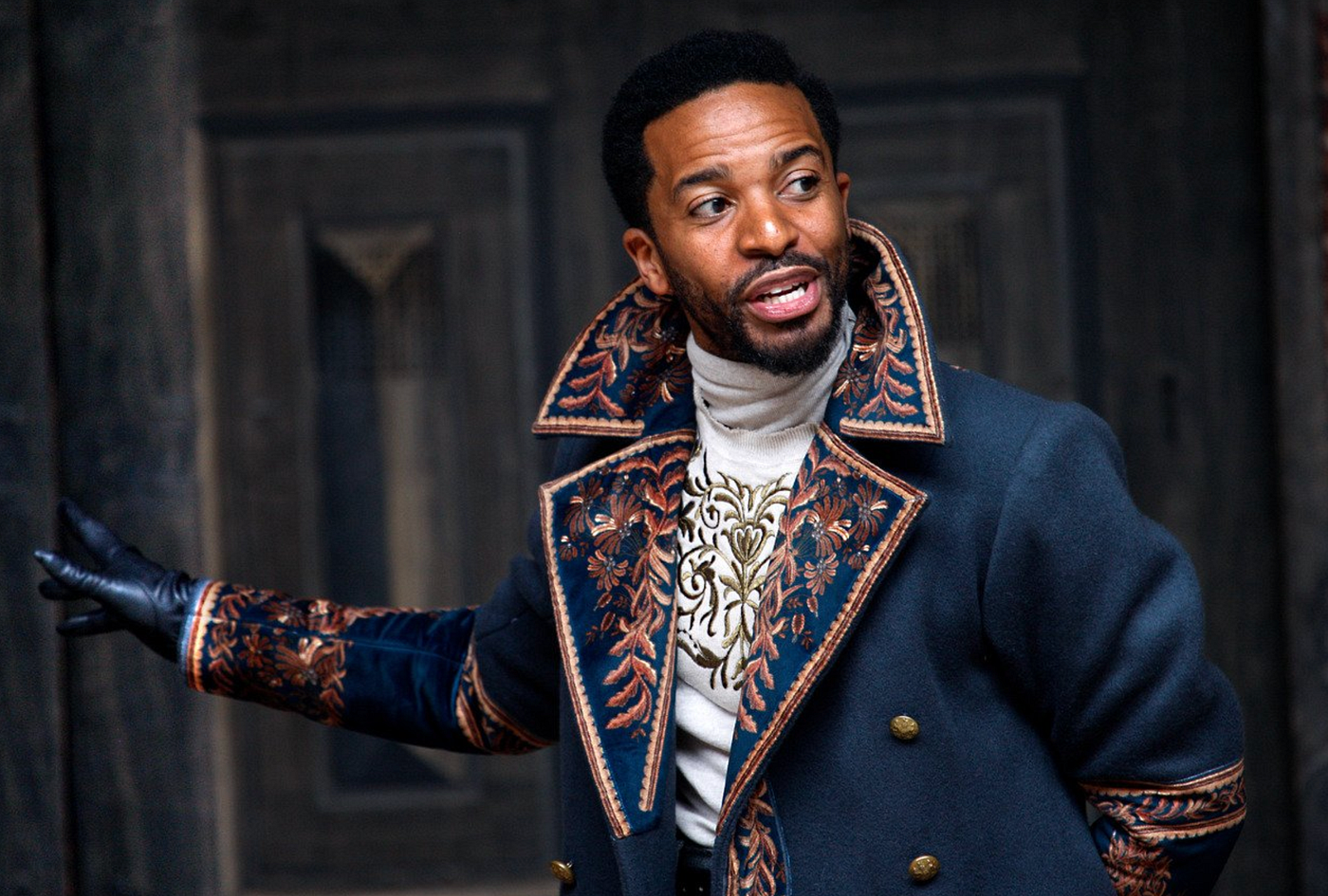
Andre Holland in the title role at the Globe Theater 2018
William Shakespeare is the most celebrated playwright the world has ever known. Born in 1564 in Stratford, England, by age 25, he had staged his first play, Henry VI Part II. While his 10 history plays continue to fascinate audiences the world over, his tragedies linger most in my heart for their complexity, soul-stirring monologues, and heartbreaking finales.
Othello is one of William Shakespeare’s less frequently staged and more controversial plays. In the story, a celebrated African general, summoned to command the Venetian armies, falls for a wealthy woman named Desdemona and is immediately set upon by the racist cruelty of her father and Othello’s own ensign, Iago.
Though Othello’s naivete is crucial to his downfall, what essentially allows him to be duped is his cultural isolation. Like Tiger Woods on the golf course, Othello is a black man in a white world.
Othello was literature’s first DEI hire.
I’ve created a conversation with William Shakespeare where I argue that having a Plus One by his side in Venice would have taken Othello’s life, and this play, in a much different direction.

Image Courtesy of PlayMakers Repertory Company
Note: William Shakespeare has been dead for 410 years. But imagine this conversation taking place at the end of his career over a glass of ale in a pub somewhere north of London Bridge.
Me: Hello, Mr. Shakespeare. It’s a pleasure to meet you!
WS: The pleasure’s all mine, madame, and you can call me Gentle Will.
Me: I like that!
WS: It’s the poet in me.
Me: Many people don’t realize that you were a poet and an actor before becoming a playwright. Did those roles serve you well in writing for the stage?
WS: Indeed, they did. There were many dark times for me in England, where poetry allowed me to clear my head and sort through my sullen emotions. Being on stage was a welcome reprieve from spending so much time alone. However, I quit the stage to work on Othello. It was not an easy play to write.
Me: Let’s talk about Othello. You composed it in 1603. What was your life like at that time?
WS: I was very well-known by the 1600s, and expectations for my work were high. People traveled internationally to see the plays, and I was paid well as a member of the King’s Men. I loved to entertain the crowds who were crammed from floor to rafter in the theater every afternoon. I was often lonely, though. My wife was reluctant to travel to London because she still blamed me for not being there when our son Hamnet passed away in 1596.
Me: Did you enjoy the company of other women?
WS: Thou art a most pernicious woman!
Me: I apologize, good sir, but surely you know that your love life has been an intense topic of speculation for years.
WS: It’s all much ado about nothing. I worked constantly during my career and had very little time for frolicking.
Me: Why did you write a play with a black man as the central character?

A Moorish man sits for a portrait in England circa 1500s. Image Courtesy of The Guardian
WS: Many Moors came through England when I was a boy. They were a curiosity and often treated with disdain by locals who were quite frankly not as intelligent or as worldly as they were. I came across a collection of tales written in 1565 called Gli Hecatommithi by Cinthio, an Italian writer. In his story titled “A Moorish Captain (Un Capitano Moro)”, a man is duped by his envious lieutenant. From that short story, Othello, the stage play, was born.
Once I read Cinthio’s line, Now amongst the soldiery there was an Ensign, a man of handsome figure, but of the most depraved nature in the world, I decided to call this character Iago. I drove myself for the better part of two months to finish the script.
Me: Why was it important for you to isolate Othello? He arrives in Venice as a war hero, but he has no family or kinsman who shares his history or culture.
WS: This is precisely what weakens him.
Me: Did you want Othello to be weak?
WS: No, but I did want him to be vulnerable.
Me: What did you want Othello to bring to the table at the beginning of the play?
WS: He was a military genius born free but captured as a slave. I wanted to show a man who had endurance and charisma. Othello rising to command an army reminded me of a tidbit of the history I researched about an African man named Hannibal Barca. A key difference in my story is that Othello commands the Venetian armies, whereas Hannibal led Carthage against the Romans.
Me: I see. As you grew up, what impression of Africa did you have?
WS: It was a wide, wondrous place in my mind. I heard of universities and expansive trading posts much more sophisticated than what we have in London.
I heard about delicious fruits growing on trees everywhere, fertile plains, and the healing waters and warmth of the sea. I heard seafarers speak about the beautiful women they saw who were both protected and desired. In my mind, every Moor was a natural warrior and protector. It seemed to be part of their upbringing.
Me: So Othello, the character, comes from an undoubtedly rich heritage, but very few people in Venice seem to take a liking to that. He converts to Christianity, but he is still outright rejected by his father-in-law, he’s manipulated by his lieutenant, and has to wed Desdemona in secret. How can a man survive that without someone to lean on?

Othello weds Desdemona. Image Courtesy of RSC
WS: If you notice, Othello sees his difference and his position as an outcast as a problem to be conquered. He doesn’t just marry Desdemona, he “wins” her. In fact, he initially makes a favorable impression on her father, Brabantio, as well until Brabantio realizes that Othello will become a member of his family.
Although it’s often lonely at the top, Othello is used to being alone; he is used to figuring things out for himself, and he is used to winning.
Me: All the more reason to have a trusted ally or a Plus One.
WS: Othello comes into Venice already a well-known man of distinction, and his ally is his ensign, Cassio.
Me: A cheap drunk and a whoremonger. He’s unreliable.
WS: Yes, Cassio is everything Othello is not.
Me: Let’s get to Iago, the most despicable villain in all of Western literature.
WS: Why, thank you!
Me: In my humble opinion, if Othello had a tribesman who traveled with him to Venice, there never would have been an Iago.
WS: There will always be an Iago. And there will always be someone duped by him. This is human nature.
Me: Yes, but a true confidant would have seen through Iago’s machinations and warned Othello.
WS: A man in love never listens to naysayers.
Me: True.
WS: Besides, Othello’s real struggle was internal. Here was a man who could win every battle on the outside and outwit every external foe. But on the inside, he was unsure of himself and struggled with self-knowledge.
Me: Did you see the Moors–black people– as insecure and lacking self-knowledge?
WS: Not exactly. What I did observe as I wrote the play is that each of us needs an anchor. At one point, Desdemona becomes Othello’s anchor, as a wife should be, but he gradually becomes unmoored. <giggle and a pause> So sorry about the pun.
Me: You’re quite clever, Gentle Will. Is his “unmooring” then all Iago’s fault?

Denzal Washington and Jake Gyllenhaal as Othello and Iago at the Ethel Barrymore Theater 2024 Photo Courtesy of Deadline
WS: Yes, initially because Iago is a schemer and a liar. Yet, Othello is vulnerable to the scheme because he quickly begins to doubt himself and Desdemona’s love for him.
Iago starts the play as Othello’s third in command and elevates himself through trickery to the level of trusted confidante and finally to a distorted paternal figure to Othello, who becomes so dependent on Iago’s “insight” and advice that when Othello threatens to kill his wife, Iago instructs him to “Strangle her in her bed,/even the bed she hath contaminated.”
Me: This is the most disturbing part of this play, but the killing is quite symbolic.
WS: Yes, this is a significant departure from Cinthio’s story in which the villain suggests they “take a stocking, filled with sand, and beat Disdemona [sic]with it till she dies; thus will her body bear no signs of violence.”
Me: Shocking! Your version is much less heinous, Gentle Will. Actually, no, it’s not.
WS: But it’s symbolic of Iago’s irrational fear, which is made clear early in the play when he surmises that Othello has been “‘twixt his sheets” with Iago’s wife Emilia. Of course, it’s his imagination going wild that fuels Iago’s vengeance.
Me: Is this an example of the European obsession with black men’s sexual prowess?
WS: Obsession would be an understatement.
Me: Othello seems unaware of this envy. He admires Cassio as more refined than he is, so when Iago plants the idea in his head that Desdemona has slept with Cassio, his fear of inadequacy kicks in. I still say this play would have had some great confrontation scenes with two valiant Moors against Iago instead of one.
WS: How do you mean?
Me: This way, Othello’s bestie would have followed Iago and fact-checked some of his ridiculous assertions.
WS: Eventually, Iago’s wife Emilia, fact-checks him.
Me: But Emilia is a white woman, and she’s more interested in protecting Desdemona’s reputation than exonerating Othello. Why not have another Moor save the day?
WS: I considered that, but I’m a businessman.
Me: Can you elaborate?
WS: I wrote for an English audience. Those with a penny sat on the floor. They were called “The Groundlings.” Members of the aristocracy sat in the balconies protected from inclement weather. Whether rich or poor, these people wanted to see themselves on stage. Whether villain or hero, they relished picturing themselves as the centerpiece of the drama.

Me: So, in order to get an Othello Part Two, we probably need a “Moorish” playwright.
WS: That and perhaps a Moorish audience and Moorish patrons who back the play and Moorish promoters. Humans are unfailingly simple in our desire to be seen. Make people feel they are not seen, not valued, or respected, and they begin to turn on themselves out of self-loathing.
Me: Is this what happens to Othello?
WS: Precisely.
Me: Thank you, Gentle Will. This has been a most enlightening interview.
Thanks for reading! ❤️
메타데이터
- post_id
- 9d79ee08860e
- slug
- what-if-othello-had-a-plus-one-9d79ee08860e
- url
- https://medium.com/readers-club/what-if-othello-had-a-plus-one-9d79ee08860e
- canonical_url
- https://medium.com/readers-club/what-if-othello-had-a-plus-one-9d79ee08860e
- author_url
- https://medium.com/@rnbdsbdb
- status
- ok
- fetched_at
- 2026-06-26 21:52:29