Improving Mathematics Achievement Through Data-Driven Multi-Step Equations Interventions in a Title…
Introduction
Improving Mathematics Achievement Through Data-Driven Multi-Step Equations Interventions in a Title I Middle School
Introduction
Mathematics proficiency remains one of the most important predictors of future academic success, STEM participation, and workforce readiness. Yet many students, particularly those in high-need educational settings, struggle with foundational algebraic concepts that are essential for success in advanced mathematics courses.
As a middle school mathematics teacher serving a Title I school, I have consistently observed that students often experience difficulties with multi-step equations, a critical skill that serves as a bridge between arithmetic reasoning and formal algebra. Recognizing the importance of this concept, I implemented a targeted intervention framework designed to identify learning gaps, provide differentiated support, and improve student mastery through data-driven instructional practices.
This article describes the intervention process, instructional strategies, and student achievement outcomes resulting from this effort.
Identifying the Learning Gap
The intervention began with a standards-aligned pre-assessment focused on multi-step equations. The purpose of the assessment was to measure students’ baseline understanding of solving equations involving multiple operations and inverse relationships.
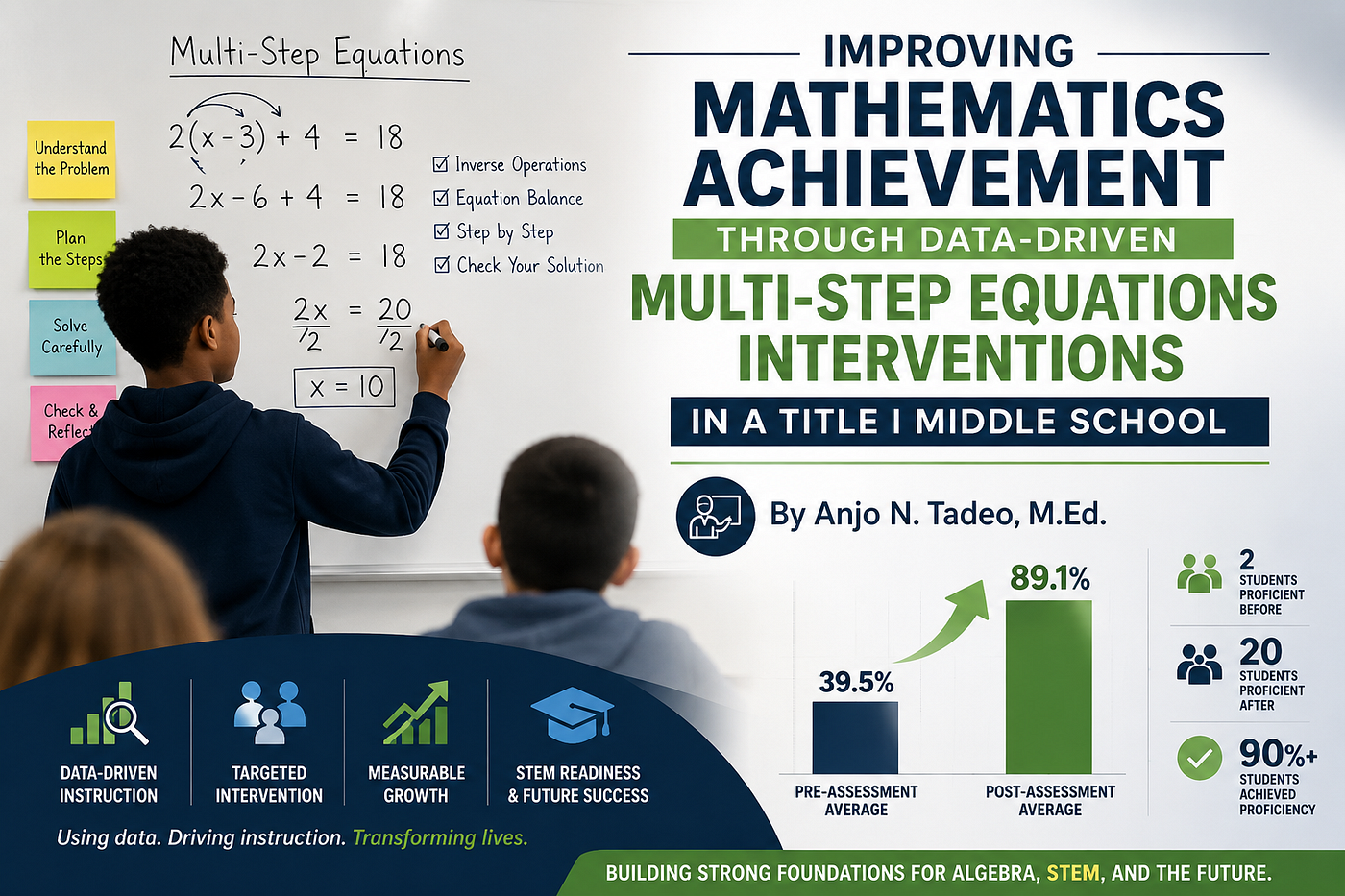
The results revealed significant learning gaps. The class average on the pre-assessment was approximately 39.5%, with only two students demonstrating proficiency at the 80% mastery level or higher. More than half of the students scored below 40%, indicating substantial deficiencies in foundational algebraic reasoning.
The data confirmed the need for immediate intervention and highlighted specific areas requiring instructional support.
Designing a Data-Driven Intervention
Following analysis of the assessment data, I implemented a structured intervention model centered on four key components:
1. Explicit Instruction
Students received direct instruction emphasizing the reasoning behind each step of solving an equation rather than simply memorizing procedures. Particular attention was given to inverse operations, equation balance, and mathematical justification.
2. Small-Group Targeted Support
Students were grouped according to specific learning needs identified through assessment data. Small-group sessions allowed for focused remediation of misconceptions and individualized feedback.
3. Scaffolded Practice
Complex problems were broken into manageable steps, allowing students to build confidence while gradually increasing the level of rigor and independence.
4. Continuous Progress Monitoring
Frequent formative assessments, exit tickets, and classroom observations were used to monitor student understanding and adjust instruction accordingly.
This approach ensured that instructional decisions were driven by student performance data rather than assumptions about student learning.
Student Achievement Outcomes
Following implementation of the intervention, students completed a post-assessment measuring mastery of the same standards.
The results demonstrated substantial growth.
The class average increased from 39.5% to 89.1%, representing a gain of nearly 50 percentage points.
Student proficiency also increased dramatically. While only two students demonstrated mastery on the pre-assessment, twenty students achieved proficiency at or above the 80% level on the post-assessment.
In addition:
- Ten students earned perfect scores.
- Seventeen students scored 90% or higher.
- More than 90% of students achieved proficiency.
Several students who initially scored between 0% and 30% improved to mastery levels of 90% to 100%.
These outcomes demonstrated that targeted intervention, when informed by data and implemented consistently, can significantly improve student achievement even in high-need educational settings.
Why Multi-Step Equations Matter
Multi-step equations are far more than an isolated middle school skill. They represent a foundational component of algebraic thinking and prepare students for future success in:
- Algebra I and Algebra II
- Geometry
- Advanced mathematics courses
- Science and engineering pathways
- Computer science and technology fields
When students develop confidence and proficiency in algebraic reasoning, they are better positioned to pursue future STEM opportunities and career pathways.
For this reason, improving mastery of foundational algebra concepts should remain a priority for educators seeking to strengthen STEM readiness and educational equity.
Lessons Learned
Several important lessons emerged from this intervention:
Data Must Drive Instruction
Assessment data provides valuable insight into student misconceptions and allows educators to allocate instructional resources more effectively.
Differentiation Matters
Students learn at different rates and require different levels of support. Flexible grouping and targeted interventions can accelerate growth for struggling learners.
High Expectations Produce Results
Students often exceed expectations when provided with appropriate support, clear goals, and opportunities to demonstrate growth.
Collaboration Strengthens Impact
Sharing successful instructional practices through Professional Learning Communities and teacher collaboration expands the impact of effective strategies beyond a single classroom.
Conclusion
The results of this intervention reaffirm the power of data-driven instruction and targeted mathematics support. Through strategic assessment, differentiated intervention, and continuous progress monitoring, significant gains in student achievement can be achieved.
As educators, our responsibility extends beyond delivering content. We must continuously seek innovative and evidence-based approaches that help all students succeed, particularly those in high-need educational environments.
By identifying learning gaps and responding with purposeful instructional action, we can improve mathematics achievement, strengthen STEM readiness, and create greater educational opportunities for the students we serve.
메타데이터
- post_id
- 9e7554cf2ce5
- slug
- improving-mathematics-achievement-through-data-driven-multi-step-equations-interventions-in-a-title-9e7554cf2ce5
- url
- https://medium.com/illumination/improving-mathematics-achievement-through-data-driven-multi-step-equations-interventions-in-a-title-9e7554cf2ce5
- canonical_url
- https://medium.com/illumination/improving-mathematics-achievement-through-data-driven-multi-step-equations-interventions-in-a-title-9e7554cf2ce5
- author_url
- https://medium.com/@tadeoanjo28
- status
- ok
- fetched_at
- 2026-07-23 06:39:59