3D Websites
3D Websites Are Changing the Way We Experience the Web
3D Websites
3D Websites Are Changing the Way We Experience the Web
For years, websites were designed around a simple formula:
Text + Images + Buttons + Navigation.
But the web is entering a new phase.
Today, brands are experimenting with 3D interfaces, immersive animations, interactive objects, cinematic scrolling and spatial experiences that make a website feel less like a document and more like a digital product.
The rise of powerful GPUs, modern browsers, WebGL, WebGPU and JavaScript 3D frameworks has made these experiences increasingly practical.
And this is not simply about making websites “look cool.”
3D is becoming a new storytelling medium for brands.
What Is a 3D Website?
A 3D website uses real-time graphics, depth, motion, lighting and interaction to create a more immersive digital experience.
Instead of simply showing a product image, for example, a website could allow users to:
- Rotate a product
- Explore it from different angles
- Zoom into details
- Change materials or colours
- Interact with components
- Navigate through a 3D environment
- Trigger animations through scrolling
- Experience cinematic transitions
The browser becomes more than a place to read information.
It becomes an environment to explore.
Why Are 3D Websites Becoming Popular?
There are three major reasons.
1. Browsers are becoming more powerful
Modern browsers can access GPU capabilities directly through technologies such as WebGL and WebGPU.
WebGL allows websites to render interactive 2D and 3D graphics using the GPU.
WebGPU takes this further by providing a more modern GPU architecture designed for high-performance graphics and computation. It is now supported across major browsers, although developers still need to consider compatibility carefully.
2. Users expect richer digital experiences
People are accustomed to highly interactive experiences from:
- Gaming
- AR/VR
- Apple Vision Pro-style interfaces
- Product configurators
- Interactive apps
- Motion-driven social media
- AI interfaces
A static website can sometimes feel surprisingly old-fashioned compared with these experiences.
3. Brands need differentiation
There are millions of websites using similar templates.
A unique interactive experience can help a brand communicate:
“We are different.”
That’s particularly valuable for technology companies, architecture firms, premium products, creative agencies, automotive brands, startups and luxury businesses.
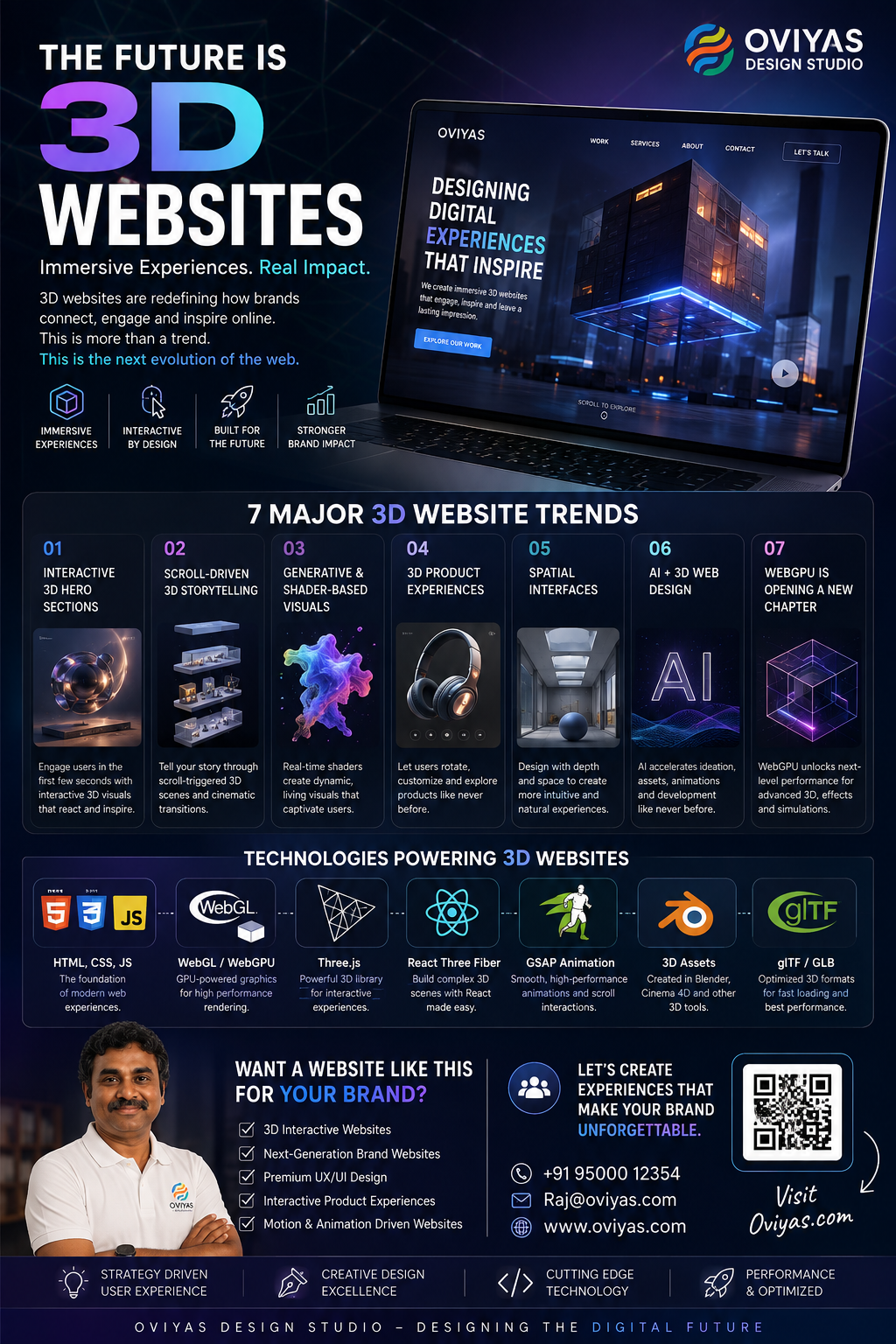
7 Major 3D Website Trends
1. Interactive 3D Hero Sections
The traditional hero section is evolving.
Instead of:
Headline + Image + CTA
we are seeing:
Headline + Interactive 3D Environment + Motion + Storytelling
A product might rotate as the visitor moves the mouse.
A 3D object might react to cursor movement.
A camera might move through an environment as the user scrolls.
The first few seconds of a website can become an experience rather than an introduction.
2. Scroll-Driven 3D Storytelling
Scrolling is no longer simply about moving down a page.
It can control the experience.
As the visitor scrolls:
Scene 01 → Scene 02 → Scene 03 → Scene 04
A product could assemble itself.
A camera could move around a 3D model.
A building could transform from wireframe to completed architecture.
A technology company could visually demonstrate how its product works.
This creates a powerful combination:
UX + Motion + 3D + Storytelling.
3. Generative and Shader-Based Visuals
Another interesting direction is procedural graphics.
Instead of using a traditional image or video, developers can create visual effects mathematically using shaders.
This can produce:
- Liquid effects
- Particles
- Noise
- Glowing surfaces
- Distortions
- Waves
- Dynamic gradients
- Smoke-like effects
- Interactive backgrounds
The result can feel alive because the visual is being generated and rendered in real time.
Three.js is particularly useful here because it provides higher-level tools for scenes, lighting, materials, textures and 3D mathematics on top of lower-level WebGL capabilities.
4. 3D Product Experiences
E-commerce is another area where 3D can make a major difference.
Imagine buying:
A car
Instead of looking at five photographs, you could:
- Rotate the car
- Change the colour
- Change wheels
- Open doors
- Explore the interior
- View different configurations
The same principle works for:
Furniture Jewellery Electronics Architecture Industrial equipment Fashion Consumer products
3D turns product presentation into product interaction.
5. Spatial Interfaces
Another emerging direction is spatial design.
Instead of thinking only in terms of flat screens, designers are beginning to think about:
Depth Distance Layers Movement Objects Space
This is especially relevant as AR, VR and spatial computing continue to evolve.
The same design thinking can influence traditional websites.
Buttons can feel physical.
Cards can have depth.
Objects can exist in 3D space.
Navigation can become an interactive environment.
6. AI + 3D Web Design
AI is also changing the workflow behind 3D websites.
Designers and developers can now use AI to accelerate:
- Concept generation
- 3D asset ideation
- Texture creation
- Image generation
- Code generation
- Animation concepts
- UX exploration
- Content creation
- Prototyping
This doesn’t mean AI replaces designers or developers.
Instead, it reduces the time between:
Idea → Prototype → Experiment → Production
That makes sophisticated web experiences more accessible to smaller teams.
7. WebGPU Is Opening a New Chapter
One of the most important technologies to watch is WebGPU.
WebGPU provides modern GPU access for both graphics and general-purpose computation. It is designed to work more closely with today’s GPU architectures than the older WebGL model.
This opens possibilities for more advanced:
- 3D rendering
- Particle systems
- Simulations
- Data visualization
- AI workloads
- Image processing
- Interactive environments
However, WebGPU should not automatically replace WebGL in every project. Browser support and implementation maturity still need to be considered, and WebGL remains an important compatibility option.
The smart approach is not:
“Use the newest technology everywhere.”
It is:
“Use the right technology for the experience.”
What Technologies Power a Modern 3D Website?
A typical modern 3D web project can combine several technologies.
Frontend
HTML + CSS + JavaScript
The foundation of the experience.
3D Rendering
WebGL / WebGPU
Used to render graphics using the user’s GPU.
3D Framework
Three.js
One of the most popular JavaScript libraries for building 3D experiences on the web.
React-Based 3D
React Three Fiber
Useful when the 3D experience is part of a larger React application.
Animation
GSAP
Useful for sophisticated timeline-based animation and scroll-driven experiences.
3D Assets
Blender / Cinema 4D / other 3D tools
Used to create and prepare models.
3D Formats
glTF / GLB
Common formats for delivering optimized 3D assets to the browser.
Shaders
GLSL / TSL / WGSL
Used to create advanced GPU-driven visual effects.
The technology stack can become extremely sophisticated.
But the visitor doesn’t care what technology is underneath.
They care about the experience.
The Biggest Mistake: Adding 3D Just Because You Can
This is where many brands get it wrong.
A website doesn’t become better simply because it has 3D.
Bad 3D can actually make a website:
❌ Slow ❌ Confusing ❌ Difficult to navigate ❌ Hard to use on mobile ❌ Distracting ❌ Inaccessible
The goal should never be:
“Let’s put 3D on our website.”
The better question is:
“Where can interaction, depth and motion improve the user’s understanding of our brand or product?”
That’s a UX question.
Performance Is Part of the Design
A beautiful 3D website that takes 15 seconds to load is not a great website.
Professional 3D web development requires careful attention to:
- Model optimization
- Texture compression
- Lazy loading
- Level of detail
- GPU performance
- Mobile performance
- Animation complexity
- Image optimization
- Progressive loading
- Fallback experiences
A good 3D website should feel fast, not heavy.
This is where UX designers and developers need to work together.
3D + UX: Where the Real Opportunity Lies
The most exciting part of this trend isn’t the technology.
It’s the combination of:
UX Design + Visual Design + Motion + 3D + Storytelling + Technology
A UX designer asks:
What does the user need?
A visual designer asks:
How should it look?
A motion designer asks:
How should it behave?
A 3D designer asks:
How should it exist in space?
A developer asks:
How can we make it work efficiently?
When all five work together, the website becomes more than a collection of pages.
It becomes a digital experience.
This Is the Direction We Are Exploring at Oviyas
At Oviyas, we believe the next generation of websites shouldn’t simply present information.
They should create experiences around brands.
Our approach combines:
**UX/UI Design
- Creative Direction
- 3D Experiences
- Motion
- Interactive Development
- Modern Web Technology**
We recently launched our own next-generation website experience to explore what is possible when traditional web design meets interactive 3D.
Want a Website Like This for Your Brand?
Your website is often the first experience people have with your business.
Why make it look like everyone else’s?
If you’re looking for a:
✨ 3D Interactive Website 🚀 Next-Generation Brand Website 🎨 Premium UX/UI Website 🌐 Interactive Product Experience ⚡ Motion & Animation-Driven Website
Let’s build something memorable.
Your brand deserves more than a template.
Let’s create a digital experience designed specifically for your brand.
📞 +91 95000 12354 📩 Raj@oviyas.com
OVIYAS — Designing the Digital Future.
Suggested Medium Tags
Web Design · 3D Web Design · UX Design · Web Development · Three.js · WebGPU · Creative Technology · Interaction Design · Digital Experience · Future of Web Design
Suggested Medium headline:
3D Websites Are the Future of Web Design: Trends, Technologies & What Brands Need to Know
Suggested subtitle: From Three.js and WebGL to WebGPU, shaders and AI — how immersive 3D experiences are transforming modern websites.
메타데이터
- post_id
- adb81ee0faf3
- slug
- 3d-websites-adb81ee0faf3
- url
- https://medium.com/@rajkumarsreeni/3d-websites-adb81ee0faf3
- canonical_url
- https://medium.com/@rajkumarsreeni/3d-websites-adb81ee0faf3
- author_url
- https://medium.com/@rajkumarsreeni
- status
- ok
- fetched_at
- 2026-08-15 16:30:46


