Generative Refinement Networks (GRN): Toward More Efficient Visual Generation
The progress in image generation over the past few years has been undeniable. Models can now produce visuals that are often…
Generative Refinement Networks (GRN): Toward More Efficient Visual Generation
The progress in image generation over the past few years has been undeniable. Models can now produce visuals that are often indistinguishable from real images. Yet, behind this progress lies a structural inefficiency that is easy to overlook: most models either over-compute or under-represent.
Generative Refinement Networks (GRN) are built around addressing this exact imbalance. Rather than introducing a single isolated improvement, GRN reorganizes the entire generation pipeline:
- how images are represented
- how they are generated
- how computation is distributed.
Source Image
The Structural Trade-off in Modern Generative Models
To understand GRN clearly, we need to look at the limitations of the two dominant paradigms.
Diffusion Models: High Quality, Fixed Effort
Diffusion models generate images by gradually denoising from noise through a fixed number of steps. This process is systematic.
Every image, regardless of complexity, undergoes the same number of steps
- Computation is uniformly distributed across all regions
- Simple patterns and highly detailed textures are treated equally
This leads to inefficiency. A large portion of computation is often spent where it is not needed.
Autoregressive Models: Adaptive but Information-Constrained
Autoregressive (AR) models generate images token by token, adapting naturally to complexity.
- They assign probabilities step by step
- They focus more on uncertainty regions
- They are inherently complexity-aware
However, this comes at a cost:
- Images must be converted into discrete tokens
- This conversion introduces information degradation during discretization
- Errors accumulate across generation steps
So while AR models are efficient in principle, their representation limits their performance.
GRN’s Position: Combine Strengths, Remove Weaknesses
GRN does not attempt to replace one paradigm with another. Instead, it integrates key strengths:
- From diffusion → high-quality generation
- From AR models → adaptive computation
And then resolves their core issues through three main contributions:
- Hierarchical Binary Quantization (HBQ)
- Global Iterative Refinement
- Entropy-Guided Adaptive Sampling
Hierarchical Binary Quantization (HBQ): Fixing Representation at the Root
The first major idea in GRN is improving how images are represented before generation even begins.
Traditional tokenization compresses images into discrete units, often sacrificing fine-grained detail. HBQ takes a different approach:
- It builds a hierarchical binary structure
- It encodes information across multiple levels
- It preserves detail progressively rather than compressing it abruptly
Why this matters
Representation defines the upper limit of generation quality. If important information is lost early, no refinement process can fully recover it.
HBQ is designed to be near-lossless, meaning:
- Reconstruction quality remains very high
- Latent space remains expressive
- Downstream generation has a stronger foundation
In effect, HBQ removes one of the most persistent bottlenecks in AR-based systems.
Global Iterative Refinement: Generation as Continuous Improvement
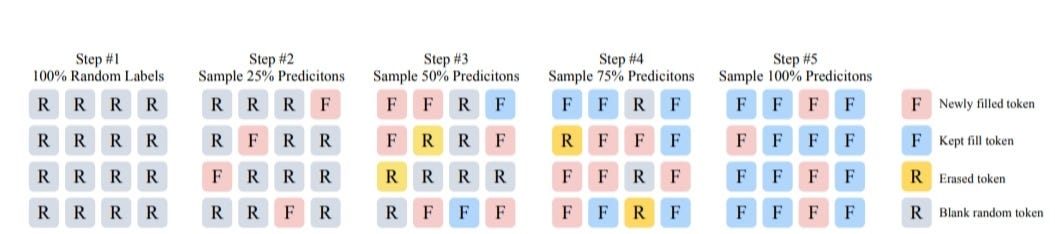
GRN shifts generation from a one-pass or fixed-step process to a refinement-driven loop.
Instead of committing to early predictions, the model:
- Produces an initial approximation
- Evaluates inconsistencies or missing details
- Refines the output iteratively
- Repeats until convergence
What this solves
- Error accumulation is reduced because mistakes are corrected
- Global consistency improves as the entire image is refined, not just local patches
- Flexibility increases, allowing the model to revisit earlier decisions
This mechanism is fundamentally different from both:
- Diffusion (fixed forward trajectory)
- AR (strict sequential dependency)
It introduces a feedback loop into generation.
Entropy-Guided Sampling: Making Computation Adaptive
One of the most practical innovations in GRN is how it allocates computational effort.
Instead of fixed steps, GRN uses entropy as a signal of uncertainty or complexity.
How it works
- Regions with low entropy → already predictable → fewer updates
- Regions with high entropy → uncertain or complex → more refinement
Impact
- Reduces unnecessary computation
- Focuses effort where it matters most
- Maintains quality without uniform processing
This makes GRN inherently compute-aware, something diffusion models lack and AR models only partially achieve.
Integration: How These Components Work Together
The strength of GRN lies not in individual components, but in how they interact:
- HBQ ensures high-quality representation
- Refinement ensures progressive correction
- Entropy ensures efficient computation
Together, they form a system where:
- Representation is preserved
- Generation is flexible
- Computation is targeted
This alignment across stages is what allows GRN to scale effectively.
Empirical Results: Evidence of the Design
GRN demonstrates strong performance on standard benchmarks:
- ImageNet Reconstruction: 0.56 rFID
- Class-Conditional Generation: 1.81 gFID
These metrics indicate:
- High fidelity in reconstruction
- Strong generative quality
More importantly, GRN extends beyond controlled benchmarks:
Extended Capabilities
- Text-to-image generation
- Text-to-video generation
This shows that the framework is not tied to a single task but generalizes across modalities.
A Process-Level Shift in Generative Modeling
GRN introduces a deeper shift in how we think about generation:
Traditional View
- Generate once, refine minimally
- Use fixed computation
- Accept representation loss
GRN View
- Generate → evaluate → refine → repeat
- Allocate computation dynamically
- Preserve information from the start
This is a move from static generation pipelines to adaptive generation systems.
Why This Matters Going Forward
As generative models scale, efficiency becomes as important as quality.
GRN suggests a direction where:
- Models are aware of their own uncertainty
- Computation is treated as a resource to allocate, not a fixed budget
- Generation becomes an iterative reasoning-like process
This is particularly important for:
- Real-time generation systems
- Resource-constrained environments
- Large-scale deployment of generative models
Final Perspective
Generative Refinement Networks are not just about improving metrics—they reshape the structure of generation itself.
They show that:
- Better outputs come from better processes
- Efficiency comes from awareness, not reduction
- Quality improves when models are allowed to refine, not just predict
In simple terms, GRN moves image generation closer to a system that builds, checks, and improves, rather than one that simply produces.
메타데이터
- post_id
- ae85ac9fe40e
- slug
- generative-refinement-networks-grn-toward-more-efficient-visual-generation-ae85ac9fe40e
- url
- https://medium.com/@ml-point/generative-refinement-networks-grn-toward-more-efficient-visual-generation-ae85ac9fe40e
- canonical_url
- https://medium.com/@ml-point/generative-refinement-networks-grn-toward-more-efficient-visual-generation-ae85ac9fe40e
- author_url
- https://medium.com/@ml-point
- status
- ok
- fetched_at
- 2026-06-09 15:37:30






