How to Overcome Panic Attacks: The Complete Guide to a Calmer Mind
I remember the first time I truly understood what a panic attack felt like from the inside.
How to Overcome Panic Attacks: The Complete Guide to a Calmer Mind
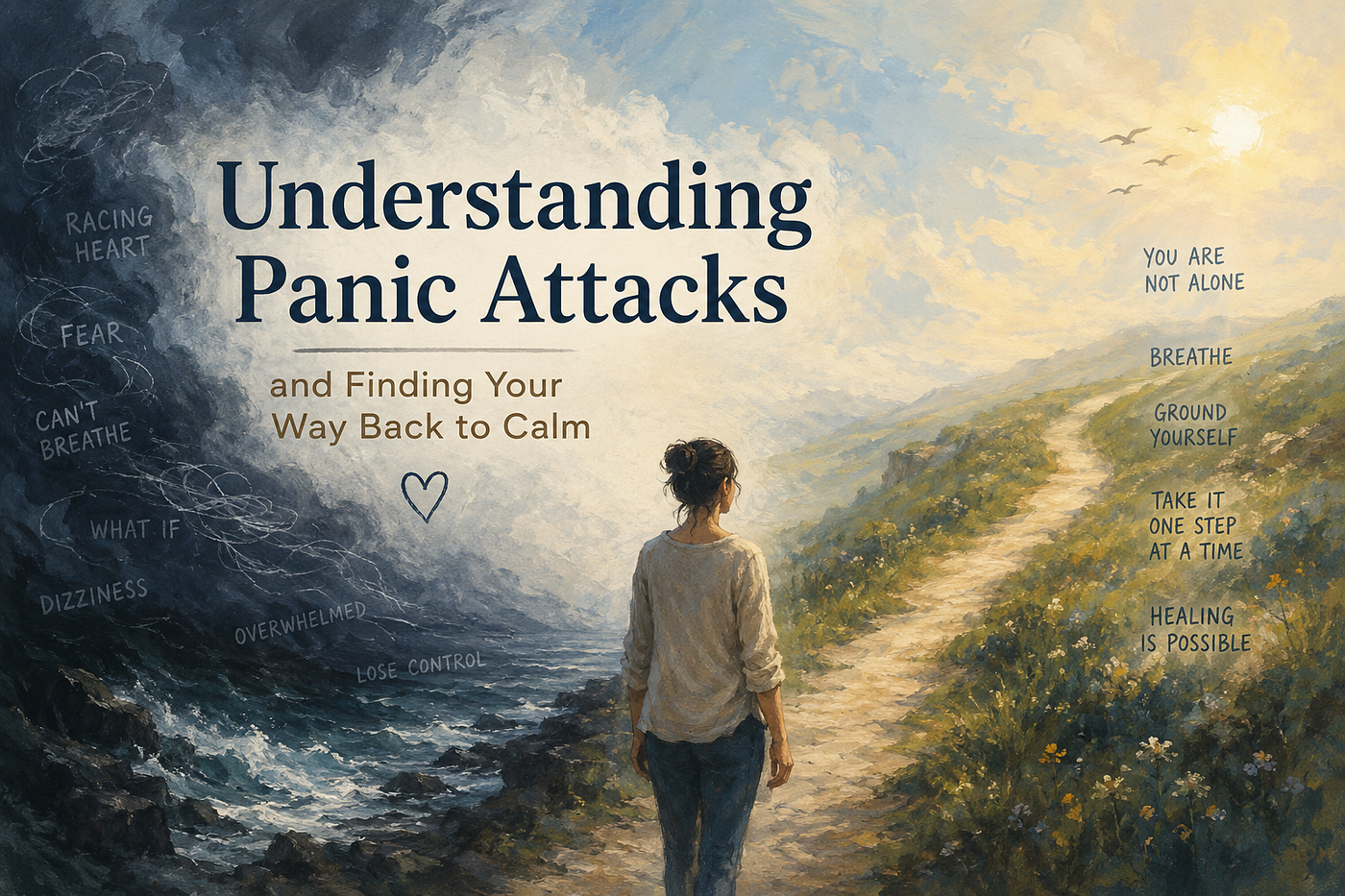
I remember the first time I truly understood what a panic attack felt like from the inside.
I was sitting with a client, a highly functional, deeply self-aware person, and they described feeling like the walls were closing in while they were sitting at their kitchen table, doing absolutely nothing. Their heart was slamming. They could not catch their breath. They were convinced something was medically wrong.
Nothing was medically wrong. But that did not make the experience any less real.
As someone whose background sits at the intersection of psychology and nervous system science, I have spent a lot of time thinking about panic attacks, not just clinically, but humanly. What they feel like. Why they happen. And most importantly, what actually helps.
This is that guide.
Part 1: Understanding Panic Attacks
Let’s start with the basics, because understanding what is actually happening is one of the most powerful things you can do.
A panic attack is not “just anxiety.” It is a sudden, intense surge of physical and emotional symptoms that peaks within minutes. Racing heart. Shortness of breath. Dizziness. Chest tightness. A desperate, clawing sense that something is terribly wrong.
Some people feel like they are dying. Others feel like they are going insane. Many feel completely detached from their surroundings, like watching life through glass.
All of it is real. And none of it is dangerous.
One of the most important things to understand is what a panic attack is NOT. It is not a heart attack, even when it feels like one. It is not the same as an anxiety attack, though the two often get lumped together. And it is absolutely not a sign that you are weak or broken.
Read more:
- What Is a Panic Attack? (And What It’s Not)
- 10 Common Panic Attack Symptoms Explained
- Panic Attack vs Anxiety Attack: What’s the Difference?
Part 2: Why It Happens (Even When Nothing Is Wrong)
This is the part that confuses most people.
You were not in danger. You were not doing anything stressful. You might have been half asleep, or watching TV, or just going about your day. And then your body sounded every alarm at once.
Here is what is happening beneath the surface.
Your brain has a built-in alarm system, centered in a small structure called the amygdala. Its job is to detect threats and mobilize your body to respond. It is incredibly fast. And it is not especially precise.
When this alarm misfires, it sends a flood of adrenaline and cortisol into your system. Your heart speeds up. Your breathing changes. Blood rushes to your limbs. Your senses sharpen. All of this is designed to help you escape a predator. But when there is no predator? It just feels like chaos.
Here is the cruel part: once you have had one panic attack, the memory of it becomes a threat in itself. Your body starts scanning for signs that another one might be coming. A slightly elevated heart rate. A dizzy spell. A slightly off breath. And the alarm sounds again.
This is the panic-about-panic loop. Understanding it is the first real step in breaking it.
Read more:
- Why Panic Attacks Happen (Even When Nothing Is Wrong)
- The Role of Fear and the Body’s Alarm System
- Why Panic Attacks Feel Like You’re Losing Control
Part 3: How to Overcome It (Step by Step)
This is where people often go wrong. They try to fight the panic.
They tense up. They resist. They try to logic their way through it. And the harder they fight, the louder the alarm gets.
The counterintuitive truth is that allowing the sensations, rather than fighting them, is what actually helps. Your nervous system is not your enemy. It is trying to protect you. When you stop treating it like a threat, it starts to stand down.
Practically, here is how that looks in the moment.
Slow your breath first. Extended exhales activate the parasympathetic nervous system. Inhale for 4 counts. Hold for 4. Exhale for 6. Repeat. Even once or twice can interrupt the spiral.
Then, ground yourself. Use your senses to pull your attention into the present. What do you see? What do you hear? What does the ground feel like under your feet? This is not a distraction technique. It is a nervous system signal that says: right now, I am safe.
Finally, change your internal dialogue. Instead of “something is wrong with me,” try: “My body is doing something it was designed to do. It will pass. It always does.” This is not toxic positivity. It is accurate. Panic attacks do not last forever. The average peak is about 10 minutes.
Read more:
- What to Do During a Panic Attack (Step-by-Step)
- 6 Simple Grounding Techniques to Regain Control During a Panic Attack
- Panic Attack Relief: How to Help Your Body Feel Safe Again
If you want a calm, structured guide to take with you: I put together an ebook called Panic-Free: A Complete Guide. It is available as a free download, so it will not cost you anything to take the next step. [Download it free here.]
Part 4: Building Long-Term Change
Getting through a panic attack is one thing. Building a life where they happen less, and eventually barely at all, is something different. And it is possible.
Long-term recovery is about more than technique. It is about slowly rebuilding trust with your own body. It is about recognizing the habits, thought patterns, and avoidance behaviors that quietly keep the fear alive, and choosing different ones.
This does not happen overnight. But it does happen.
Daily habits make an enormous difference. Sleep quality matters. So does reducing caffeine, building a consistent breathing practice, getting regular gentle movement, and working on the internal narrative you carry about your own mind and body.
Small, consistent steps add up faster than you think.
Read more:
- How to Reduce Panic Attacks Over Time
- 8 Daily Habits That Can Help Prevent Panic Attacks
- How to Rebuild Trust in Your Body After Panic
A Final Word
If you are reading this in the middle of a hard season, I want you to know something.
What you are experiencing is real. It is not permanent. And you are not alone in it.
Panic attacks are one of the most common and most treatable experiences in mental health. Millions of people have been exactly where you are and have found their way to a calmer place. You can too.
Start with one thing. One breath. One article. One small act of care toward yourself.
Free Download: Panic-Free: A Complete Guide. Everything covered here, and much more, structured into one calm, accessible resource. No cost. Download it free here.
Browse the full resource hub: Panic Attacks: Everything You Need to Know.
Take a moment today to quiet the noise in your mind.
메타데이터
- post_id
- e4798b5f9e86
- slug
- how-to-overcome-panic-attacks-the-complete-guide-to-a-calmer-mind-e4798b5f9e86
- url
- https://medium.com/@michael_creating-quiet/how-to-overcome-panic-attacks-the-complete-guide-to-a-calmer-mind-e4798b5f9e86
- canonical_url
- https://medium.com/@michael_creating-quiet/how-to-overcome-panic-attacks-the-complete-guide-to-a-calmer-mind-e4798b5f9e86
- author_url
- https://medium.com/@michael_creating-quiet
- status
- ok
- fetched_at
- 2026-06-27 18:20:27