AEM as a Cloud Service 2025.12.0: Quiet Hours, Runtime Readiness, and Guardrails
What changed in the December 2025 AEM as a CS feature release — and how to test and adopt the operational controls and platform guardrails.
AEM as a Cloud Service 2025.12.0: Quiet Hours, Runtime Readiness, and Guardrails
What changed in the December 2025 AEM as a Cloud Service feature release — and how to test and adopt the operational controls and platform guardrails safely.
What Adobe Released
AEM as a Cloud Service — current feature release references (2025.12.0)
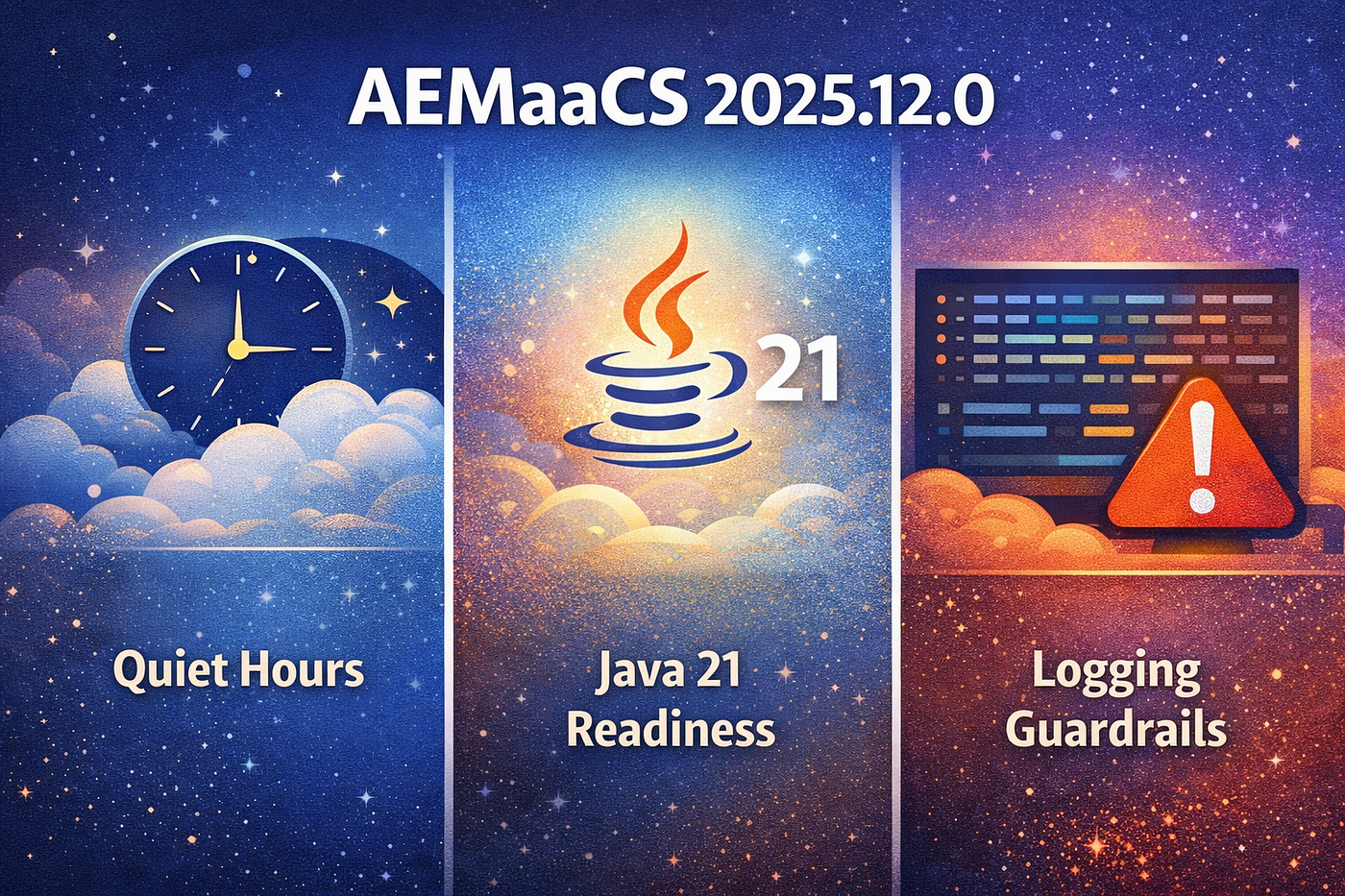
- Update-free periods (“quiet hours”) to limit automatic updates during defined windows (limited availability / enablement required).
- Ongoing Java 21 adoption guidance and related platform readiness (build/runtime guidance is documented under build environment/runtime requirements). Experience League
- Logging configuration policy tightening: certain Sling logging properties should not be customized; enforcement behavior is described in release notes. Experience League
- “Request for feedback” on edge computing use cases (explicitly framed as feedback, not a GA feature announcement). Experience League
Why Business Teams Should Care
- Operational governance: Quiet hours reduce risk of platform change during peak campaign windows (or critical editorial deadlines), which can lower incident probability and protect revenue-impacting periods.
- Change predictability: Java/runtime readiness and log-policy enforcement are the kind of “silent breakers” that show up as pipeline failures or monitoring blind spots. Getting ahead of them is cheaper than firefighting. Experience League
- Security posture: The direction is toward more standardized observability and controlled edge behavior, which usually maps to stronger auditability and lower operational variance. Experience League
Developer Deep Dive
1) Implement and test “Quiet Hours” (update-free periods)
What it is: A Cloud Manager capability to keep automatic updates from applying during specified windows; it’s described as limited availability and requires Adobe enablement.
Step-by-step to test
- Request enablement (limited availability) using the process described by Adobe (the doc indicates contacting Adobe for enablement).
- Once enabled, in Cloud Manager go to: Activities → Automatic Updates → Update Options.
- Enable “Update-free period”, then define:
- timezone
- days
- start/end times
- any maximum duration/constraints indicated by the UI/documentation
- Validate behavior by checking Cloud Manager activity/audit trail around scheduled update windows and confirming updates do not apply during the quiet period.
Step-by-step to implement
- Treat quiet hours like a release-management policy: document the windows (e.g., “Mon–Fri 10:00–22:00 IST”).
- Align the quiet hours with:
- campaign calendar
- support coverage hours
- release train windows
- Revisit quarterly: seasonal peaks change.
2) Java 21 readiness (build/runtime)
Adobe’s AEMaaCS release notes continue to point teams to Build Environment and Java 21 runtime requirements for the exact compatibility expectations and setup steps. Experience League
Step-by-step to test
- In a non-prod branch, update your build configuration per Build Environment guidance (Cloud Manager supports modern Java build options). Experience League
- Run a non-production pipeline and validate:
- compilation
- unit/integration tests
- OSGi startup sanity checks
- Smoke test critical flows (authoring, replication/publish, search, asset processing) in dev before stage.
Step-by-step to implement
- Roll forward in stages:
- local dev alignment → dev pipeline → stage → production
- Track and remediate:
- deprecated libs / bytecode assumptions
- custom integrations that pin older Java dependencies
- Use the “runtime requirements” doc as the final gate before promoting.
3) Logging policy enforcement (avoid unsupported Sling log overrides)
Adobe documents that AEM Java logs should keep consistent formatting and default file outputs, and explicitly calls out Sling logging properties that should not be modified. Experience League
Step-by-step to test
- Search your repo for OSGi configs touching:
- org.apache.sling.commons.log.LogManager (all properties)
- org.apache.sling.commons.log.LogManager.factory.config with:
- org.apache.sling.commons.log.file
- org.apache.sling.commons.log.pattern
- In a dev environment, deploy without those overrides and confirm:
- log forwarding/parsing still works
- dashboards aren’t dependent on custom patterns
Step-by-step to implement
- Remove unsupported overrides for product logging configuration, and keep any log-level tweaks limited to customer-developed code as described by Adobe.
- If you forward logs, make sure ingestion rules can handle default formats (Adobe explicitly warns about downstream ingestion impacts).
4) “Edge computing” feedback program (not GA)
Adobe’s release notes describe edge computing as a request for feedback with example use cases and an email channel. Experience League
Step-by-step to test / implement
- Not confirmed in official Adobe sources as a self-serve GA feature with documented implementation steps; the official guidance currently is to provide feedback via the listed email channel.
- Practical prep you can do now:
- Identify which edge use case you want (auth gating, personalization, middleware, etc.).
- Ensure your CDN governance is already clean (config pipelines, traffic rules discipline), because that’s the operational surface area that typically matters for edge controls.
Real-World Use Cases
- Editorial blackout windows: Quiet hours during live events or high-traffic campaigns.
- Regulated operations: Logging policy standardization reduces monitoring variance and supports auditability.
- Developer velocity with safety rails: Java/runtime readiness handled early avoids late-stage pipeline surprises.
What You Should Do Next
- Request enablement and configure quiet hours for your highest-risk windows.
- Run a Java readiness sprint: align local/dev/stage builds to documented expectations.
- Audit logging configs in Git and remove unsupported Sling logging overrides before enforcement affects you. Experience League
- If edge computing is important, engage the feedback channel with a concrete use case and constraints. Experience League
References (official Adobe URLs)
- Current AEM as a Cloud Service release notes: Experience League
- Quiet Hours / Update-free periods:
- Build Environment
- Java 21 runtime requirements
메타데이터
- post_id
- e4d5a05e8265
- slug
- aem-as-a-cloud-service-2025-12-0-quiet-hours-runtime-readiness-and-guardrails-e4d5a05e8265
- url
- https://medium.com/@kambam.bharath/aem-as-a-cloud-service-2025-12-0-quiet-hours-runtime-readiness-and-guardrails-e4d5a05e8265
- canonical_url
- https://medium.com/@kambam.bharath/aem-as-a-cloud-service-2025-12-0-quiet-hours-runtime-readiness-and-guardrails-e4d5a05e8265
- author_url
- https://medium.com/@kambam.bharath
- status
- ok
- fetched_at
- 2026-08-05 00:36:06