Top 10 Coding Languages Every Beginner Should Know
If you’re just getting started with coding, one of the first questions you’ll run into is this: which programming language should I learn?
Top 10 Coding Languages Every Beginner Should Know
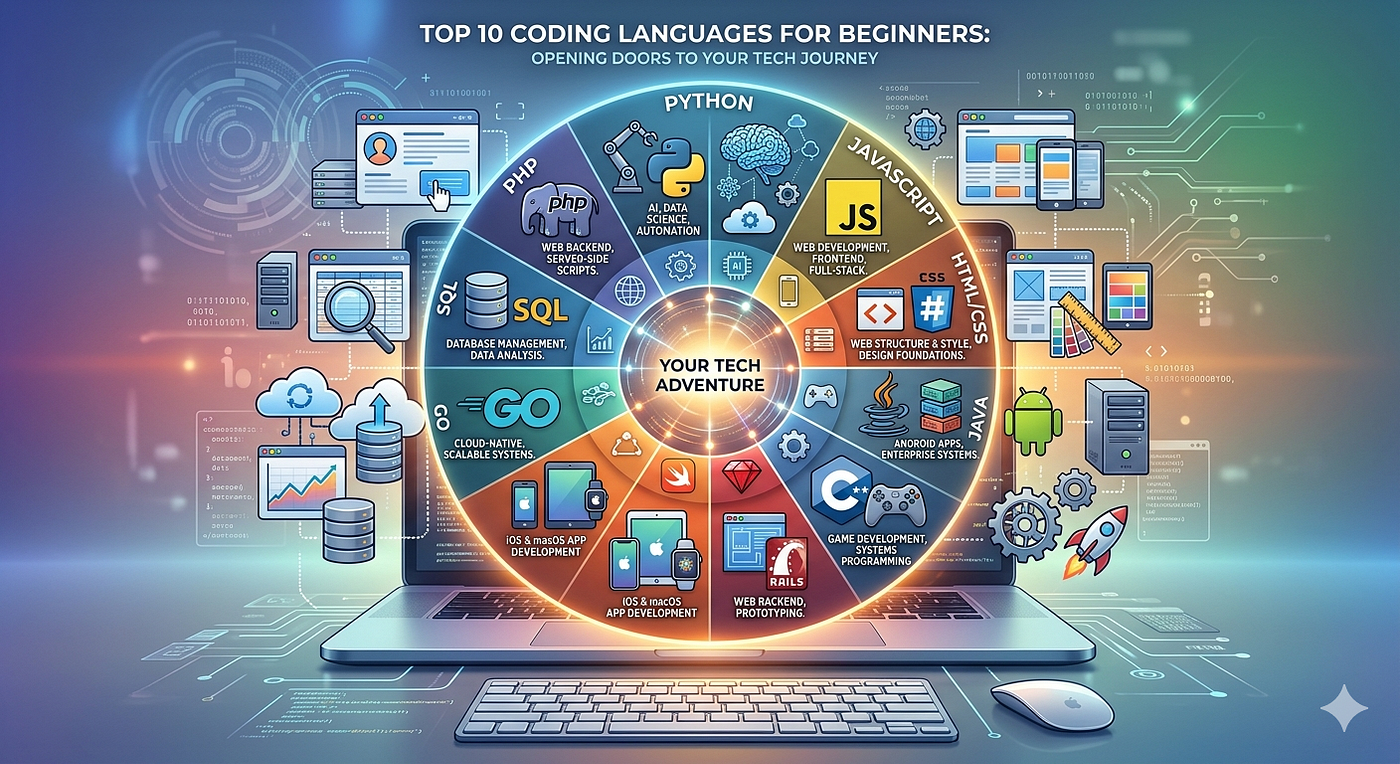
If you’re just getting started with coding, one of the first questions you’ll run into is this: which programming language should I learn?
There’s no shortage of options, and that’s exactly what makes it confusing. Each language has its own purpose, strengths, and learning curve. The good news is you don’t need to learn all of them at once. You just need to understand what they’re used for and pick a starting point that fits your goals.
This guide breaks down 10 beginner-friendly coding languages that are worth knowing and why they matter.
Why Choosing the Right Language Matters
The language you start with can shape your early experience.
A good beginner language should be:
- Easy to read and understand
- Widely used
- Supported by strong learning resources
Choosing the right one makes the process smoother and helps you build confidence early on.
1. Python
Python is one of the most popular programming languages for beginners.
Why it’s great:
- Simple and clean syntax
- Easy to read and write
- Used in many fields
What you can do with it:
- Data analysis
- Automation
- Web development
- Artificial intelligence
If you’re unsure where to start, Python is a safe and practical choice.
2. JavaScript
JavaScript is essential if you’re interested in building websites.
Why it’s great:
- Runs in every web browser
- Highly versatile
- Huge community and resources
What you can do with it:
- Create interactive websites
- Build web apps
- Develop front-end and back-end systems
If your goal is web development, JavaScript is a must-learn.
3. HTML
HTML (HyperText Markup Language) is not a programming language in the traditional sense, but it’s the foundation of web development.
Why it’s great:
- Very easy to learn
- Forms the structure of web pages
What you can do with it:
- Build the layout of websites
- Organize content
Every beginner interested in web development should start here.
4. CSS
CSS (Cascading Style Sheets) works alongside HTML.
Why it’s great:
- Controls the design and appearance of websites
- Easy to pick up for beginners
What you can do with it:
- Style web pages
- Create layouts and animations
Together, HTML and CSS allow you to build visually appealing websites.
5. Java
Java is a widely used programming language known for its stability.
Why it’s great:
- Strong performance
- Used in large-scale applications
- In-demand in many industries
What you can do with it:
- Android app development
- Enterprise software
- Backend systems
Java has a steeper learning curve but offers long-term value.
6. C++
C++ is a powerful language often used for performance-heavy applications.
Why it’s great:
- Fast and efficient
- Teaches deep programming concepts
What you can do with it:
- Game development
- System programming
- High-performance applications
It’s not the easiest for beginners, but it builds strong fundamentals.
7. C#
C# is developed by Microsoft and is widely used in application and game development.
Why it’s great:
- Clean syntax
- Strong integration with Microsoft tools
What you can do with it:
- Build desktop applications
- Develop games using Unity
- Create web applications
It’s a solid choice if you’re interested in game development.
8. Ruby
Ruby is known for its simplicity and readability.
Why it’s great:
- Beginner-friendly syntax
- Focus on productivity
What you can do with it:
- Web development (especially with Ruby on Rails)
- Rapid application development
Ruby is a good option if you want to build web applications quickly.
9. Swift
Swift is used for building apps in the Apple ecosystem.
Why it’s great:
- Designed for performance and safety
- Modern and easy to read
What you can do with it:
- iOS app development
- macOS applications
If you want to create apps for iPhones or iPads, Swift is the way to go.
10. Go (Golang)
Go is a newer language that has gained popularity for its simplicity and performance.
Why it’s great:
- Easy to learn compared to other system-level languages
- Fast and efficient
What you can do with it:
- Backend development
- Cloud-based systems
- Scalable applications
Go is a good choice if you’re interested in modern backend systems.
How to Choose the Right Language for You
You don’t need to learn all 10 languages. Start with one based on your goals.
Here’s a simple guide:
- Web development: HTML, CSS, JavaScript
- General-purpose and beginner-friendly: Python
- Mobile apps: Swift (iOS), Java (Android)
- Game development: C# or C++
- Backend systems: Java, Go, Python
Pick one path and focus on it.
Should You Learn Multiple Languages?
Eventually, yes.
But not at the beginning.
Learning one language well will make it easier to learn others later. The core concepts are similar across most languages.
Start with one, build a foundation, then expand.
Tips for Beginners
To make your learning process smoother:
- Practice regularly
- Build small projects
- Focus on fundamentals
- Avoid jumping between languages
- Be patient with yourself
Coding is a skill that improves over time.
Common Mistakes to Avoid
Many beginners slow their progress by:
- Trying to learn too many languages at once
- Watching tutorials without practicing
- Skipping the basics
- Expecting quick results
Avoid these, and you’ll move forward faster.
Final Thoughts
There’s no single “best” programming language for everyone.
The best language for you depends on your goals and what you want to build.
If you’re just starting out, keep it simple:
- Choose one language
- Learn the fundamentals
- Practice consistently
Over time, you’ll gain confidence and expand your skills.
The important part is not which language you choose, but that you start.
Because once you do, you open the door to a whole new set of opportunities.
메타데이터
- post_id
- ed850d26c3dc
- slug
- top-10-coding-languages-every-beginner-should-know-ed850d26c3dc
- url
- https://medium.com/@beastpleasure/top-10-coding-languages-every-beginner-should-know-ed850d26c3dc
- canonical_url
- https://medium.com/@beastpleasure/top-10-coding-languages-every-beginner-should-know-ed850d26c3dc
- author_url
- https://medium.com/@beastpleasure
- status
- ok
- fetched_at
- 2026-07-15 12:09:26