Why Databrick’s Photon Makes Spark SQL Faster
A Memory & Execution Perspective
Why Databrick’s Photon Makes Spark SQL Faster
A Memory & Execution Perspective
What Photon Really Is
Photon is not a Spark configuration or a library. It is a native, C++-based vectorized execution engine that replaces Spark’s JVM-based execution for SQL and DataFrame workloads.
In simple terms: Spark plans the query, Photon executes it.
Spark still handles:
- Query planning (Catalyst optimizer)
- Scheduling
- Task orchestration
- Metadata and lineage
Photon takes over:
- Joins
- Aggregations
- Filters
- Projections
- Sorts
- Delta Lake read/write execution
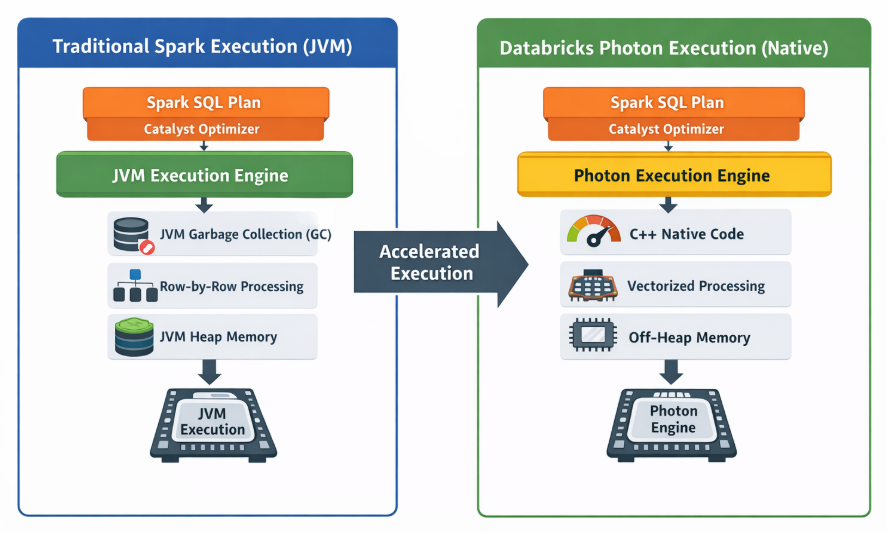
The Core Problem with JVM-Based Spark Execution Even with Tungsten:
- Execution happens in the JVM
- Data structures live in or near the heap
- GC must scan memory repeatedly
- Processing is still largely row-oriented
For large analytical queries, this leads to:
- GC pauses
- Higher memory pressure
- CPU underutilization
- Spills during joins and aggregations
What Photon Changes Under the Hood
1. Fully Off-Heap Native Execution
Photon executes operators in native memory, completely outside the JVM:
- No JVM heap allocation
- No garbage collection
- Deterministic memory release
This alone removes one of the biggest bottlenecks in Spark SQL.
2. Vectorized (Columnar) Processing
Instead of processing one row at a time, Photon processes batches of column values:
- Thousands of values per operation
- Fewer function calls
- Better CPU cache locality
This drastically reduces per-row overhead.
3. CPU-Level Optimizations (SIMD)
Photon uses modern CPU instructions:
- SIMD (AVX/AVX2)
- Cache-aligned memory access
- Tight native loops
As a result, a single CPU instruction can process multiple values at once, something JVM-based Spark cannot reliably achieve.
4. Native Hash Tables for Joins & Aggregations
In classic Spark:
- Join hash tables often live in JVM memory
- GC scans them repeatedly
- Pointer-heavy structures reduce performance
In Photon:
- Hash tables live entirely in native memory
- Compact, cache-friendly layouts
- No GC scanning
This makes joins and aggregations significantly faster and more memory-efficient.
5. Reduced Serialization & Shuffle Overhead
Photon keeps data in binary columnar format throughout execution:
- Less serialization/deserialization
- Fewer intermediate buffers
- More efficient shuffle pipelines
Even though shuffles still happen, they are cheaper and faster.
6. Operator Fusion
Photon fuses multiple operators (scan → filter → project → aggregate) into a single execution pipeline, reducing:
- Memory reads/writes
- Temporary buffers
- Peak memory usage
Why Queries Finish Faster
Photon improves performance in three fundamental ways:
- Less memory overhead → lower peak usage, fewer spills
- No GC pauses → stable and predictable execution
- Better CPU efficiency → higher throughput per node
Even with the same cluster size, jobs complete faster because memory is used more efficiently and released sooner.
What Photon Does NOT Accelerate
Photon does not speed up:
- Python UDFs
- RDD-based code
- Non-SQL JVM logic
- Driver-side operations
Photon accelerates only SQL, DataFrame API, and Delta Lake operations.
* Typical Performance Gains

Actual gains depend on data size, skew, and IO characteristics.
Spark with Photon = JVM control plane + native execution engine
- JVM handles what to run
- Photon handles how fast it runs
This separation is what allows Photon to eliminate JVM bottlenecks while keeping Spark’s flexibility.
메타데이터
- post_id
- eda039dfed8d
- slug
- why-databricks-photon-makes-spark-sql-faster-eda039dfed8d
- url
- https://medium.com/@hrishikeshgade/why-databricks-photon-makes-spark-sql-faster-eda039dfed8d
- canonical_url
- https://medium.com/@hrishikeshgade/why-databricks-photon-makes-spark-sql-faster-eda039dfed8d
- author_url
- https://medium.com/@hrishikeshgade
- status
- ok
- fetched_at
- 2026-08-21 17:08:42



