A2A (Agent-to-Agent) Protocol
The Missing Layer in Enterprise AI Architectures
A2A (Agent-to-Agent) Protocol
The Missing Layer in Enterprise AI Architectures
As enterprises rapidly operationalize AI agents across workflows, a new bottleneck is emerging — not model capability, but agent interoperability.
The A2A project addresses this exact gap. It proposes a standardized way for autonomous agents to discover, communicate, coordinate, and transact with each other — independent of vendor, runtime, or model provider.
This article breaks down:
- Why A2A is necessary (beyond APIs and microservices)
- Its architectural primitives
- How it fits into modern enterprise systems
- Design patterns for adoption
- Strategic implications for CTOs
The Problem: AI Silos Are the New Microservices Sprawl
Most organizations today are building:
- Task-specific agents (support, coding, analytics, ops)
- Tool-augmented LLM pipelines
- Event-driven workflows
But these systems are:
- Tightly coupled
- Context-isolated
- Coordination-poor
Even with REST/gRPC, you still face:
- No shared semantic understanding
- No autonomous negotiation between agents
- No dynamic capability discovery
- Manual orchestration glue everywhere
In short: We’ve recreated distributed systems complexity — now with probabilistic actors.
Why A2A Exists
A2A introduces a protocol layer for agent ecosystems, similar to:
- HTTP for web
- TCP/IP for networking
- Kafka for event streaming
But specifically designed for:
Autonomous, reasoning-capable, tool-using entities.
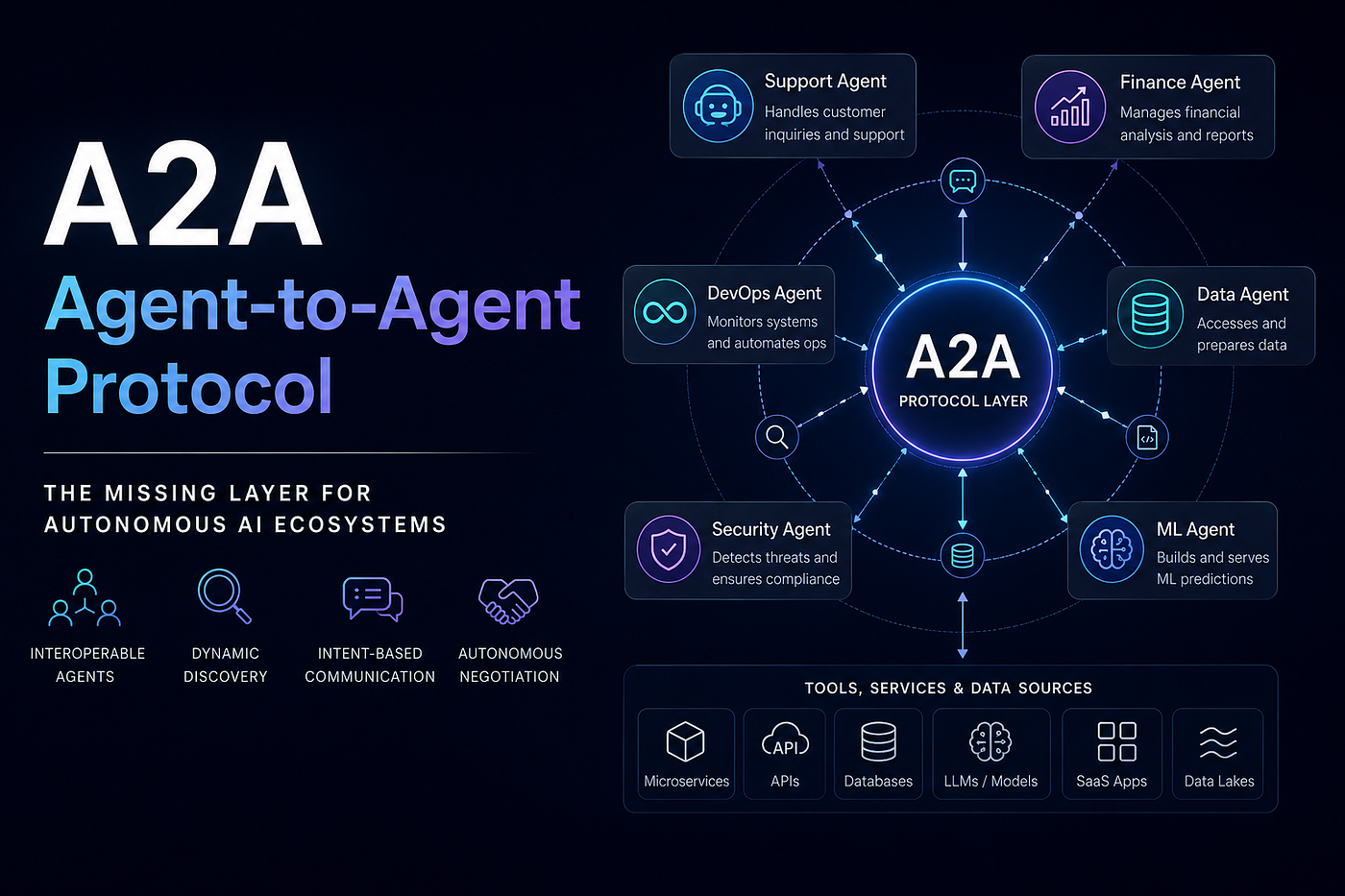
Core Design Goals
Interoperability
- Agents from different vendors can collaborate
Autonomy-first
- Agents negotiate instead of being orchestrated
Capability discovery
- Dynamic, runtime understanding of “what can you do?”
Composable intelligence
- Systems emerge from agent collaboration, not static workflows
Architectural Model

High-Level A2A Architecture (Conceptual)
1. Agent Identity & Capability Schema
Each agent exposes:
- Identity (ID, trust metadata)
- Capabilities (functions, tools, reasoning domains)
- Constraints (latency, cost, permissions)
Think of this as:
{
  "agent_id": "fraud-detector-v3",
  "capabilities": ["anomaly_detection", "transaction_scoring"],
  "constraints": {
    "latency_ms": 200,
    "cost_per_call": 0.002
  }
}
This replaces:
- Hardcoded service contracts
- Static OpenAPI specs
2. Message Protocol (Agent-to-Agent)
Instead of REST calls, A2A enables:
- Intent-based communication
- Context-rich payloads
- Multi-turn negotiation
Example abstraction:
{
  "intent": "analyze_transaction",
  "context": {
    "transaction_id": "123",
    "risk_level": "unknown"
  },
  "expected_outcome": "risk_score"
}
This is fundamentally different from:
- RPC → “execute function”
- A2A → “achieve outcome”
3. Negotiation Layer
One of the most powerful concepts.
Agents can:
- Refuse requests
- Delegate to other agents
- Propose alternative execution strategies
- Optimize for cost, latency, or accuracy
This introduces:
Market-like dynamics inside your architecture
4. Discovery & Routing
Agents can:
- Discover peers dynamically
- Select best-fit collaborators
- Route tasks without centralized orchestration
This reduces reliance on:
- Workflow engines
- Hardcoded pipelines
How A2A Fits into Enterprise Architecture
Traditional Stack
- Frontend
- Backend services
- APIs
- Databases
- Event buses
With A2A Layer
You introduce:
[ Agents Layer ]
        ↑
[ A2A Protocol Layer ]
        ↑
[ Existing Services / Tools / Models ]
Agents become:
- Intelligent wrappers over services
- Decision-makers, not just executors

Layered Enterprise Architecture with A2A
Key Architectural Patterns
1. Agent Mesh (Decentralized Intelligence)
Instead of:
- Central orchestrator
You get:
- Peer-to-peer agent collaboration
Use cases:
- Incident response systems
- Multi-domain analytics
- Autonomous DevOps
2. Brokered Intelligence (Hybrid Control)
Introduce a broker agent:
- Manages trust
- Applies governance
- Observes interactions
Balances:
- Autonomy vs control
3. Capability Marketplaces
Agents publish capabilities:
- Other agents “bid” or “select”
Enables:
- Internal AI marketplaces
- Cost-aware execution
- Plug-and-play innovation
4. Federated Enterprise AI
Across business units:
- Finance agents
- Risk agents
- Marketing agents
A2A allows:
- Cross-domain collaboration without tight coupling
Why APIs Alone Are Not Enough

APIs assume:
“You know exactly what service to call.”
A2A assumes:
“Figure out who can best solve this.”
Governance & Control Considerations
CTOs should not overlook:
1. Trust & Identity
- Agent authentication
- Capability verification
- Zero-trust enforcement
2. Observability
- Multi-agent tracing
- Decision audit trails
- Emergent behavior monitoring
3. Cost Explosion Risk
Autonomous agents can:
- Over-call
- Loop
- Over-negotiate
Mitigation:
- Budget constraints
- Rate limiting
- Policy engines
Integration Strategy (Practical Approach)
Phase 1: Agent Wrapping
Wrap existing services as agents:
- Keep APIs
- Add capability metadata
Phase 2: Introduce A2A Communication
Allow agents to:
- Call each other via A2A instead of direct APIs
Phase 3: Enable Autonomy
- Remove hardcoded workflows
- Let agents decide routing
Phase 4: Optimize
- Introduce negotiation policies
- Add governance layers
Real-World Use Cases
1. Autonomous DevSecOps
Agents:
- Code reviewer
- Security scanner
- Deployment manager
Flow:
- Agents negotiate deployment readiness
- Security agent can block or propose fixes
2. Intelligent Customer Support
Agents:
- Intent classifier
- Knowledge retriever
- Billing resolver
Instead of pipelines:
- Agents collaborate dynamically per query
3. Financial Risk Systems
Agents:
- Fraud detection
- Credit scoring
- Compliance validation
They:
- Cross-validate decisions
- Escalate based on uncertainty
Strategic Implications for CTOs
1. Shift from Service-Oriented to Intelligence-Oriented Architecture
Services:
- Execute logic
Agents:
- Decide logic
2. Vendor Lock-In Reduction
A2A enables:
- Mixing OpenAI, Anthropic, internal models
- Swapping capabilities dynamically
3. Faster Innovation Cycles
Instead of:
- Rebuilding workflows
You:
- Add new agents to the ecosystem
4. Emergent System Behavior
This is both:
- A superpower
- A risk
You gain:
- Adaptive systems
But must handle:
- Non-determinism at scale
When NOT to Use A2A
Avoid if:
- Workflows are simple and deterministic
- Latency must be ultra-low (microseconds)
- Governance maturity is low
A2A shines in:
- Complex, cross-domain, decision-heavy systems
Finally —
We are entering a new architectural era:
- Microservices → modular execution
- Event-driven systems → reactive execution
- Agent systems → autonomous execution
The A2A protocol is not just another framework — it’s a foundational layer for multi-agent systems at scale.
The real question for CTOs is not:
“Should we adopt A2A?”
But:
“How do we prepare our architecture for a world where software components think, negotiate, and collaborate?”
메타데이터
- post_id
- f212b9cd10ba
- slug
- a2a-agent-to-agent-protocol-f212b9cd10ba
- url
- https://medium.com/@uchit86/a2a-agent-to-agent-protocol-f212b9cd10ba
- canonical_url
- https://medium.com/@uchit86/a2a-agent-to-agent-protocol-f212b9cd10ba
- author_url
- https://medium.com/@uchit86
- status
- ok
- fetched_at
- 2026-07-16 09:15:59



