Building a High-Performance API Gateway with Vert.x: Architecture Deep Dive
An API gateway is the front door of your microservices platform. Every request your clients make — authentication, rate limiting…
Building a High-Performance API Gateway with Vert.x: Architecture Deep Dive
An API gateway is the front door of your microservices platform. Every request your clients make — authentication, rate limiting, encryption, routing — passes through it. Get the architecture wrong and you have a bottleneck. Get it right and it becomes invisible: fast, reliable, and easy to reason about.
This article walks through the architectural decisions we made when building an API gateway on top of Eclipse Vert.x, a toolkit that made it possible to handle massive concurrent traffic without the overhead of traditional thread-per-request servers. We’ll cover the event-driven model that makes Vert.x compelling for this use case, the pipeline design that keeps concerns separated, and the operational lessons we learned along the way.
Production scale:
The gateway described in this article runs in production at PhonePe, handling close to 800,000 requests per second at peak. Despite that volume, the time spent inside the gateway itself — validation, security checks, and routing — stays consistently under 2 ms per request.
Why Vert.x?
The most common Java web frameworks — Spring MVC, Jersey, classic Servlets — assign one thread per incoming request. This model is easy to reason about, but it does not scale cheaply. A thread in the JVM consumes around 512 KB–1 MB of stack memory. At 5,000 concurrent requests, that is already several gigabytes of memory dedicated purely to thread stacks that spend most of their time blocked on I/O.
Vert.x takes a different approach. It runs a small pool of event loop threads — typically one per CPU core — and multiplexes all I/O through those threads using non-blocking system calls (epoll on Linux, kqueue on macOS). A single event loop thread can manage tens of thousands of open connections because it never blocks: it simply registers callbacks and moves on to the next event.
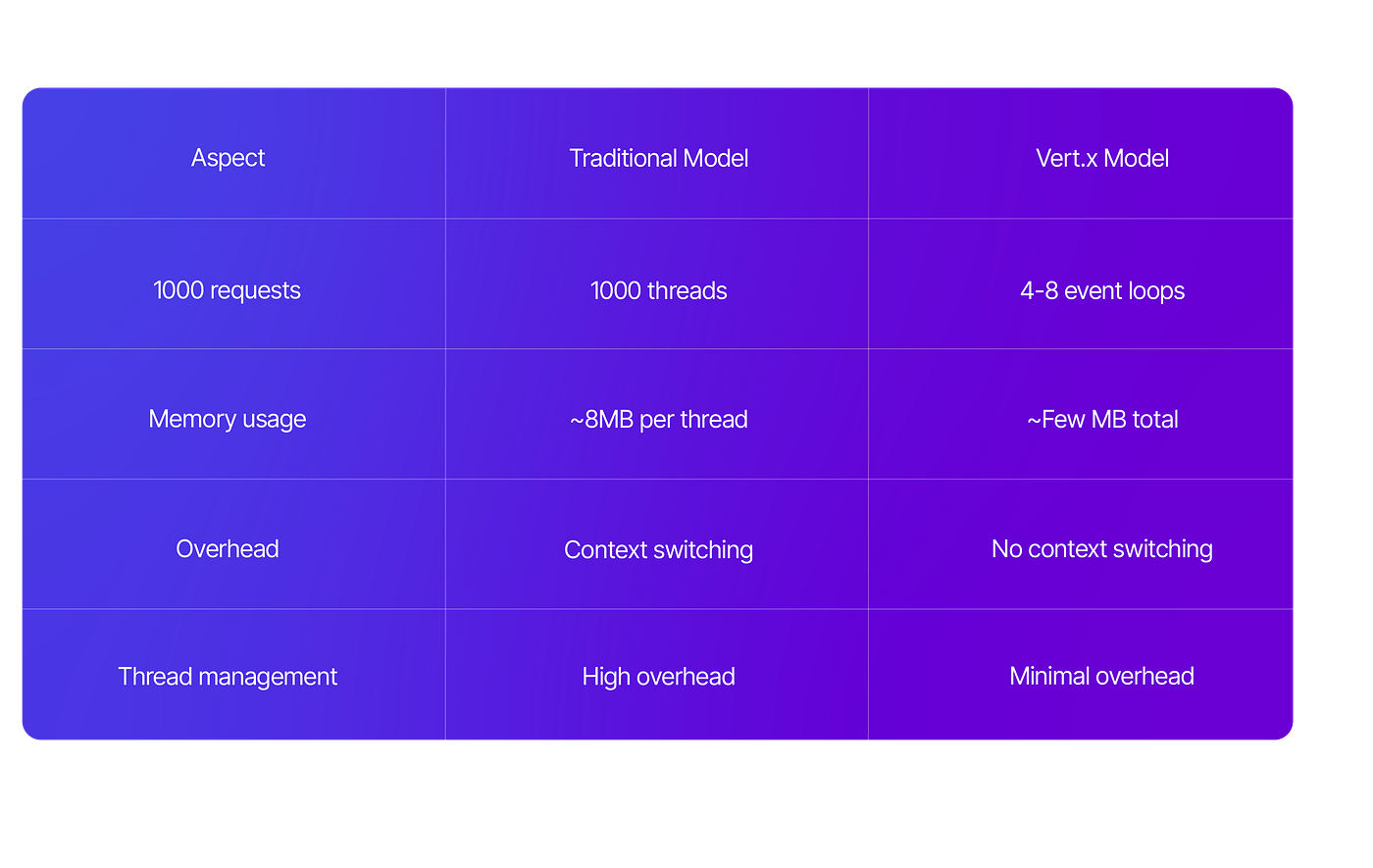
For an API gateway the practical effect is significant. After migrating from a thread-per-request architecture, we observed a CPU reduction of over 30% at equivalent throughput. The main driver is context-switching: the OS no longer has to save and restore thousands of thread stacks every few milliseconds.
The golden rule: never block the event loop
Everything that runs on the event loop must complete quickly —
microseconds, not milliseconds. Any operation that could block
(synchronous file I/O, JDBC calls, CPU-intensive cryptography) must be
dispatched to a separate worker thread pool using Vert.x’s
blockingHandler. This is the most common source of performance
regressions in new Vert.x services, and it is worth getting right from
day one.
Pipeline Architecture
The cleanest way to model an API gateway in Vert.x is as a handler
pipeline: a sequence of handlers attached to a Router route, each of
which either modifies the request/response context and calls
routingContext.next() to continue, or terminates the chain early by
setting an error status.
Sample pipeline — Different from our actual prod pipeline
router.route("/api/*")
 .handler(this::preRequestSetup)
 .handler(this::authentication)
 .handler(this::requestValidation)
 .handler(this::circuitBreaker)
 .blockingHandler(this::heavyCryptographyOrIO) // off the event loop
 .handler(this::integrityValidation)
 .handler(this::proxyToBackend)
 .handler(this::responseProcessing)
 .handler(this::metrics);
Lessons Learned
-
Design the pipeline order carefully. The order of handlers is a security contract. Authentication must come before any handler that returns data. Integrity validation must come before authentication (no point validating a token on a tampered request). Write the order down, review it, and enforce it in code review.
-
Blocking handlers are not free. blockingHandler dispatches to a worker thread pool. If that pool is exhausted, requests queue. Monitor the worker pool queue depth and tune pool size alongside your load tests.
-
Fail loudly, degrade gracefully. When the gateway cannot determine whether a request is safe — because the signing key service is down, or the auth service times out — decide upfront whether to fail open or fail closed. For most security controls the right answer is fail closed: return an error to the client rather than pass the request through in an unknown state.
-
Profile before optimising. The crypto object allocation optimisations described above only became visible under realistic load. Run profiling (async-profiler is excellent for JVM event-loop code) on production-like traffic before deciding where to spend engineering effort.
Conclusion
Vert.x provides a strong foundation for an API gateway. Its event-loop model eliminates the overhead of thread-per-request architectures, and its Router API maps naturally onto the pipeline pattern that makes gateway logic composable, testable, and maintainable.
The most important architectural decision is not which framework to choose — it is committing to a clear pipeline structure where each handler has a single responsibility and failures terminate the chain early. That discipline, combined with careful attention to blocking operations and per-request allocation, is what separates a gateway that works in demos from one that holds up under production load.
The patterns described here are not Vert.x-specific. The same pipeline approach, the same circuit breaker integration, the same observability investments apply regardless of your async framework. What Vert.x gives you is a runtime that makes these patterns feel natural rather than bolted on.
메타데이터
- post_id
- f2a5790a6e9e
- slug
- building-a-high-performance-api-gateway-with-vert-x-architecture-deep-dive-f2a5790a6e9e
- url
- https://medium.com/@nitishgoyal13/building-a-high-performance-api-gateway-with-vert-x-architecture-deep-dive-f2a5790a6e9e
- canonical_url
- https://medium.com/@nitishgoyal13/building-a-high-performance-api-gateway-with-vert-x-architecture-deep-dive-f2a5790a6e9e
- author_url
- https://medium.com/@nitishgoyal13
- status
- ok
- fetched_at
- 2026-06-09 15:37:30