The Erasure of Interaction
AI Notetakers and the transition from human interaction to machine coordination
The Erasure of Interaction
AI Notetakers and the transition from human interaction to machine coordination
AI notetakers have become ubiquitous. They record the meetings, transcribe them. They extract decisions. In doing so, they transform note‑taking into the production of structured, searchable memory for the institution. They may seem like a trivial and useful application of AI, yet they show how the erasure of interaction is underway.
Recurring appointment
Google Calendar reminds me that I have a meeting with the ERP consultant, a recurring appointment every Friday at 14:00 to discuss acute problems with the system’s implementation.
It is part of a larger company goal to migrate disparate data into the system, everything from stock unit governance, orders, transactions. My role was translating supply chain needs into the system, things like stock movement, inventory, manufacturing compliance data. As top management impatiently monitors progress, implementation faces resistance as daily operations collide with longer-term strategy. The objective and key result of creating a “single source of truth” resonates across the organization but the reality is harder to reconcile. On my table I face the exact tension as I rush to switch from time critical tasks to strategic ones. With three minutes to go, I turn to my Artificial Intelligence notetaker so that I can review last week’s meetings notes.
I was not successful. Just as I began reviewing the notes, a phone call came in: The production facility had been expecting a critical inbound shipment of raw materials for Monday morning’s production, but it had not arrived. At the same time, an outbound shipment of finished goods to our third-party logistics partners was delayed, blocking the space needed for the incoming materials. In short, the finished goods should have left yesterday to prevent stockouts on the sales channels and free up capacity for the raw materials that had to be unfailingly on‑site by the end of the day.
On the other end of the line is a frustrated production manager. Both issues risk a ripple effect across departments. The pressure to coordinate what seems like a straightforward flow of inbound and outbound goods reflects the reality of a business where demand is outpacing operational capacity. Nonetheless, the production manager remains accountable for ensuring that next week’s replenishments are ready and aligned with the forecasted output.
As supply chain manager, I ensure these movements happen, while also communicating constraints — or ideally solutions — to stakeholders who, if I succeeded, would never need to know there had been a problem at all. It’s the kind of firefighting that defines the messy world of goods movement when business is good.
The production manager was already preparing to extend into overtime on Friday to accommodate the delays. The truck’s ETA was now 16:00, not 11:00. Production had been secured, and with some extra effort, space for the incoming goods had been cleared. For the moment, the situation was contained. I could finally turn my attention back to the meeting. I was late, but stabilising the operational flow had been worth it.
Notetakers
Most meetings are now supported by AI notetakers, often with video. Internally, we rely on an official tool, but things become more interesting in meetings with external parties. Everyone arrives accompanied by their own AI assistant. I usually revisit recordings or search transcripts for key terms, especially when updating SOPs or recovering details from previous meetings. Pre-loading notes before a meeting helps keep discussions structured. These tools are particularly useful in onboarding, where new hires can stay present while relying on recordings to revisit workflows afterward. The benefits of documentation and efficiency seem obvious. AI notetakers were unavailable just yesterday, yet they are already woven into coordination flows. It feels like corporate evolution.
I had repeatedly joked with the ERP consultant about comparing which AI notetaker performed better, and behind every joke lies a truth. We never actually compared the two brands, which already shows how these tools produce more than we can consume, interpret, or articulate.They, along with other AI products, slowly displace human‑to‑human interaction, and this is what the article is about; a sideways extension of my earlier argument on the emergence of the beast.
The fear of AI is not the beginning of wisdom
Fears about AI dominate the news, and many people follow these developments with a sense of dread. From job displacement, misinformation, cyber security, topics abound depending on who is asked. Some concerns, like the energy demands of scaling the technology, are tangible. Others not as much. In any case, fear narrows vision; it blinds us to what sits in the periphery. Or as Nas put it, with poetry that is relevant today: people “…fear what they don’t understand, hate what they can’t conquer.” Much of today’s AI discourse is shaped by a mix of confusion and hostility as people are faced with the unknown.
AI’s existential risk to humans need not be approached with confusion or hostility. If anything, the rise of AI forces us to reconsider who we are as humans. It also forces us to reconsider what actually constitutes the risk. Is it killer robots, economic displacement, misalignment, or misinformation — or is it, as I argue — the gradual decline in human-to-human interaction?
This essay examines the reduction of interaction and outlines objective criteria for understanding the role AI systems now play in our society.
In a previous essay, I laid out my approach to artificial intelligence. I argued that the defining feature of human struggle is the cultivation of four relational models drawn from relational models theory¹. You can think of these models as algorithms that enable human coordination. These algorithms are encoded rather than learned because evolution could not leave something so vital to individual learning or chance. Whether one sees them as God‑given or as patterns carved into our genome over a very long time, they operate as a survival mechanism. They simplify overwhelming complexity into a few stable relational patterns that make collaboration possible. As complexity grows, the algorithm reduces friction and moves toward optimization. When the simplification drive becomes total, when one model organizes all domains of life, the beast emerges².
History has already shown us what happens when one logic overpowers the others. The beast emerges accompanied by violence³. The beast theory presents two tensions. First, preventing any one relational model from dominating all domains of life. Second, the drift of the models toward over‑optimization, which collapses the tension that makes human logic possible. My claim is that perfecting inefficiency is the toil of man under the sun, while eliminating inefficiency is the desire of systems; algorithms, infrastructures, and AI alike. The outcome, as my previous essay argued, is the erasure of human logic itself.
Let us return to the AI notetaker. It records the meeting, transcribes it, extracts decisions, drafts summaries, and sends the recap. In doing so, it moves from note‑taking to producing structured, searchable memory for the institution. Operationally it reduces administrative work, but it also changes the meeting itself. Attention becomes reduced presence, more data becomes more surveillance, and automation becomes dependence. I see these effects daily.
Notetakers are being adopted with little resistance. Even job interviews now run through them, consent reduced to a checkbox, not unlike agreeing to terms when installing an app. The question is no longer their adoption, but what their adoption produces. Notetakers are only the entry point. Peter Steinberger’s work on systems like OpenClaw demonstrates the shift beyond assistance toward autonomous, goal‑driven agents embedded directly in the machine. To understand how these systems displace human logic, we must return to interaction itself.
Interaction
From physics, biology, and the social sciences, thinking moved from the study of isolated units toward interaction. Physics moved from particles to fields, biology from organisms to ecosystems, and the social sciences from individual traits to relational systems. Psychiatry shifted from individual pathology towards relational dynamics — from Freud to Bowen⁴.
As social beings, our interactions are patterned by four relational models whose evolutionary purpose is coordination⁵. Language likely evolved alongside this need⁶. Large‑scale human coordination is nearly impossible without language, and language without coordination has little reason to exist. Together they structure social life and are powered by interaction. This is why the relational models — and the interactions that enact them — define what it means to be human and, by extension, configure our reality. If relationships are the building blocks of reality, then interaction, enabled by language and sustained through its friction, is what makes us human⁷.
Simply put, whenever people interact, they enact relational models. This does not mean that every encounter forms a relationship; instead, social relationships exist only when each person’s actions make sense in relation to the other. In other words, relationships appear only when both parties act within a shared relational model — when actions, emotions, intentions complement one another and cannot be understood in isolation⁸.
Interaction, in its broadest sense, is mutual influence. It unfolds through words, gestures, timing, silence, and symbols; how people come to understand each other⁹. Human interaction is a dynamic, reciprocal exchange in which people for example, respond, take turns, and adjust so the interaction holds together — or doesn’t. Interaction sustains the coordination that makes social life possible. Exactly why notetakers offer a concrete way to observe how AI enters the human domain.
What do I mean? Humans generate meaning from interaction itself. By meaning, I do not mean mere interpretation; I mean the reality that emerges when we relate. This reality proved so essential that evolution, through the Baldwin effect, encoded its patterns into our genome as four relational models — the innate algorithms that structure all human coordination¹⁰. From the deep, embodied bond of a mother nursing her child, to the subtle interactions that permeate our relationships, or the random exchanges of everyday life, meaning materializes from the verbal, the non-verbal, the veiled expressions, the silence. These exchanges carry weight. Any system that substitutes for them inevitably alters what they become. It alters reality as such.
In prisons, solitary confinement works by removing interaction to inflict psychological harm. Human‑rights organizations argue that the absence of interaction constitutes inhumane treatment. The erasure of interaction is not simply dehumanization in the moral sense, but a step toward a non‑human mode of life.
Interaction is so vital to being human that any system designed to substitute for it, inevitably suppresses it. In light of this, it is essential to distinguish between tools that substitute for interaction and ones that support it.
Media support interaction because they extend human presence rather than replace it — radio, television, print, phones, social platforms, online games — are, in McLuhan’s words, “extensions of man.” They mediate interaction, broaden it outward, and open new ways to connect. Even when they distort, they do not replace. AI notetakers, by contrast, substitute. They listen, summarize, and decide what matters instead of you. Eventually, they interact with other systems in your place.
Beyond notetakers, the human domain gradually disappears as machine‑to‑machine interaction expands. When systems optimize against each other, humans become spectators while retaining the illusion of participation. We barely notice this tension as systems begin to interact in our place. Optimization, coded as efficiency, rewires the human. It becomes a kind of unlearning. A reverse Baldwin effect. What we once had to learn to survive is now bypassed, and therefore becomes unnecessary. AI notetakers are demonstrating the trajectory of AI systems because they remove the need for interaction to do what interaction evolved to do.
The animal in man, the ghost not in the machine
Animals also sustain their world through interaction. Primates negotiate hierarchy, birds synchronize movement, wolves and orcas coordinate the hunt, dolphins coordinate complex behaviours. These are biological systems evolving to coordinate action. Coordination does not require language. But language is the prerequisite for advanced human coordination. It defines the distinctiveness of human evolution. Language evolved to enhance interaction, which in turn birthed the relational models; the innate algorithms that make relationships the human survival toolkit.
Mutual awareness is the basis of interaction for both animals and humans. Humans, however, add a layer of symbolic abstractions, enabling them to share goals, imagine hypotheticals, structure relationships, create obligations, and build societies. But not all forms of coordination rely on interaction, some require neither awareness nor reciprocation.
Bees and ants coordinate flawlessly but without negotiation or shared meaning. They achieve coordination through environmental traces — trails, pheromones, and signals — in a highly algorithmic manner, the biological equivalent of machines¹¹. Bacteria and fungi show an even more primitive version: mechanistic coordination without cognition or reciprocity¹².
Trees fit the same pattern. They coordinate through chemical and electrical networks; highly mechanical, slow, distributed¹³. They exhibit no mutual awareness or reciprocity, yet they still achieve coordination without interaction in either the biological or sociological sense.
Machine coordination takes place without awareness, reciprocity, or interaction. Humans, however, require interaction and attempt to recreate it in the machines they build.
Interactivity
And then humans began creating machines in their own image. The more a machine simulates interaction, the more effectively humans can coordinate with it. With simple machines the exchange is minimal; pull a lever, press a button or turn a switch on. A toaster is fixed, single-purpose offering little feedback. A car is more layered, interwoven with mechanical and electronic inputs. With computers interaction broadens even further, since they are reconfigurable and capable of simulating other machines.
As machines became more interactive, coordination with them improved. The introduction of the computer mouse in the 1960s revolutionized human-machine interaction by switching from specialized command-line interfaces to intuitive point-and-click actions. CLIs resemble control panels of Industrial machines or DJ equipment. These are systems requiring specialized knowledge within a narrow, predefined spectrum of interaction possibilities to operate, unlike the fixed, single‑purpose simplicity of a toaster.
The mouse introduced a new flexibility. Users could choose what to click and determine what would happen. Graphical interfaces extended this by mapping visual elements to tangible feedback. A click on an icon or a tap on a touchscreen launches an application that triggers a sequence of operations — opening email, playing music, activating a camera. From programmable GUIs like Windows or Linux to touchscreens and haptic modules, each step widened the range of possible exchanges between human and machine. This is what computer science calls interactivity: the technical responsiveness of systems to user input.
Interactivity emerged from computer science and cybernetics, later joined by psychology, sociology and media theory. Because interactivity refers to a system’s responsiveness to user input, the aim has been to make machines intuitive so that coordination with them becomes effortless. No wonder the study of human-computer interaction (HCI) focuses on usability and interface design aimed at smooth coordination between humans and digital systems¹⁴.
Interactivity was once a topic of excitement. The idea that computers could finally “answer back” was a big deal. Over time, this amazement faded as the term became normalized. What is still taken for granted is that human-human interaction serves as the benchmark for evaluating machine responsiveness even though genuine interaction is impossible for machines, including those powered by AI.
When we speak of interactivity, we are speaking of mediated communication. Interactivity is the simulation of interpersonal interaction by media systems¹⁵. In the strict sociological sense, conversation remains the only genuine form of interaction. Media theory makes this explicit by distinguishing between the dimensions and the types of interactivity. The dimensions describe what the systems can do (structure), what users do (function), what users feel (perception). The types of interaction¹⁶. adapt classical mathematical models of communication to account for system responsiveness¹⁷.
The first is transmissional interactivity, exemplified by television or radio: a one‑way flow in which the user may switch channels or streams but cannot request content. The second is consultational interactivity, where users select from pre-produced information — most of the internet, from Google searches, YouTube and Netflix. The third is conversational interactivity, the only type that structurally resembles human interaction, in which users produce information in genuine two‑way exchange — telephones, video calls, email. The fourth, and most relevant here is registrational interactivity: the capacity of systems to register information from the user whether through cookies, surveillance mechanisms, GPS tracking, smart home devices and now, increasingly, AI notetakers.
Interactivity: from illusion to erasure
Media theory explains why something feels interactive and what kind of interactivity it is. With this typology in place, we can determine where AI notetakers sit within it. To understand their effect, we must first consider the most common AI system in everyday life: conversational AI. Public discourse focuses on the psychological risks — people treating it “as another human”, while being framed in ways that encourage that very response. This anthropomorphization is a category mistake in the Rylean sense¹⁸.
This produces my first claim: Conversational AI simulates interaction but does not participate in the human process of conversation.
Conversational AI approximates interaction. It produces an illusion of reciprocity by simulating dialogue, yet it does not engage in the mutual, co‑constructed process that defines human conversation. There is no reciprocity¹⁹, no mutual awareness, no relational model, no shared meaning. Conversational AI is consultation and registration, not conversation in the sociological sense. Even though the medium can sense and generate language, the user simply issues a request and receives content.
To recap the conceptual framework: the types of interactivity are, transmission (one‑way), consultation (the user requests information), registration (the system records behaviour), and conversation (mutual exchange between humans). The dimensions describe how interactivity is structured, how it functions, and how it is perceived.

Interactivity Types by System
With this clarified, we can turn to AI notetakers. They operate almost entirely through registration.
They capture, structure, and route human communication. Today they appear as harmless “assistants”, but looking into the future, the development is clear. Notetakers are moving from merely documenting meetings, to scheduling them, conducting them, and reaching decisions. Humans remain present, as ornaments, participating in the illusion of interaction while the real coordination happens elsewhere. This is already visible when everyone enters a meeting accompanied by an AI notetaker. The AIs do not yet interact with one another, but the logic is already in place. Their design makes it easy to imagine a future where coordination happens between systems rather than between humans.
This leads to the second claim: AI notetakers shift coordination away from human interaction and into machine networks.
While AI notetakers reduce human involvement, Agentic AI extends this logic. Agents push registration into autonomous sequences. They monitor states, trigger operations, and coordinate with other systems without requiring human participation. They represent the highest structural interactivity and the lowest functional demand on the human.
Conversational AI simulates interaction; notetakers move toward replacing it; agents are built to bypass it. Taken together, these systems escalate the reduction of human interaction. They approximate interaction through interactivity, but none replicate the human process of interaction. Since interaction is the foundation of relationships and the basis of human reality, its erasure has implications that exceed current debates about job loss, economic inequality, privacy, misinformation, ethics, or existential doom.
Based on these claims, I propose the thesis: as machine‑to‑machine interaction increases, human interaction becomes inefficient.
Interaction is how we enact Communal Sharing, Authority Ranking, Equality Matching, and Market Pricing. When interaction erodes, these relational models weaken. When they weaken, one model inevitably expands to fill the void. Since our societies are already organized around Market Pricing as the dominant relational logic, its expansion becomes total²⁰. This is what I call the emergence of the beast: a world in which value calculations and optimization come to govern domains once primarily structured by other relational models. In such a world, human relations become inefficient compared to machine coordination. Humans become the bottleneck.
The shift is barely noticeable because the movement of coordination into the machine world is masked by the illusion of participation. The system performs the act while humans appear to be involved. In media theory, this structure is captured by the term interpassivity.
Interpassivity
People have delegated experience to external entities in ways that resemble how we outsource tasks to AI notetakers. Think of the function of a black-magic doll, you stick pins into the doll so the doll “performs” the act of harming someone, while you remain at a distance, as if the doll carries out the violence on your behalf. Or recall that sitcom you grew up watching, like Friends or The Big Bang Theory, where the television laughs in your place through canned laughter. A pre‑recorded audience erupts at the right comical moment, relieving you of the need to laugh while still letting you feel as if you participated. The TV laughs at itself and in your place. In both cases, something else performs the act so you can remain active, relieved, and still present²¹.
Interpassivity originates in psychoanalysis and treats delegation as a relief mechanism: you are freed from the burden of performing the passive dimension of the act. For Robert Pfaller and Slavoj Žižek, it is a stabilizing response to superego pressure — a way to hand over impossible demands of enjoyment and belief to something else. An advert where an actor bites into a chocolate bar and moans with pleasure enjoys in your place; the TV laughs for you at the right moment; a priest believes for you when he prays on your behalf. Even Christ dies for you so that you do not have to carry the passive weight of redemption — the guilt, the suffering, the atonement²².
Interpassivity delegates the passive dimension of an act; the object carries it while you remain active. AI inverts this mechanism in the context of work. It performs the act itself and leaves you with the burden of labour in a capitalist world. The TV laughs for you, Christ suffers for you, but AI does the work and removes the activity entirely. If this can be called interpassive at all, it is an interpassivity without relief. It produces anxiety rather than comfort, because no interpassive object can take the pressure away.
This pressure is real, and it appears everywhere in the public discourse on AI and work. When the TV laughs for you, you do not need to laugh to feel relief; but when AI takes your tasks, what remains are the pressures of the labour system — the demand to stay employable, to work to survive, the guilt of failure, the risks of the market. These cannot be delegated to anything or anyone. Many enjoy their work, most do not, but the need to survive makes work bearable.
In interpassivity, the delegated act is enjoyable and the effect is stabilizing. On the other hand, work is rarely enjoyable, yet it provides meaning, dignity, and survival. In one of Žižek’s more recent jokes he illustrates this with a couple who bring sex toys to a date: the devices perform the sexual act, and the couple is freed for intimacy — the superego demand is delegated, and relief appears.
The problem with delegating tasks and interaction in the same way is that the capitalist system does not permit leisure, creativity, or relational life that delegation produces. AI relieves us of tasks, but unless the free time is translated into a value metric, it cannot be assimilated. In optimization, the system keeps moving. Fungi do what they need to under biological optimization. Unlike Žižek’s joke, AI does not liberate us. The system performs the act, and the human becomes unnecessary.
It is no wonder that the workforce is weary about AI taking their jobs.
Interpassivity is more pervasive in everyday life than one may realize and a powerful concept that addresses a wide variety of behaviours. Consider the manifestations in media — autocorrect finishing our sentences, the like button expressing our reactions, films saved on Netflix that we never watch, bookmarks we never open. These little delegations relieve us from the emotional investment or time required to perform the act; the passivity is enough.
Interpassivity offers the clearest lens through which to assess the unconscious question running through workers’ minds in the age of AI. This is why “loss of jobs” feels catastrophic even to those who say they hate their jobs. We are told by AI tech leaders and the optimists who echo them that, as in every technological revolution, some jobs disappear and others emerge. That is precisely the statement that blocks us from seeing the real catastrophe that is emerging in the world: that what is disappearing is not tasks, but the last site where the capitalist injunction is met.
Under capitalism, the message is be productive, be employable, add value. Like in the 1988 film by John Carpenter They Live, once you put the glasses on, this is all you see. Capitalism does not care who performs the act — human or machine — as long as the demand is met. AI aligns with this logic perfectly. Unlike the emotional injunctions of enjoyment or belief, the injunctions to be productive, be employable, add value are non‑delegable by design. They are not tied to the task itself but to the worker’s position in the labour relation, and no machine can carry them.
Conclusion
The erasure of interaction does not mean that we are on the verge of human extinction. The erasure simply marks the entry into a world that is becoming increasingly non-human. The erasure inverts the category mistake: “AI is becoming like us”. Quite the contrary, without interaction, we become AI.
Non-humanity is coordination devoid of interaction. That is not to say that interaction is absent from non-human systems, it means that only humans depend on it to exist. Only humans build meaning through interaction. Yet popular culture and intellectual narratives have us fearing the rise of machines against us. This frame projects the destruction of the human species while ignoring the true catastrophe which is the structural erasure of the human world.
The film Project Hail Mary depicts in an uncanny way how interaction is the foundation of co‑constructed reality. The story follows Ryland Grace, a lone astronaut sent to save Earth, who unexpectedly encounters Rocky, a non-human, and together they must cooperate despite their totally different origins. It would appear that Rocky enters the human world of meaning-building interaction, the instrument through which relational models emerge. But this reading is only half true. Yes, Rocky does enter the world inhabited by humans, yet that world is not uniquely human, because interaction is not a human trait or skill but an objective unit of reality. Although humans require interaction to exist and evolved the relational models as a survival kit to navigate a hostile world, interaction itself remains the condition under which any shared world becomes possible.
Project Hail Mary cinematically exhibits the evolutionary cost of interaction. Co-creation of meaning powered by interaction is fragile. It must be built through enormous work. In the film, Grace must risk his life merely to receive a single message, stepping into open space and reaching the furthest extent of his harness to catch a sealed container of communication he cannot yet interpret. Interaction precedes communication, and the film makes this palpable: from the initial non‑verbal exchanges to the slow construction of shared signals, schemas, expectations, and obligations, all the way to language and finally coordinated problem‑solving.
Even if we flip the script and assume the anthropocentric interpretation that Grace’s entire encounter with Rocky was a hallucination, produced by isolation — just as Tom Hanks’ character turns a volleyball into Wilson in Cast Away — the requirement for interaction remains constant.
Before the mission, Ryland was an overenthusiastic high school science teacher, and the final scene shows him on Rocky’s planet teaching a group of Adrian children in a makeshift classroom. This could be interpreted literally: he survived and travelled with Rocky. It can also be interpreted as a hallucination: Ryland must simulate interaction to stay alive; to exist at all. When interaction is absent, the mind generates it because humans cannot exist without it.
That is how important interaction is. Once interaction becomes the unit of analysis, it becomes clear that intelligence and consciousness obscure understanding of the human. In a recent podcast, Geoffrey Hinton views the ability to understand jokes as one of the most unsettling aspects of AI. The other is the sheer speed and scale at which AIs can share information, billions of times faster than humans.
As Elon Musk notes, human speed may appear to AI the way trees appear to us. However, from the perspective of coordination, AI itself is tree‑like. Apart from humans, everything else — bacteria, fungi, plants, insects, and now AI — coordinates without interaction. Their coordination is interactionless.
In this sense, humans are the outliers. Everything else operates through interactionless, optimization‑driven coordination.
Humans are the outliers because AI, like an ant colony, coordinates in an algorithmic manner. Here we land directly into a Zizekian parallax gap. To AI, humans appear as trees, while to humans AI appears tree‑like. These are two perspectives that cannot be merged into a single higher view, yet both are true and describe the same reality from incompatible angles²³.
The idea of non‑humanity walks in the footsteps of Copernicus and Darwin, who decentered humans in nature. AI is our portal into this decentering. It reveals that consciousness, the soul, or intelligence are neither evidence for human reality nor the elements that constitute it. Prometheus’ fire is interaction; wisdom and technology follow from it. Humans are distinct in one respect only: the acquisition of symbolic interaction.
Symbolic interaction through language makes social coordination possible through shared knowledge of what works and what doesn’t. It is the point where shared knowledge becomes a universal human capacity. Without these capacities, no reality can be built. Reality is socially constructed, not as manufacturing consent, but as the minimal condition of the human world. There is no ghost in the human machine; only a shared world produced through interaction, reducible to four relational models that organize human coordination.
Intelligence is easier to disentangle than consciousness when it comes to AI. As Anil Seth argues, conscious AI is a myth. His approach remains within brain science, based on predictive processing, where perception is modeled as controlled simulation. But perception is still an internal model, it cannot cross the boundary into interaction. It explains how experience is constructed, not how a shared world is built.
Once reality is treated as an internal model, it becomes open to manipulation by any power capable of shaping that model²⁴. Perception turns into a surface for managing emotion, cognition and reputation. And this is precisely what obscures the structural clarity needed to understand AI’s encroachment into the human world.
Carissa Véliz is precise about prediction; it is never neutral²⁵. It is a mechanism of power. Modern algorithms operate like oracles, shaping expectations, frames, and reputations. The same logic that underlies propaganda in public relations, if reality is internal, then whoever configures perception configures reality. Beauty is in the eyes of the beholder. One man’s food is another man’s poison. Perception is volatile; relationships are stable. Perceptions are subjective, they vary from person to person. A break in authority, reciprocity, or communal sharing is an objective event²⁶.
When we fall asleep, we vanish from the world and then return. When we ask whether someone is conscious we mean are they there? Consciousness basically means presence. Seth is right, AI will never be conscious, but it is not the decisive point. The human world is not built out of consciousness; it is built out of interaction. That is the blind spot in the consciousness lineage.
In making sense of AI, media theory is the missing link. It is the framework that synthesises what cognitive science, neuroscience, psychology, and sociology each grasp only in fragments. Media theory begins with interaction, how technologies mediate, why they are used, what forms they take, and what effects they produce. Besides, media is, in a structural sense, the lifeblood of society: the infrastructure through which social life circulates.
Why focus on AI notetakers when AI safety proponents such as Dario Amodei warn that frontier systems may soon resemble weaponizable nuclear materials, capable of automated biological threat design, AI‑enabled cyber‑offense, and other catastrophic risks?

Humanitas — photo by Ioannis A.
AI notetakers are interaction‑substitution devices. They register information through external capture, the only mode of input available to AI systems. Notetakers may seem like a trivial manifestation of AI, a non‑threatening addition to the corporate toolkit. Yet they show, in the most accessible way, how the erasure of interaction is already underway. When Pope Leo XIV expresses fears about human dignity, this is what he is really talking about.
An earlier version of this article was first published on Substack
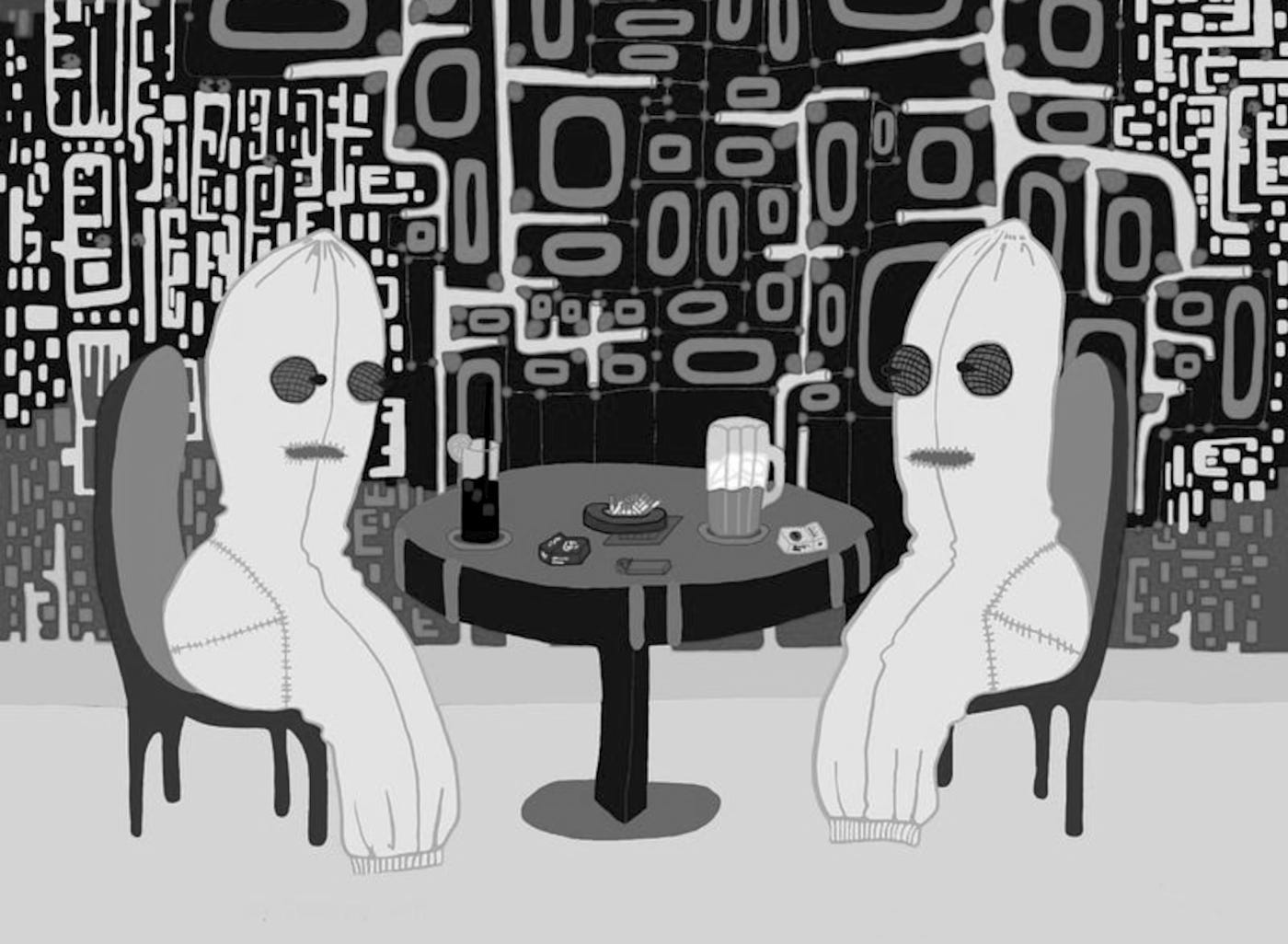
Title Image: “Socks” — Artwork by Lola K.
¹ Fiske, A. P. (1991). Structures of social life: The four elementary forms of human relations
² A totalizing “one model” can take many forms such as tribalism, fascism, techno-feudalism. The structure is: one logic or model expands until it organizes everything
³ Zizek, S. (2008). Violence: Six sideways reflections
⁴ I owe the ideas from Bowen Family Systems Theory to Aaron’s Substack
⁵ Communal Sharing, Authority Ranking, Equality Matching, and Market Pricing
⁶ I owe this idea to Alan P. Fiske for sending me a transcript to his new article “Why just these four”.
⁷ The relational models form the basis of human reality, and humanity depends on maintaining tension among them rather than allowing any single model — such as Market Pricing — to organize all domains of life.
⁸ Fiske, A.P. (2025) Representing Relationships: Modes of Cognition and Connection
⁹ Through communication
¹⁰ Over generations, the most effective ways humans coordinated spread culturally until natural selection gradually encoded them into our biology through Baldwinian genetic assimilation.
¹¹ Bees (some wasps) and ants achieve this through stigmergy
¹² Through quorum sensing
¹³ Through mycorrhizal fungal networks or wood wide web. See Wohlleben, P. (2016) The Hidden Life of Trees
¹⁴ I use machines to refer to devices whose main function is mechanical rather than computational; computers are a specialised subset built for information processing.
¹⁵ Kiousis, S. (2002) Interactivity: a concept explication. New media & society, 4(3), 355–383
¹⁶ Jensen, J.F. (1998) ‘Interactivity’: tracking a new concept in media and communication studies’ Nordicom Review 19: 185–204.
¹⁷ The Shannon–Weaver model
¹⁸ Ryle, G. (1949) The Concept of Mind
¹⁹ There is no reciprocity because the system does not recognise, adjust to, or participate in the human process of meaning‑making
²⁰ The relational model based on proportional exchange is Market Pricing; its institutional expression is capitalism
²¹ Pfaller, R. (2017) Interpassivity: The Aesthetics of Delegated Enjoyment
²² The Christian idea “born again” symbolically simulates dying without requiring the believer to bear Christ’s burden, functioning like canned laughter that performs enjoyment on the subject’s behalf
²³ Žižek, S. (2006) The Parallax View. Žižek defines the parallax gap as “the confrontation of two closely linked perspectives between which no neutral common ground is possible
²⁴ This is the classic terrain of media theory: agenda‑setting, framing, priming, and the entire repertoire of perception management from news to public relations to social media
²⁵ This is the classic terrain of media theory: agenda‑setting, framing, priming, and the entire repertoire of perception management from news to public relations to social media
²⁶ Misunderstandings in relational models often escalate into conflict. When one party assumes Communal Sharing and the other applies Market Pricing, or when Authority Ranking is violated, the mismatch is experienced as a breach, not a mood. RMT treats these breaks as objective events in social coordination
메타데이터
- post_id
- f41e6bea7d1b
- slug
- the-erasure-of-interaction-f41e6bea7d1b
- url
- https://read.misalignedmag.com/the-erasure-of-interaction-f41e6bea7d1b
- canonical_url
- https://read.misalignedmag.com/the-erasure-of-interaction-f41e6bea7d1b
- author_url
- https://medium.com/@yannipropa
- status
- ok
- fetched_at
- 2026-07-08 23:38:59