The 3D Blindspot: Why Your Enterprise DAM is Failing Your Spatial Workflow
As spatial computing and digital twins become standard enterprise operations, organizations are generating massive volumes of 3D assets…
The 3D Blindspot: Why Your Enterprise DAM is Failing Your Spatial Workflow
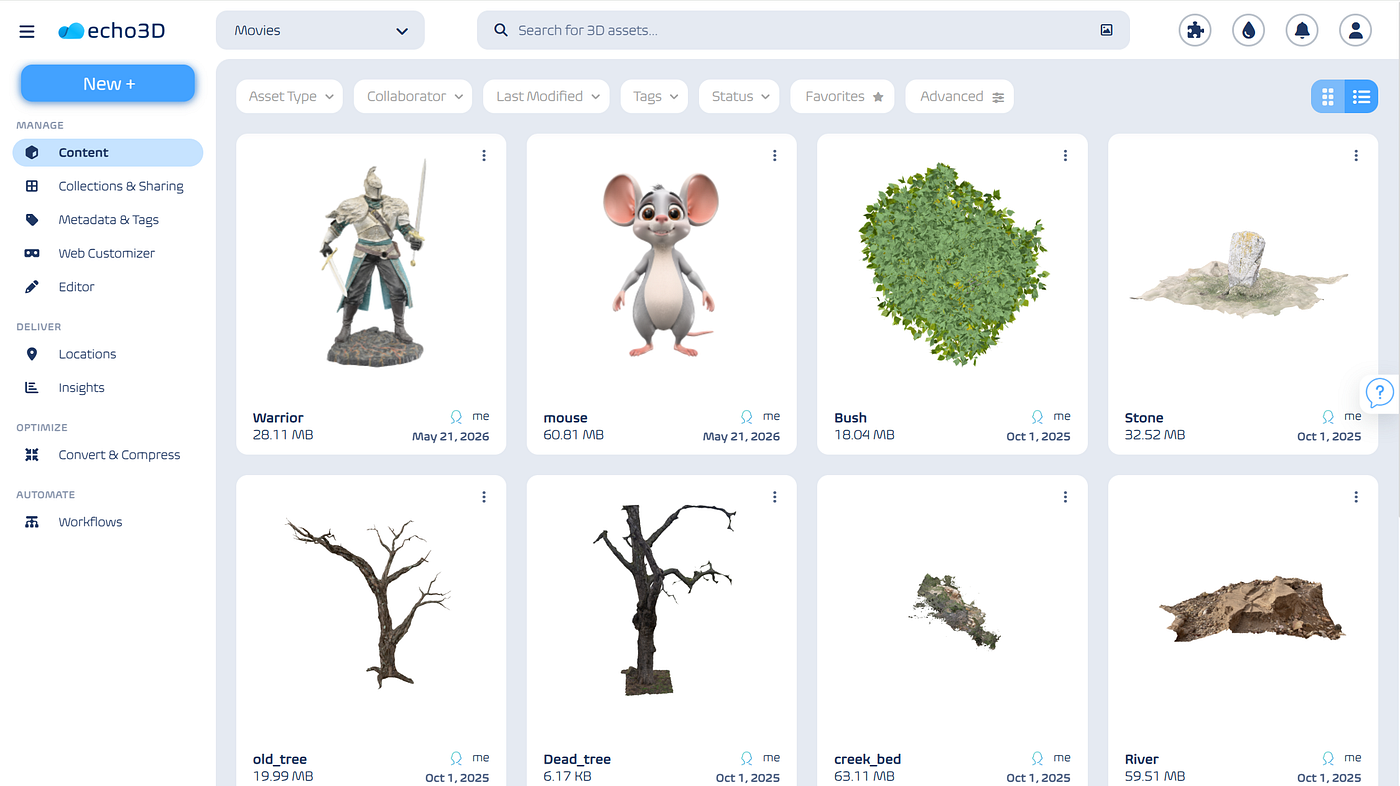
© echo3D, 3D Digital Asset Management Platform
As spatial computing and digital twins become standard enterprise operations, organizations are generating massive volumes of 3D assets. Yet, a critical friction point remains: the very infrastructure relied upon to manage digital content was built exclusively for a 2D world.
For enterprise teams, the thought of abandoning heavily integrated legacy systems for a brand-new 3D-first platform is daunting. Fortunately, adopting 3D does not require a “rip and replace” strategy. By integrating a dedicated “visual layer” over existing infrastructure, organizations can empower their teams to store, secure, optimize, and share 3D content seamlessly, bridging the gap between legacy storage and spatial innovation.
The 3D Blindspot: Why Traditional DAMs Are Falling Short
Organizations have invested heavily in robust Digital Asset Management (DAM) systems like Canto and Bynder. These platforms are phenomenal for organizing marketing collateral, PDFs, and 2D video. However, when tasked with handling spatial data, these traditional systems hit a wall.
**echo3D’s 3D DAM integrates with, and offers 3D file support to, Canto, Bynder, Acquia, Box, Google Drive, Airtable, and more.**
The Heavy Lifting of Complex File Types
Standard DAMs are not equipped to render or manage the intricacies of native 3D formats.
- Complex Entertainment Assets: High-fidelity Maya files, rich with textures and rigging, often show up as blank thumbnails or unsupported file types in traditional storage.
- Massive AEC Models: Heavy Revit models used in architecture and construction crash standard web viewers, making it impossible for non-technical stakeholders to review designs without downloading massive files and specialized software.
The Breakdown of Metadata Mapping
In a 2D DAM, an image of a shoe might have simple tags: red, running, summer collection. A 3D model of that same shoe, however, requires complex metadata mapping. It needs data regarding its polygon count, material textures, lighting environments, and rigging structure. Traditional 2D DAMs lack the structural hierarchy to attach, search, and parse this multi-dimensional metadata, leaving 3D assets virtually unsearchable and severely limiting their utility across departments.

The Solution: An Integrated 3D Visual Layer
Instead of discarding platforms like Canto or Bynder, teams can implement a 3D visual layer that sits on top of their existing stack. This approach provides a dedicated ecosystem for spatial assets while syncing with existing workflows.
- Instant Viewability: A visual layer automatically generates interactive web viewers for heavy formats, allowing anyone to rotate, zoom, and inspect a Maya or Revit model directly in their browser.
- Intelligent AI Tagging: Specialized 3D AI can automatically analyze the geometry and materials of a model, generating accurate tags and enabling multimodal search capabilities.
- Spatial Version Control: It tracks iterative changes specific to 3D workflows — such as polygon reduction or texture updates — ensuring teams are always working with the most optimized, up-to-date asset.
Bridging PLM and 3D: Creating a Visual Paper Trail
The friction with 3D assets extends beyond marketing and design into engineering, manufacturing, and industrial operations. Systems like Siemens Teamcenter or SolidWorks PDM are the gold standard for Product Lifecycle Management (PLM). They are excellent at handling the deeply technical, data-heavy side of engineering. However, they lack the visual accessibility needed for cross-departmental collaboration.
The High-Volume Prototyping Bottleneck
During the concept and ideation phases, companies generate a staggering volume of prototypes. Whether working with CAD designs, raw additive manufacturing files (STLs), or advanced Gaussian Splats (PLY), engineering teams are moving fast.
The problem arises when these iterations are locked inside heavy PLM systems. If a product manager, marketing lead, or external client needs to see the evolution of a prototype, they cannot simply “browse” Teamcenter. The assets must be manually exported, converted, and sent back and forth — a process that introduces security risks, versioning nightmares, and massive delays.

Creating a Browsable 3D Catalog
Integrating a 3D visual layer transforms a dense PLM database into an interactive, browsable 3D catalog.
- The Visual Paper Trail: By syncing PLM data with a 3D visual layer, organizations create a highly accessible historical record of every prototype iteration. This visual paper trail is critical for compliance, safety audits, and intellectual property protection.
- Accessibility Without Compromising Security: A visual layer allows engineering teams to keep their proprietary CAD files locked down in their PDM, while safely sharing lightweight, interactive, and heavily DRM-protected versions of those models with internal stakeholders or clients.
- Accelerated Decision Making: When stakeholders can visually browse a catalog of high-volume prototypes in real-time without needing a localized CAD license, the feedback loop shrinks from weeks to hours.
Enterprise teams do not need to choose between their trusted legacy systems and the future of spatial computing. By deploying a 3D visual layer, organizations can extend the life of their existing DAMs and PLMs, creating a unified, visual, and highly optimized pipeline for the next generation of digital content.
Ready to unlock the full value of your organization’s 3D content?
**Contact Us** today to see the echo3D 3D Digital Asset Management platform in action.
**echo3D is a 3D digital asset management (DAM) platform for teams to store, secure, optimize, and share 3D models and scans across their organization and beyond. [Talk to us today](https://www.echo3d.com/sales).**

메타데이터
- post_id
- fac3af42340e
- slug
- the-3d-blindspot-why-your-enterprise-dam-is-failing-your-spatial-workflow-fac3af42340e
- url
- https://medium.com/echo3d/the-3d-blindspot-why-your-enterprise-dam-is-failing-your-spatial-workflow-fac3af42340e
- canonical_url
- https://medium.com/echo3d/the-3d-blindspot-why-your-enterprise-dam-is-failing-your-spatial-workflow-fac3af42340e
- author_url
- https://medium.com/@echo3D
- status
- ok
- fetched_at
- 2026-06-26 21:52:29