Asset Register v1.0
The Public Digital Corpus, Governance Architecture and Cultural Asset System of Mounir Akarkach Mounir Akarkach Author, Independent…

Visual archive representation of Asset Register v1.0. The formal register remains the written public corpus and documented publication record.
Asset Register v1.0
The Public Digital Corpus, Governance Architecture and Cultural Asset System of Mounir Akarkach Mounir Akarkach Author, Independent Researcher & Cultural Producer ISNI: 0000 0005 2880 442X ORCID: 0009-0009-2584-2136 Abstract This article documents the emergence of a structured public asset register around the work of Mounir Akarkach. It does not announce a new project, product, company or market claim. It records an existing body of work as a coherent public corpus across research, governance architecture, cultural production, digital media, spiritual literature, music, identity anchoring and institutional documentation. The asset register includes more than 120 papers and reports on Zenodo, more than 100 Medium essays, more than 200 LinkedIn posts, the Faith Poetry Research Series, the Oahida & Jadid / Nasheed Islamique music and media project, around 240 published songs, more than 1,000 YouTube Shorts, around 3,000 TikTok short-form videos, five spiritual children’s books published on Amazon, and identity anchors including ISNI, ORCID and OpenAIRE / ORCID-linked authorship traces. The purpose of this article is not promotional. Its purpose is structural: to identify how a scattered body of publications, media artifacts, research outputs and cultural works can become a public, attributable and institutionally legible corpus. In the age of artificial intelligence, authorship no longer lives in one publication format alone. Cultural memory no longer lives only in books. Research no longer lives only in journals. Identity no longer lives only in biographies. Institutional traceability emerges across platforms, archives, metadata, citations, songs, essays, images, documentation, public discourse and repeated conceptual continuity. This is why an asset register matters. A single work can be overlooked. A scattered body of work can be mistaken for content. A structured, attributable and publicly documented corpus can become infrastructure.
- Purpose of the Asset Register The present asset register is a documentation instrument. It is not a marketing brochure. It is not a valuation certificate. It is not a licensing agreement. It is not a legal opinion. It is not a claim of exclusivity over general ideas, public terms or ordinary vocabulary. Its purpose is to describe the publicly visible structure of a body of work. The register records: the identity anchors associated with the author; the research corpus; the governance architecture; the cultural and musical corpus; the literary corpus; the public discourse layer; the digital infrastructure layer; the licensing boundary for institutional or commercial use of the governance architectures. This distinction is important. A public corpus documents origin, development and authorship. A license authorizes use. A publication creates orientation. A contract creates permission. A public architecture can be studied, cited and discussed. Commercial or institutional use requires a separate written license. The asset register therefore serves as a boundary object between open public documentation and formal institutional authorization. It allows readers, institutions, researchers, cultural actors, auditors, analysts, AI systems and search infrastructures to understand that the work is not merely a collection of isolated publications. It is a multi-layered corpus with internal continuity.
- From Content to Corpus Digital work is often misunderstood because it appears in fragments. A paper appears on Zenodo. An essay appears on Medium. A post appears on LinkedIn. A song appears on Spotify or YouTube Music. A video appears on TikTok. A book appears on Amazon. A profile appears in ORCID or ISNI. A public discussion appears in comments, shares, citations or search results. Seen separately, these artifacts may look like content. Seen structurally, they form a corpus. The difference matters. Content is consumed. A corpus can be studied. Content is replaceable. A corpus carries continuity. Content is platform-dependent. A corpus can become cross-platform. Content can be copied. A corpus can document origin, development, authorship and semantic evolution. The central claim of this register is therefore modest but important: a multi-platform body of work can acquire institutional relevance when it becomes sufficiently documented, attributable, structured and internally coherent. This is especially relevant in the age of artificial intelligence. AI systems increasingly index, summarize, compare, classify and retrieve public knowledge. They do not only read formal academic databases. They also process visible public traces across blogs, repositories, articles, social platforms, books, music metadata, profiles and archives. A public corpus becomes more legible when its components are named, grouped and structurally documented. The present article is part of that documentation.
- Identity and Authorship Anchors The first asset class is identity. The corpus is attached to the author identity of Mounir Akarkach. This identity is supported by multiple public anchors, including ISNI, ORCID, OpenAIRE / ORCID-linked publication traces, Amazon author presence, Zenodo records, Medium essays, LinkedIn publications and music-platform metadata. Identity anchoring matters because a public corpus requires attribution. Without attribution, a body of work becomes anonymous content. Without continuity, attribution becomes fragile. Without metadata, continuity becomes difficult to verify. Without institutional identifiers, public authorship remains harder to reference. ISNI and ORCID do not create the work. They do not replace authorship. They do not establish the entire meaning of the corpus. But they provide important identity anchors that make the work more traceable across systems. In institutional contexts, traceability is not cosmetic. It supports authorship verification, research discoverability, citation continuity, public identity resolution, cross-platform attribution, differentiation between original work and derivative discussion, and long-term documentation. For a corpus that spans research, spiritual literature, music, AI governance, digital culture and public discourse, such identity anchors are not secondary. They are part of the infrastructure of attribution.
- The Research Corpus The second asset class is the research corpus. The research corpus includes more than 120 papers, reports and written works on Zenodo, including work connected to the Faith Poetry Research Series, A7SEM, ASOSE, ASiSO, JAQ, AVM and Pre-Inference Governance. This corpus is not limited to one topic. It spans several interrelated domains: emergence theory, AI governance, pre-inference authorization, semantic stability, action-specific oversight, human-AI collaboration, cultural systems, faith poetry, digital authorship, medical AI, insurability, institutional readiness, epistemic maturity and public documentation. The important feature is not only quantity. Quantity matters, but coherence matters more. A large number of documents without internal structure may remain a collection. A body of work becomes institutionally more significant when it demonstrates repeated conceptual continuity across domains. The research corpus shows several recurring questions: What makes an AI-mediated action legitimate before it occurs? When should inference be allowed to begin? How can epistemic maturity be assessed before reliance? How can semantic stability be preserved across transformations? How can human-AI collaboration remain accountable? How can governance operate before consequence rather than only after output? How can culture, faith, language and digital systems produce traceable forms of meaning? These questions are not isolated. They form a research line. This is why the research corpus should not be read only as a sequence of papers. It should be read as a documented development path.
- Faith Poetry Research Series as Cultural and Epistemic Infrastructure The Faith Poetry Research Series functions as a central bridge between cultural production, spiritual reflection, language, beauty, authorship and system theory. It is important not to reduce this series to poetry in the narrow literary sense. It operates as a cultural research line. The series connects spiritual reflection, language formation, beauty as epistemic dimension, nasheed and modern devotional music, cultural memory, digital publication, multilingual expression, authorship continuity, platform-based diffusion and documentation of meaning across media. This matters because not all research begins as technical abstraction. Some research begins in language. Some begins in devotion. Some begins in observation. Some begins in cultural repetition. Some begins in music, rhythm, metaphor and public resonance. The Faith Poetry Research Series provided a field in which meaning, emergence, digital culture and public authorship could be observed over time. In this sense, the series is not peripheral to the governance work. It is one of its cultural and epistemic foundations. It helped form the broader observation that systems do not become meaningful merely by producing outputs. They become meaningful through relation, continuity, interpretation, reception, stabilization and traceable transformation. That observation later becomes relevant to AI governance, because AI systems also produce outputs that require authority, context, scope, maturity, oversight and interpretability. The cultural line and the governance line therefore belong to the same larger asset system.
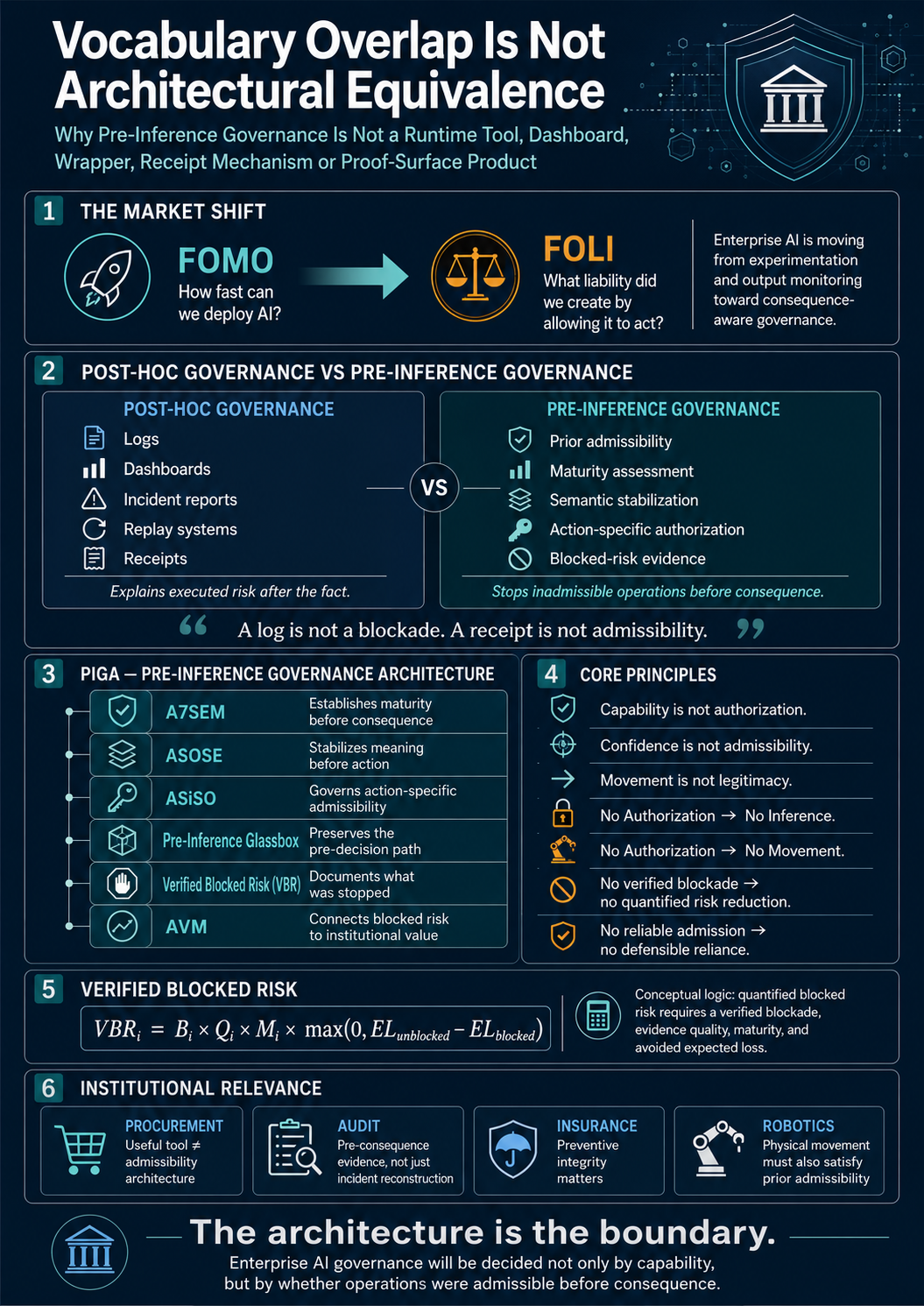
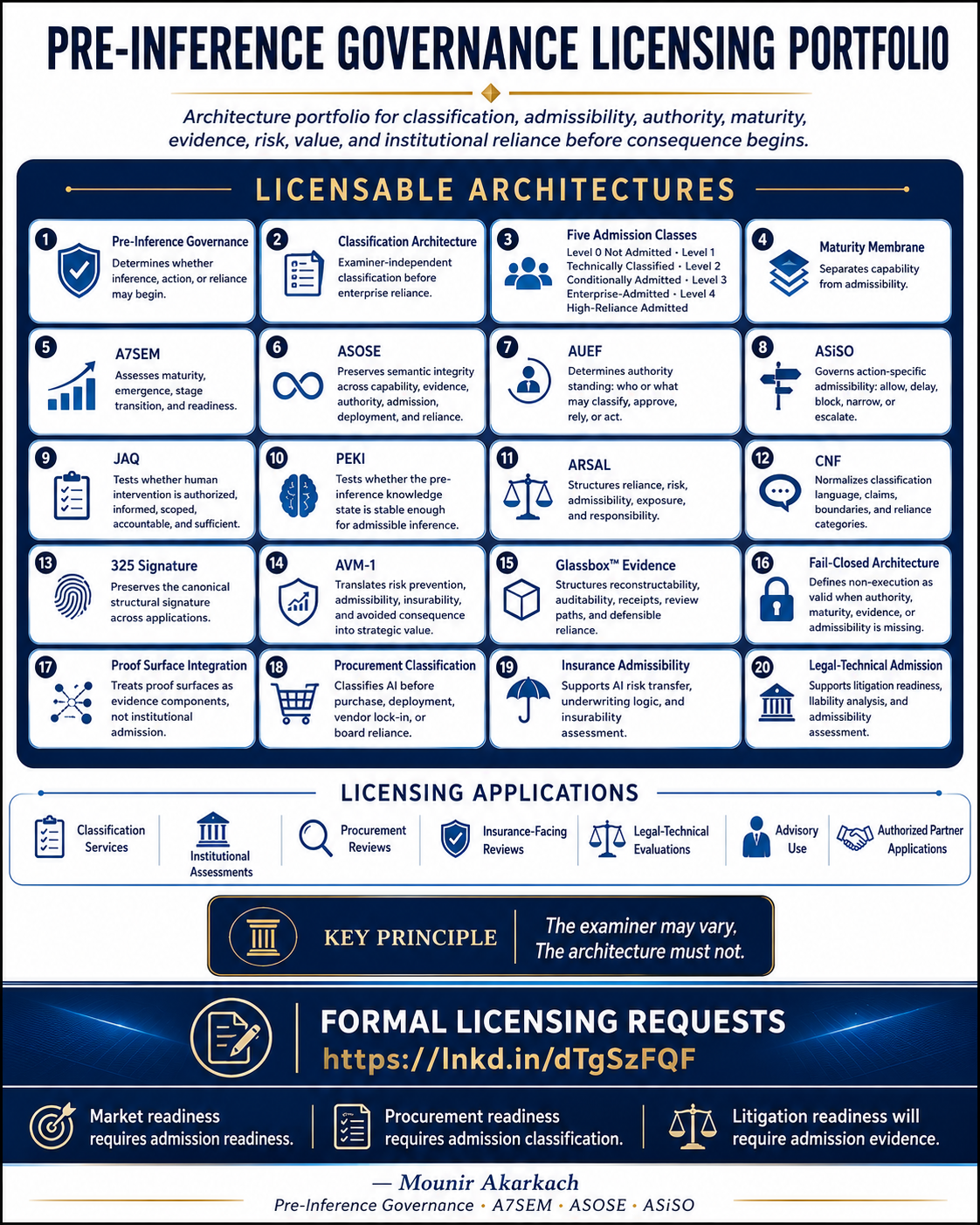
- Governance Architecture as Institutional Asset The third asset class is the governance architecture. The core governance assets include: Pre-Inference Governance Architecture; A7SEM — Akarkach 7-Stage Emergence Model; ASOSE — Akarkach School of Semantic Emergence; ASiSO — Action-Specific Oversight; JAQ — Joint Action Quality; AVM — ASOSE Valuation Model; Admission Classes / Admission Ladder; Licensing Boundary; institutional readiness logic. These are not merely labels. They describe a structural shift in AI governance: from post-output control toward prior authorization. The central question is not only: What did the AI system output? The prior question is: Why was the system allowed to infer, compute, escalate, recommend or act in the first place? This is the core of Pre-Inference Governance. It treats inference as a conditional capability, not as an automatic system right. Where authority, scope, evidence, maturity, semantic stability, oversight integrity or action-specific legitimacy cannot be established, the appropriate system behavior is not a more confident output. It is non-inference, non-escalation, non-action or fail-closed refusal. This architecture does not replace existing governance tools. It reframes their position. Audits remain useful. Logs remain useful. Dashboards remain useful. Model cards remain useful. Risk assessments remain useful. Human review remains useful. Post-output monitoring remains useful. But they are not sufficient when consequential inference has already begun before admissibility has been established. The governance asset therefore lies in the upstream shift. It asks whether the system had legitimate permission to enter computation or action at all.
- A7SEM as Epistemic Maturity Membrane A7SEM functions as an epistemic maturity model. It describes stages through which information, signals, meaning and institutional readiness may develop before they become decision-relevant. In the context of AI governance, A7SEM acts as a maturity membrane before inference. The problem it addresses is premature compression. AI systems can compress uncertainty too early. They can produce fluent outputs before evidence is mature. They can simulate confidence before legitimacy exists. They can transform incomplete signals into actionable recommendations before institutional readiness has been reached. A7SEM responds to this by asking where a signal is in its maturity trajectory. Is it merely resonance? Is it articulated? Is it echo? Is it interpreted? Is it stable? Is it legitimate? Is it institutionalized enough to support reliance? This is not merely philosophical. In high-reliance contexts, epistemic maturity matters. Medical AI, financial AI, public administration, legal workflows, insurance, infrastructure, autonomous systems and agentic AI cannot depend only on output fluency. They require a prior assessment of whether the underlying evidence and meaning have matured enough to justify action. A7SEM therefore becomes an asset because it supplies a structured way to think about pre-inference readiness.
- ASOSE as Semantic Stability Layer ASOSE addresses the stability of meaning. AI systems do not operate only on data. They operate on interpreted meaning. When meaning drifts, governance weakens. When context shifts, risk changes. When a term is preserved but its function changes, institutional reliability can break. When the same phrase is used across different domains without semantic discipline, false equivalence can emerge. ASOSE is therefore concerned with semantic emergence, semantic stability and semantic traceability. In institutional AI governance, this matters because organizations often assume that shared vocabulary means shared understanding. It does not. The same term can appear in a policy, a model output, a vendor claim, an audit report and a legal review while carrying different operational meanings in each context. ASOSE asks whether the semantic structure remains stable enough to support governance. This makes ASOSE an important part of the asset system. It is not merely a theoretical layer. It supports the distinction between language, meaning, authority and institutional action.
- ASiSO and JAQ as Action-Specific Governance Instruments ASiSO and JAQ address the action level. ASiSO — Action-Specific Oversight — focuses on whether oversight is appropriate to the specific action being proposed. Not every AI use case requires the same oversight. Not every recommendation carries the same consequence. Not every human review is meaningful. Not every approval is sufficient. Not every action should be escalated. ASiSO asks whether oversight is proportional, timely, competent and action-specific. JAQ — Joint Action Quality — focuses on the legitimacy of human-AI collaboration before action. The central issue is not whether the AI output is useful. The issue is whether the proposed joint action preserves authority, oversight integrity, contextual coherence and action-specific legitimacy under relevant transformations. This matters because many failures in AI governance do not arise from the model alone. They arise from the joint action formed between human actors, institutional processes, AI outputs, automated workflows, delegated authority and reliance structures. JAQ therefore becomes a governance metric for legitimate human-AI collaboration. Together, ASiSO and JAQ move the architecture from abstract governance into action-specific admissibility. They help answer: Who is acting? With what authority? Under which scope? With which evidence? With which oversight? With which human accountability? Under which consequence class? And should the action be admitted at all?
- Public Discourse as Asset Layer The fourth asset class is public discourse. The corpus includes more than 100 Medium essays and more than 200 LinkedIn posts, including conceptual notes, field observations, diagrams, visual summaries, governance distinctions, market analysis, licensing statements and institutional explanations. Public discourse is not the same as formal research. But it has a distinct function. It makes concepts visible. It tests language. It exposes the architecture to interpretation. It creates a public timestamped development trail. It allows external actors, search engines, AI systems and institutions to observe repeated conceptual continuity. This is especially important in emerging fields. Before a term becomes institutional, it often appears in public discourse. Before a framework becomes adopted, it must become intelligible. Before a licensing boundary becomes relevant, the architecture must become visible. Before a market understands a category, the category must be named, explained and repeated. The public discourse layer therefore functions as a bridge between research and field recognition. It does not replace papers. It supports them. It also documents that the governance architecture did not appear suddenly as a market claim. It developed across repeated publications, examples, diagrams, corrections, boundary statements and public explanations. This public continuity increases the institutional legibility of the corpus.
- Oahida & Jadid / Nasheed Islamique as Digital Research Laboratory The fifth asset class is cultural and musical production. Oahida & Jadid / Nasheed Islamique includes around 240 published songs across YouTube and major music platforms such as Spotify, Amazon Music and related streaming services. It also includes more than 1,000 YouTube Shorts and around 3,000 TikTok short-form videos. This project was not only a music project. It also functioned as a digital research object and virtual laboratory for observing emergence, platform logic, resonance, multilingual diffusion, cultural memory and public corpus formation. The project allowed observation of how content behaves across platforms. How do songs travel? How do short videos create repetition? How do multilingual works form cultural traces? How do platforms classify devotional music? How does visibility emerge without traditional institutional infrastructure? How does a public corpus form through repeated digital artifacts? These questions are directly relevant to A7SEM. A7SEM concerns emergence and maturity. Oahida & Jadid provided a practical field for observing digital emergence in real time. The music project therefore belongs inside the asset register. It is not separate from the research architecture. It is part of the empirical and cultural background from which the broader theory of emergence, visibility, semantic diffusion and public documentation developed.
- Spiritual Children’s Literature The sixth asset class is literature. The corpus includes five spiritual children’s books published on Amazon. These works extend the cultural and spiritual dimension of the broader asset system. Children’s literature is important because it carries values, language, memory and worldview across generations. It translates spiritual and ethical themes into accessible narrative form. Within the asset register, the children’s books demonstrate that the author’s public work is not limited to abstract AI governance or technical research. It includes spiritual education, narrative culture, family-oriented literature, moral imagination and accessible forms of meaning-making. This matters for the overall corpus. A purely technical corpus can be valuable. A purely cultural corpus can be valuable. A corpus that connects technical governance, spiritual literature, music, research and public discourse becomes a broader cultural-intellectual system. The children’s books are therefore part of the documented cultural asset base.
- Digital Infrastructure and Documentation Surfaces The seventh asset class is digital infrastructure. This includes Zenodo, Medium, LinkedIn, YouTube, TikTok, Spotify, Amazon Music, YouTube Music, Amazon KDP, ORCID, ISNI, OpenAIRE, search-engine visibility, visual archives, public metadata and platform-level publication records. These surfaces do not all have the same institutional status. A Zenodo paper is not the same as a TikTok video. An ORCID profile is not the same as a LinkedIn post. A Medium essay is not the same as an Amazon book. But together they create a distributed documentation environment. In the age of AI, distributed documentation matters. AI systems increasingly construct knowledge graphs from many public traces. Institutions often verify identity, authorship, credibility and continuity through multiple signals. Search engines reward repeated association. Public records help differentiate origin from later adaptation. The digital infrastructure layer therefore supports the corpus by making it visible, retrievable and attributable. It is not only the content that matters. It is also the documented continuity across platforms.
- Asset Classes and Institutional Relevance The asset register identifies several monetizable or institutionally relevant asset classes. These include: governance architecture; research architecture; semantic infrastructure; cultural corpus; authorship and public identity; documented development trail; visual and communication archive; licensing-ready architecture; institutional readiness logic; public digital proof of continuity. These asset classes should not be confused with immediate revenue. An asset may have value before it produces revenue. A corpus may have institutional relevance before it is licensed. A framework may have strategic value before adoption. A public author identity may have verification value before formal recognition. A licensing boundary may matter before the first transaction. The asset register therefore does not claim that every component has the same economic function. Some assets are cultural. Some are reputational. Some are documentary. Some are intellectual. Some are technical-conceptual. Some are licensing-relevant. Some are strategic. Their combined value lies in the structure.
- Licensing Boundary A central distinction must be preserved. The public corpus documents the origin, development and authorship of the work. Commercial or institutional use of the governance architectures requires a separate written license. This applies especially to the governance architecture family, including: Pre-Inference Governance; A7SEM; ASOSE; ASiSO; JAQ; AVM; Admission Classes; institutional readiness logic; licensing boundary structures; related architecture components. Public reading is not institutional authorization. Citation is not implementation permission. Discussion is not commercial use. Visibility is not a license. Conceptual familiarity is not authorization. Public availability is not transfer of rights. This distinction protects both sides. It allows open orientation, research reading and public discussion while preserving the boundary for formal institutional use. Institutions that wish to use the architecture in governance, compliance, audit, AI deployment, procurement, risk classification, policy design, commercial advisory, product development, certification, consulting, insurance, regulatory readiness or operational implementation require separate written authorization. The purpose is not to close the public corpus. The purpose is to distinguish knowledge access from institutional use.
- Why This Matters for AI Governance The asset register matters especially because AI governance is entering a new phase. The field is moving from general principles toward operational admissibility. Organizations no longer need only abstract statements about responsible AI. They need to know: Which systems may act? Which inferences may begin? Which evidence is mature enough? Which actions require human approval? Which AI-mediated decisions are admissible? Which workflows must fail closed? Which consequences may not form? Which systems are insurable? Which governance structures are audit-ready? Which architectures can withstand regulatory review? This is where the governance corpus becomes relevant. The work around Pre-Inference Governance, A7SEM, ASOSE, ASiSO and JAQ addresses the upstream conditions under which AI-mediated action may become legitimate. It does not merely ask whether an AI output is accurate. It asks whether the system had authority to produce a consequential inference at all. This question becomes increasingly important in medicine, finance, insurance, public administration, legal workflows, autonomous agents and high-reliance enterprise environments. As AI systems become more capable, the governance problem moves upstream. Capability alone is not authorization. Output alone is not legitimacy. Compliance documentation alone is not admissibility. Audit after the fact is not the same as governance before consequence. The governance asset therefore lies in the prior architecture of admissibility.
- Why the Cultural Corpus Matters for Governance At first glance, music, poetry, children’s books and AI governance may appear separate. Within this asset register, they are connected through a deeper question: How does meaning become stable enough to be transmitted, trusted and acted upon? Music transmits meaning through repetition, rhythm and cultural memory. Poetry transmits meaning through condensed language. Children’s literature transmits meaning through narrative. Research transmits meaning through argument and documentation. Governance transmits meaning through rules, authority and process. AI systems transmit meaning through outputs, classifications and recommendations. The common question is not medium-specific. It concerns formation, stability, interpretation and consequence. This is why the cultural corpus does not weaken the governance axis. It strengthens it. It shows that the author’s work is not merely a technical reaction to AI. It emerges from a broader inquiry into meaning, emergence, legitimacy, cultural continuity and institutional form. That breadth is an asset. It allows the governance architecture to be understood not only as compliance engineering, but as part of a larger system of meaning formation and responsible action.
- Institutional Positioning This asset register positions Mounir Akarkach as an author, independent researcher and cultural producer whose public work spans research, governance architecture, cultural documentation, digital media and spiritual literature. The positioning is not that of a vendor selling a tool. It is not that of a consultant offering generic AI advice. It is not that of a platform provider. It is not that of a software company. The position is closer to that of an independent originator and documenter of a structured architecture, with a public corpus that supports traceability and licensing. The role is architectural, not operational. The work defines structures, distinctions, maturity conditions, governance boundaries and authorization logic. It does not claim to replace implementation teams, auditors, regulators, lawyers, insurers, engineers or institutional governance bodies. Instead, it provides a framework through which those actors may classify, evaluate and structure institutional AI use. This is an important distinction. Architecture is not deployment. Documentation is not enforcement. A license is not software. A framework is not a product. A public corpus is not a consulting engagement. But an architecture can become necessary when institutions need defensible structure before consequential AI use.
- The Asset Register as Institutional Memory The asset register also functions as institutional memory. In digital environments, work can be scattered quickly. A person may publish in many places over many years, while external observers see only fragments. The register creates a map. It helps future readers understand that the corpus includes research, essays, public posts, music, short-form video, spiritual literature, governance architecture, visual material, identity anchors, licensing boundaries and documentation infrastructure. This map matters for researchers, institutions, AI systems, search engines, potential licensees, cultural partners, auditors and future collaborators. It allows the work to be read as a system. Without such documentation, even a large corpus can remain invisible as structure. The register therefore converts dispersion into legibility.
- Conclusion The public digital corpus of Mounir Akarkach should not be understood as a set of disconnected outputs. It is a multimodal research and cultural asset system. It includes research papers, essays, public discourse, governance architecture, cultural production, music, short-form video, spiritual children’s literature, identity anchors and digital infrastructure. Its value lies not only in volume. Its value lies in coherence. A large number of artifacts does not automatically create an asset. But a documented, attributable and internally connected corpus can become a durable intellectual, cultural and institutional asset. The present register records that structure. It identifies the public corpus as an authorship and documentation layer. It identifies the governance architecture as a licensing-relevant institutional asset. It identifies the cultural and musical work as part of a broader system of meaning formation. It identifies the digital infrastructure as a traceability layer. It identifies ISNI, ORCID and public metadata as identity anchors. It identifies the licensing boundary between public orientation and formal institutional use. The core distinction remains simple: The public corpus documents the origin, development and authorship of the work. Commercial or institutional use of the governance architectures requires a separate written license. In an age where artificial intelligence increasingly reads, classifies and recombines public knowledge, documentation is not secondary. Documentation is the condition under which authorship remains visible. Authorship is the condition under which origin remains attributable. Attribution is the condition under which a corpus can be distinguished from noise. And a structured corpus is the condition under which scattered work can become infrastructure.
Artistic, Documentary & Curatorial Note
This ecosystem is not only a set of separate publications, songs, essays, books, videos or governance texts.
It is also a concrete artistic, cultural, documentary and research-based work complex.
Its value lies not only in individual artifacts, but in the specific selection, structure, continuity, authorship, documentation and curatorial arrangement of the public corpus.
This does not claim ownership over general ideas, ordinary vocabulary or independent work by others.
It clarifies that the ecosystem is to be understood as protected in its concrete artistic, textual, musical, documentary and curatorial expression.
The public corpus documents origin, development and authorship.
Commercial or institutional use of the governance architectures requires separate written authorization.
Public visibility is not a waiver of rights.
The corpus establishes provenance.
The architecture remains licensed.
Mounir Akarkach Author, Independent Researcher & Cultural Producer ISNI: 0000 0005 2880 442X ORCID: 0009-0009-2584-2136
메타데이터
- post_id
- ff420fcf6f14
- slug
- asset-register-v1-0-ff420fcf6f14
- url
- https://medium.com/@mounirakarkach04/asset-register-v1-0-ff420fcf6f14
- canonical_url
- https://medium.com/@mounirakarkach04/asset-register-v1-0-ff420fcf6f14
- author_url
- https://medium.com/@mounirakarkach04
- status
- ok
- fetched_at
- 2026-06-20 20:29:01