Rethinking “Be the Change”: A Five-Dimensional Analysis
Some ideas do not announce their depth immediately.
Rethinking “Be the Change”: A Five-Dimensional Analysis
Some ideas do not announce their depth immediately.
They arrive quietly — almost too simple to deserve serious attention. The kind you read, agree with, and move past without a second thought.
This was one such line.
But the more I returned to it, the more it resisted being dismissed. It began to unfold — layer by layer — revealing ethical, psychological, and even systemic implications I had not initially seen.
The line was this: “Be the change you wish to see.”
What appears to be a simple call to action is, in fact, a deeply layered idea. It can be understood through at least five distinct lenses.
I am a great follower of quotes, regardless of the faith, religion, or person they originate from, provided they add value by helping me see problems from a different perspective. It can also be an uplifting and motivational quote for inspiration and motivation. However this quote attributed to Mahatma Gandhi has cast a spellbinding influence on me, since it says so much in a short phrase.
At first glance, it appears to be another innocuous quote to be archived, stored, and documented . However, upon closer examination, one finds that the quote as enunciated years back is far more ahead in age and beliefs.it, is a call to personal agency. It suggests that instead of waiting for the world to improve, we must embody the qualities we want to see in our environment.
Here is an analysis of “Be the change you wish to see” through five distinct lenses.
1. The Ethical Angle: Integrity and Alignment
This perspective focuses on the gap between our values and our actions. It is about “walking the talk” to ensure your internal compass matches your external behavior.
- Why it matters: Hypocrisy breeds cynicism. When we demand honesty from others but lie to ourselves, we erode the moral fabric of our community.
- Significance: It establishes you as a person of character. True leadership is not about authority; it is about being a living example of a standard.
- How to start: Identify one value you complain is “missing” in the world (e.g., empathy,kindness, punctuality). For the next 48 hours, make that your primary rule of conduct, regardless of how others treat you.
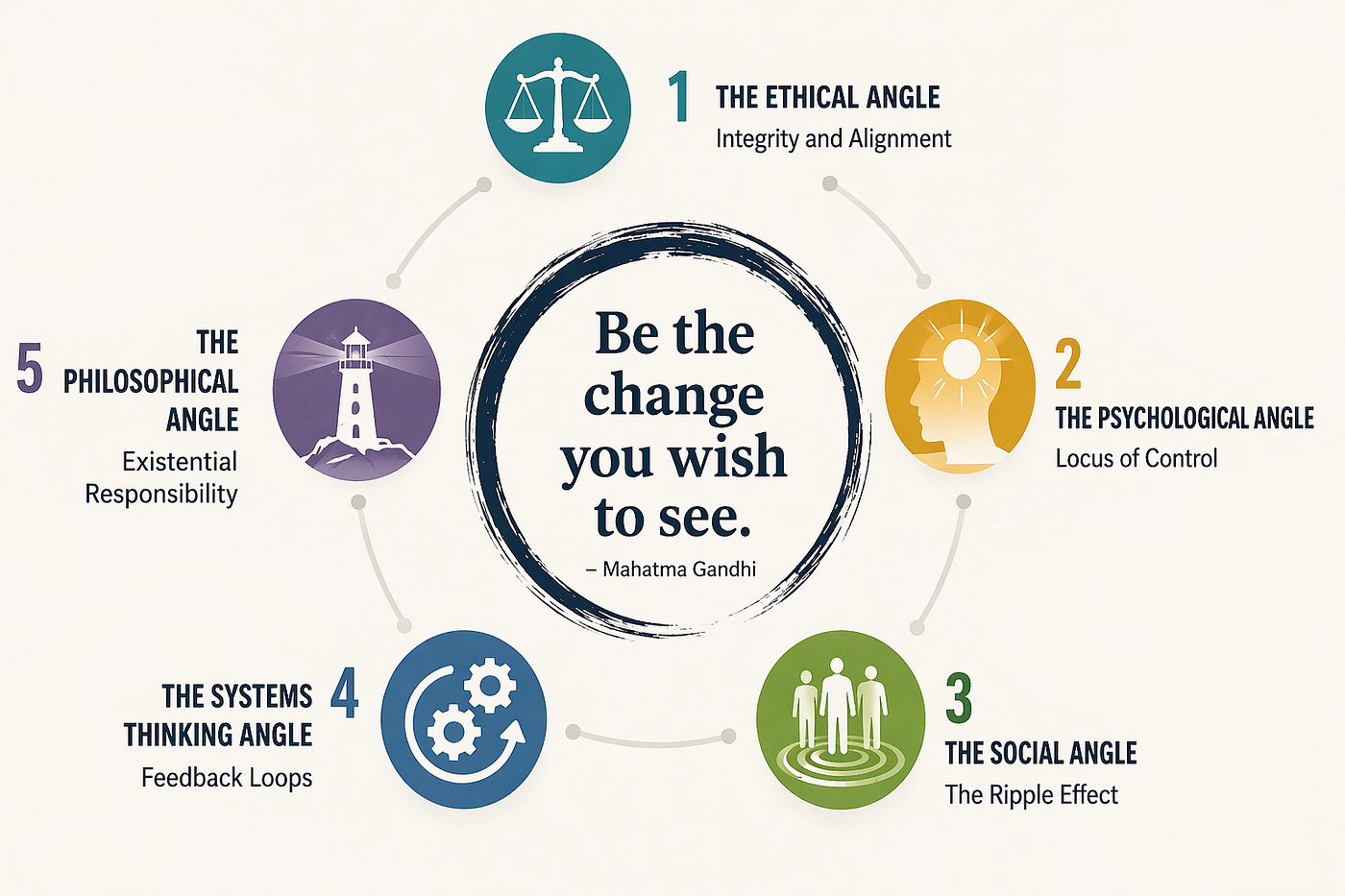
Image created using AI
2. The Psychological Angle: Locus of Control
Psychologically, this quote shifts you from an “external locus of control” (feeling like a victim of circumstances) to an internal locus of control (feeling empowered to influence outcomes).
- Why it matters: Waiting for others to change causes frustration and helplessness. Taking action reduces anxiety and builds self-efficacy.
- Significance: It transforms “complaint energy” into “creative energy.” You stop being a spectator of your life and become the protagonist.
- How to start: Notice when you use the phrase “They should…” and replace it with “I can…” Even a small shift in language changes how your brain processes a problem.
3. The Social Angle: The Ripple Effect
Change is rarely a top-down phenomenon; it is often a “contagion.” This angle looks at how individual behavior influences the collective through social modeling.
- Why it matters: Humans are mimetic creatures — we copy what we see. Your change gives others “permission” to change as well.
- Significance: You don’t need a platform of millions to start a movement. A single person acting with conviction can shift the culture of an office, a family, or a neighborhood.
- How to start: Perform one “unprompted” act that reflects the culture you want. If you want a more collaborative workplace, share credit for a success before anyone asks you to.
4. The Systems Thinking Angle: Feedback Loops
From a systems perspective, you are not separate from “the world.” You are a data point within it. When you change your input, the system must respond differently.
- Why it matters: Systems are maintained by repetitive patterns. If you break your pattern, the people and structures around you are forced to recalibrate.
- Significance: It proves that the “system” is not a stagnant wall; it’s a living network. You are a lever that can move the whole machine.
- How to start: Analyze a recurring conflict in your life. Instead of trying to change the other person’s “output,” change your “input” (your reaction) and observe how the dynamic shifts.
5. The Philosophical Angle: Existential Responsibility
This draws on the idea that we are the architects of our own reality. If you want to live in a world of beauty, you must create beauty.
- Why it matters: It provides a sense of purpose. It suggests that the “missing piece” in the world is exactly what you are here to provide.
. Significance: It moves us away from nihilism. If the world feels dark, you do not curse the darkness; you recognize your responsibility to be a light source.
- How to start: Ask yourself: “If everyone in the world acted exactly like I am acting right now, what kind of world would this be?” If the answer scares you, change the action.
What appears to be a simple line is, in reality, a deeply layered proposition. It asks for ethical consistency, psychological ownership, social awareness, systemic sensitivity, and ultimately, personal responsibility.
The power of the idea lies not in its elegance, but in its demand. It leaves very little room for passive agreement.
If there is a gap between the world we want and the world we experience, this idea quietly redirects the question back to us. Not as a burden, but as a starting point.
Change, then, is not something we wait for. It is something we practice.
Which of these five angles resonates most with a change you’ve been thinking about making lately?
If this resonated with you, I would appreciate your claps, comments, and highlights, and I would also appreciate it if you shared the article with someone who might benefit.
Thanks for reading and follow me at the link given below: musings123.substack.com
메타데이터
- post_id
- 6a0f01e864e1
- slug
- rethinking-be-the-change-a-five-dimensional-analysis-6a0f01e864e1
- url
- https://medium.com/illumination/rethinking-be-the-change-a-five-dimensional-analysis-6a0f01e864e1
- canonical_url
- https://medium.com/illumination/rethinking-be-the-change-a-five-dimensional-analysis-6a0f01e864e1
- author_url
- https://medium.com/@drtvan
- status
- ok
- fetched_at
- 2026-06-11 05:11:55