Electric Bacteria: Biological “Power Cords”
SBGrid member Fengbin (Jerry) Wang of University describes their use of CryoEM to identify the biological “power cords” bacteria use.
Publication Highlight
Electric Bacteria: Biological “Power Cords”
This publication highlight is part of the SBGrid Communities Project focused on science education and demonstrating how structural biology and preclinical science connect to medicine, a collaboration between SBGrid PI Piotr Sliz and Jamaine Davis of Belmont University.
Releasing or reorganization of electrons in some biological reactions can generate energy. For example, Geobacter sulfurreducens (G. sulfurreducens) bacteria can generate energy by releasing electrons. When in a challenged environment without oxygen, they must “breathe” by transferring these electrons to external surfaces. However, bacteria’s outer membrane acts as an insulator, blocking the flow of electricity. Bacteria have evolved to accomplish this feat through extracellular electron transfer using cytochromes — proteins that contain hemes (iron-rich molecules) by growing tiny, conductive “nanowires” that act like biological power cords, bridging the gap and exporting the electricity. While scientists initially thought these wires were simple protein hairs called “e-pili,” further analysis with Cryo-EM revealed otherwise. In this publication, Fengbin (Jerry) Wang from University of Alabama at Birmingham and colleagues discuss how structural information was used to identify the mechanistic functions of microbial nanowires in long range electron transfer.
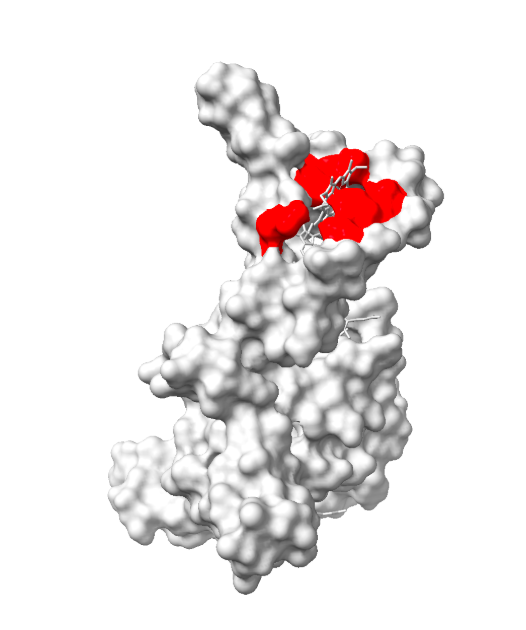
Residues contributing to Heme C (HEC Residues: Val61, His65, Ile68, Cys77, His93, Arg109) from Cryo-EM subunit of the OmcZ nanowires from Geobacter sulfurreducens (PDB 8D9M) highlighted in red. CC by SBGrid.
G. sulfurreducens overcomes the insulating properties of its outer membrane via extracellular electron transfer (EET), utilizing microbial nanowires composed of multi-heme c-type cytochromes. Using high-resolution Cryo-EM analysis, supported by software like AlphaFold and ModelAngelo, researchers identified three primary structures: OmcS, OmcE, and OmcZ.
These structures consist of subunits with closely packed heme cofactors arranged in alternating parallel (stacked) and T-shaped (perpendicular) geometries that facilitate long-range electron hopping. Structurally, these nanowires are classified into two groups based on solvent accessibility: insulated wires (OmcS and OmcE), where the protein matrix shields hemes, and leaky wires (OmcZ), which feature solvent-exposed hemes that may facilitate interconnected conductive networks.
This new structural knowledge serves as a blueprint for how to harness microbial electron transfer. This discovery will help to shape the future of bioelectronics and microbial fuel cells.
Read more in *Emerging Topics in Life Sciences*.
By Cariuna M. Ellison, Fisk University (Cariuna Ellison)
Cariuna M. Ellison is an undergraduate student at Fisk University, pursuing a bachelor’s degree in Biochemistry and Molecular Biology. She is on track to graduate in May 2028. In her free time, she enjoys reading, exercising, and giving back to her community in any way she can.
메타데이터
- post_id
- a78abcb2b46a
- slug
- electric-bacteria-biological-power-cords-a78abcb2b46a
- url
- https://medium.com/sbgrid-community-news/electric-bacteria-biological-power-cords-a78abcb2b46a
- canonical_url
- https://medium.com/sbgrid-community-news/electric-bacteria-biological-power-cords-a78abcb2b46a
- author_url
- https://medium.com/@sbgrid
- status
- ok
- fetched_at
- 2026-06-11 21:11:36