Why Most AI Products Fail at UX — It’s a Maturity Problem
AI isn’t failing because of technology. It’s failing because we’re designing it at the wrong level.
Why Most AI Products Fail at UX — It’s a Maturity Problem
AI isn’t failing because of technology. It’s failing because we’re designing it at the wrong level.
AI is not failing because the technology is weak. It’s failing because the experience around it is immature.
We’re building systems that can generate answers, automate workflows, and simulate intelligence — but we’re still designing them like traditional software.
That mismatch is where most AI products quietly break.

AI doesn’t fail at capability — it fails at how decisions are structured around it. -By KreativePS
The Illusion of “Working AI”
On paper, most AI products work.
They generate outputs. They complete tasks. They look impressive in demos.
But real-world usage tells a different story:
- Users don’t fully trust the output
- They double-check — or ignore — recommendations
- They hesitate before acting
- Adoption drops after initial excitement
Nothing is technically broken.
But something is fundamentally missing.
The system functions — but it doesn’t fit into how decisions are actually made.
AI Changed the Question — But UX Didn’t Catch Up
Traditional UX was built around interaction:
- Navigation
- Flows
- Interfaces
But AI changes the nature of the user moment.
The question is no longer:
“How do I use this?”
It becomes:
- Can I trust this?
- What should I do next?
- What happens if I’m wrong?
If your product doesn’t support these decisions, interface quality becomes irrelevant.
Most AI Products Are Stuck at the Surface
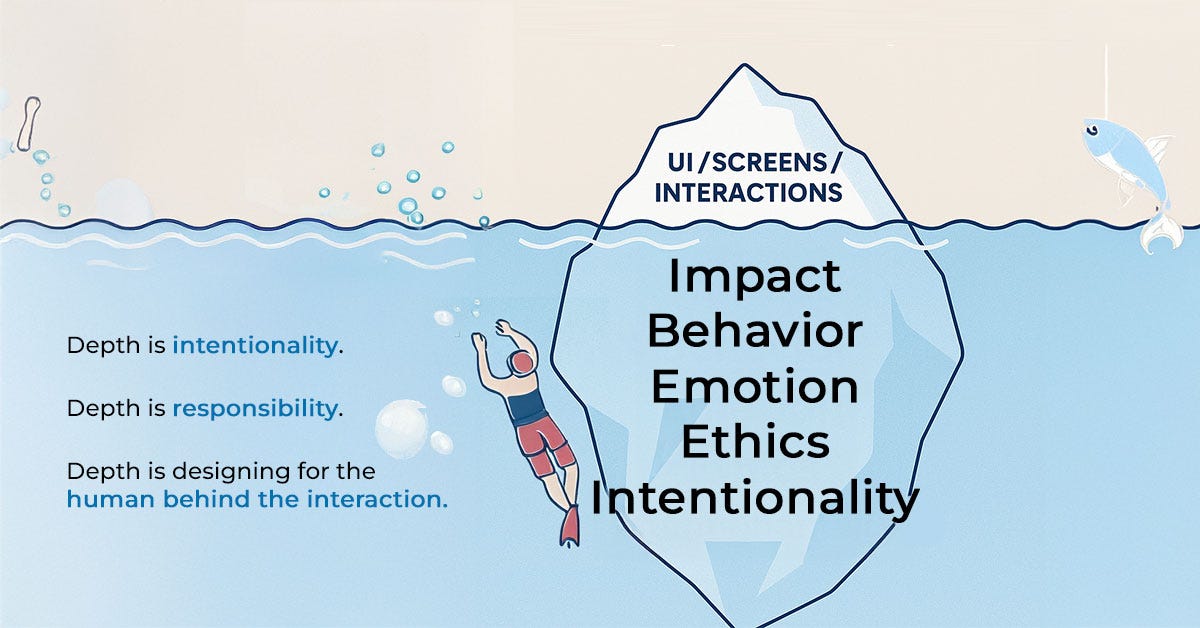
Most AI products are designed at the lowest levels of UX maturity.
They focus on:
- Generating outputs
- Displaying results
- Optimizing surface-level interactions
But they fail to support what happens around those outputs.
That’s why they feel:
- Impressive — but not trusted
- Useful — but not relied on
The Real Gap: Decision Support, Not Output Quality
Most teams try to improve AI by making outputs better.
More accurate. More relevant. More polished.
But better answers don’t automatically lead to better decisions.
Because users still have to:
- Interpret the output
- Evaluate its reliability
- Decide what to do next
And most systems leave that burden entirely on the user.
A Different Lens
The better question is:
Is this system helping users make better decisions?
Not:
- Is it usable?
- Is it fast?
- Is it visually polished?
But:
Does it improve decision quality?
What’s Missing in Most AI Experiences
Across products, the same gaps appear:
- Decisions are generated — but not clarified
- Systems respond — but don’t explain themselves
- Automation removes effort — but also control
- Products improve internally — but not experientially
- AI behaves like a tool — not a thinking partner
Where Most AI Products Actually Sit
Most AI systems today fall into:
Level 1 — Output AI generates answers.
Level 2 — Partial Explainability AI explains some reasoning.
Very few reach:
- Adjustable
- Collaborative
- Adaptive
In AI, Bad UX Creates Bad Decisions
In traditional software, bad UX creates friction.
In AI systems, bad UX creates bad decisions.
That’s a fundamentally different risk.
Because now the cost isn’t just time — it’s outcomes.
The Shift UX Needs to Make
UX can’t stay focused on screens.
It needs to evolve into:
- Decision design
- System thinking
- Human–AI collaboration
Because the future of UX is not about usability.
It’s about decision quality.
Key Takeaways
- AI UX failures are maturity problems, not design issues
- Output quality ≠ decision quality
- Trust and clarity are structural, not visual
- Most AI systems stop at output and explainability
- UX must evolve into decision design
AI isn’t lacking intelligence.
What it lacks is structure around how that intelligence is used.
And until we design for that, AI products will continue to feel powerful —
but never truly dependable.
🌱 Enjoyed this read?
If this article sparked an idea, made you reflect, or inspired your creative journey, feel free to share it with someone who’d appreciate it.
🌻 Thanks for being part of this growing creative community.
— Kreative PS Exploring ideas, imagination, and innovation through words that spark connection.
✦ Follow for more insights on design trends, creativity, and human-centered ideas ✦ Let’s connect on LinkedIn and Twitter ✦ I also write on my blog for long-form content: Read Here

Subscribe for More
메타데이터
- post_id
- 005d79ea0c41
- slug
- why-most-ai-products-fail-at-ux-its-a-maturity-problem-005d79ea0c41
- url
- https://medium.com/@Kreativeps/why-most-ai-products-fail-at-ux-its-a-maturity-problem-005d79ea0c41
- canonical_url
- https://medium.com/@Kreativeps/why-most-ai-products-fail-at-ux-its-a-maturity-problem-005d79ea0c41
- author_url
- https://medium.com/@Kreativeps
- status
- ok
- fetched_at
- 2026-06-09 15:37:30