Ijtehad (Jurisprudence) ijma ( Consensus )
Islamic law, known as Shariah, is primarily derived from the Qur’an and Sunnah. Alongside these primary sources, secondary principles play…
Ijtehad (Jurisprudence) ijma ( Consensus )
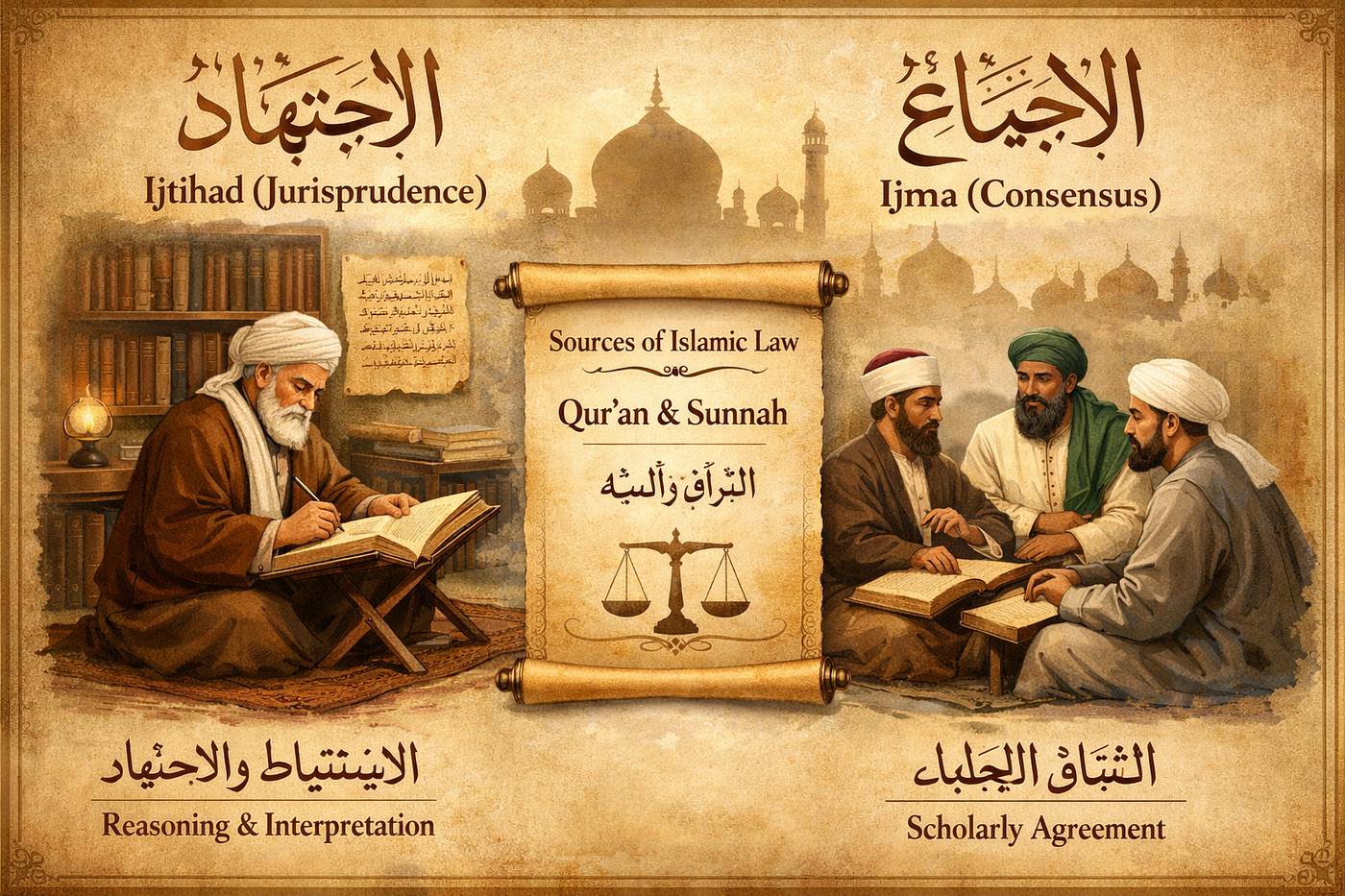
Islamic law, known as Shariah, is primarily derived from the Qur’an and Sunnah. Alongside these primary sources, secondary principles play an important role in interpreting and applying Islamic teachings to different situations. Among the most significant of these are Ijtehad (independent reasoning) and Ijma (consensus). These principles ensure that Islamic law remains relevant and capable of addressing changing social, cultural, and historical contexts . Ijtehad refers to the intellectual effort made by qualified scholars to derive legal rulings from the Qur’an and Sunnah in cases where explicit guidance is not available . It is essential for addressing modern issues such as technological developments, medical ethics, and financial systems. Through Ijtehad, Islamic law remains flexible and adaptable rather than rigid, allowing it to respond effectively to new challenges . Only scholars with specific qualifications are permitted to perform Ijtehad. These qualifications include a deep understanding of the Qur’an and Hadith, proficiency in the Arabic language, knowledge of Islamic legal principles (Usul al-Fiqh), and strong analytical and reasoning abilities. Ijtehad can take different forms, including individual Ijtehad carried out by a single scholar, and collective Ijtehad conducted by groups of scholars, often within modern institutions. Ijtehad promotes intellectual engagement and enables Islamic law to remain applicable in diverse contexts. It is particularly important for resolving new legal questions that arise in contemporary society. Ijma refers to the unanimous agreement of qualified Muslim scholars on a legal issue after the death of Prophet Muhammad (PBUH) . It is based on the belief that the Muslim community will not collectively agree on an error, a principle supported by Hadith emphasizing the unity and correctness of the Muslim Ummah . Ijma can be classified into different types, including the consensus of the Companions (Sahaba) and the consensus of later scholars. It plays an important role in promoting unity within the Muslim community, providing certainty and authority in legal rulings, and reducing differences of opinion among scholars . Ijtehad and Ijma are closely related concepts. Ijtehad represents the process of reasoning and interpretation, while Ijma reflects the agreement that may emerge from these efforts. When multiple scholars independently reach the same conclusion through Ijtehad, their agreement can develop into Ijma . There are clear differences between the two concepts. Ijtehad is an intellectual effort carried out by individuals or groups, whereas Ijma is a collective agreement. Ijtehad is flexible and subject to change, while Ijma becomes fixed once it is established. Furthermore, Ijtehad is not always binding, whereas Ijma is generally considered authoritative in Islamic law . In the modern era, new issues continue to emerge in areas such as bioethics, artificial intelligence, and global finance. Ijtehad enables scholars to address these challenges effectively, while Ijma ensures broader acceptance and uniformity in legal interpretations. Today, collective Ijtehad through scholarly councils often contributes to the development of contemporary Ijma .
메타데이터
- post_id
- 03bf34ec0e8a
- slug
- ijtehad-jurisprudence-ijma-consensus-03bf34ec0e8a
- url
- https://medium.com/@laibashabir002/ijtehad-jurisprudence-ijma-consensus-03bf34ec0e8a
- canonical_url
- https://medium.com/@laibashabir002/ijtehad-jurisprudence-ijma-consensus-03bf34ec0e8a
- author_url
- https://medium.com/@laibashabir002
- status
- ok
- fetched_at
- 2026-06-22 08:06:21