Smriti-Mandir
Building an Accurate Dravidian Temple Environment in Unreal Engine 5
Smriti-Mandir
Building an Accurate Dravidian Temple Environment in Unreal Engine 5
The Concept
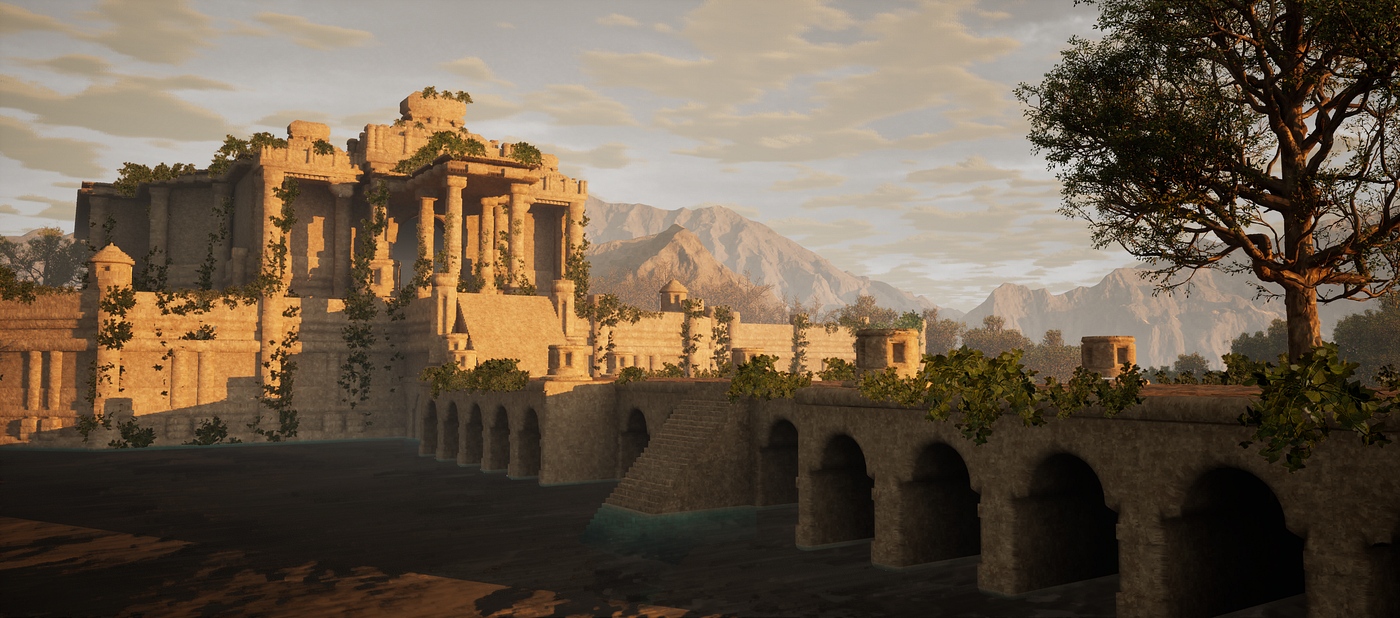
Western games and television have long used Indian architecture as a backdrop, and while the intention is rarely malicious, something almost always feels off. The proportions, the patterns, the materiality. It never quite lands. Smriti-Mandir started as a direct response to that. The goal was simple: build a fictional ancient Indian temple environment that actually gets it right.
The project was my final work for my MA in Interactive Design and Game Development at SCAD. I chose to base the environment on Chola dynasty Dravidian architecture, specifically drawing from the Brihadeeswarar Temple in Thanjavur and several other temples across the Tamil Nadu region. The result is a fictional temple, but one grounded in real structural logic, material behaviour, and spatial hierarchy.
Software Used
- Unreal Engine 5
- Autodesk Maya
- Substance Designer
- Substance Painter
- SpeedTree
- Gaea
Research and References
Before opening Maya, I spent significant time studying Chola architecture. Dravidian temples are not just visually distinct, they follow strict structural rules. The gopuram proportions, the stepped platform systems, the way stone accumulates moisture and weathering in humid South Indian climates. Getting these details right was the whole point of the project.
My primary reference was the Brihadeeswarar Temple in Thanjavur, one of the finest examples of Chola period Dravidian architecture and a UNESCO World Heritage Site. I supplemented this with references from several other temples across Tamil Nadu, studying their stonework patterns, column profiles, and spatial organization.
On the CG side I looked at environments that handled ancient architecture with care, studying how lighting and material aging were used to sell believability.

Modular Kit and Modelling
The modular kit was the backbone of the entire environment. I broke the architecture down into its core repeating components: pillars, floor segments, wall sections, and staircases. Each piece was designed to snap together cleanly while still feeling hand-built rather than mechanical.
I built everything in Maya, keeping dimensions grid-friendly to ensure clean snapping inside UE5. The modular approach also meant I could rearrange and iterate on the layout without rebuilding assets from scratch, which was essential given the 10 week timeline.
The key challenge was making a modular kit feel organic. Dravidian architecture has a lot of intricate surface detail and rhythm. Getting that to read correctly across repeating pieces required careful planning at the modelling stage.


Terrain
The mountains visible in the environment were built in Gaea, a procedural terrain generation software. Since the mountains serve purely as a background element and are not part of the walkable space, they were exported from Gaea as heightmaps and brought directly into UE5. This kept the geometry lightweight while still giving the environment a sense of geographic scale and context beyond the temple itself.

Materials and Texturing
This is where a significant amount of the project time went. I built all materials in Substance Designer, focusing on stone that felt aged, moisture-affected, and structurally honest.
The biggest technical challenge was surface patterns. Dravidian architecture uses dense, repeating decorative patterns across large surfaces, and getting those to tile correctly across irregular geometry without obvious repetition was a real problem.
The solution was a master material system built in UE5. Rather than relying on perfectly laid out UVs for every static mesh, the master material used world-aligned texturing. This meant the patterns projected correctly across the geometry regardless of UV layout, and a single material instance could drive the entire environment. It solved both the repetition problem and saved significant time that would have otherwise gone into hand-laying UVs on every asset.


Foliage
All trees in the environment were built in SpeedTree and integrated directly into UE5. Choosing the right foliage for this project required a deliberate design decision. Accurate regional trees like banyan or tamarind are indigenous to Tamil Nadu, but at proper scale they would have overwhelmed the temple’s silhouette and pulled visual focus away from the architecture. A banyan in full canopy is a dominant presence. The temple needed to remain the clear subject of the scene.
Since Smriti-Mandir is a fictional setting rather than a documentary recreation of a specific place, I made the choice to use a southern live oak form. It retains the spirit of South Indian forest canopy, the weight, the branching behaviour, the density, without competing with the architecture for dominance. It was a conscious artistic call in service of the environment’s overall read. I made two different trees with some small changes to them. Used one in front of the scene and put both of them in the background for the depth.


Lighting
Lighting took the most iteration of any part of the project. The goal was a warm late afternoon orange that felt specific to the Indian subcontinent, the quality of light you get when the sun is low and the stone has been absorbing heat all day. Sky and atmospheric lighting was handled using Ultra Dynamic Sky, which gave me precise control over sun angle, cloud coverage, and atmospheric scattering to achieve the late afternoon light I was after. UE5’s Lumen handled the global illumination, but getting the exact color temperature and shadow behaviour I wanted required significant tuning on top of that. The stone needed to feel warm without going muddy, and the shadows needed enough depth to sell the architectural detail without flattening the scene. This was the stage where the research paid off most directly. Having spent time studying reference photographs of these temples at different times of day gave me a clear target to work toward rather than guessing.


What I Learned
Building Smriti-Mandir taught me that research is half the work. The 10 weeks I spent in engine were only as strong as the time I spent studying Chola architecture before touching Maya. If I were to revisit this project, I would push the environment further by adding water features, more temple structures in the background to sell the sense of scale, and foliage native to Tamil Nadu. The master material system I built here is something I will carry into every future project. It solved a real pipeline problem and that kind of thinking, building systems rather than one-off solutions, is what I want to keep developing as I move into the industry.
Western games and television have long used Indian architecture as a backdrop, and while the intention is rarely malicious, something almost always feels off. The proportions, the patterns, the materiality. It never quite lands. Smriti-Mandir started as a direct response to that. The goal was simple: build a fictional ancient Indian temple environment that actually gets it right.
The project was my final work for my MA in Interactive Design and Game Development at SCAD. I chose to base the environment on Chola dynasty Dravidian architecture, specifically drawing from the Brihadeeswarar Temple in Thanjavur and several other temples across the Tamil Nadu region. The result is a fictional temple, but one grounded in real structural logic, material behaviour, and spatial hierarchy.
메타데이터
- post_id
- 0404b81bf3fb
- slug
- smriti-mandir-0404b81bf3fb
- url
- https://medium.com/@kumaraprajwal66/smriti-mandir-0404b81bf3fb
- canonical_url
- https://medium.com/@kumaraprajwal66/smriti-mandir-0404b81bf3fb
- author_url
- https://medium.com/@kumaraprajwal66
- status
- ok
- fetched_at
- 2026-06-09 15:37:30