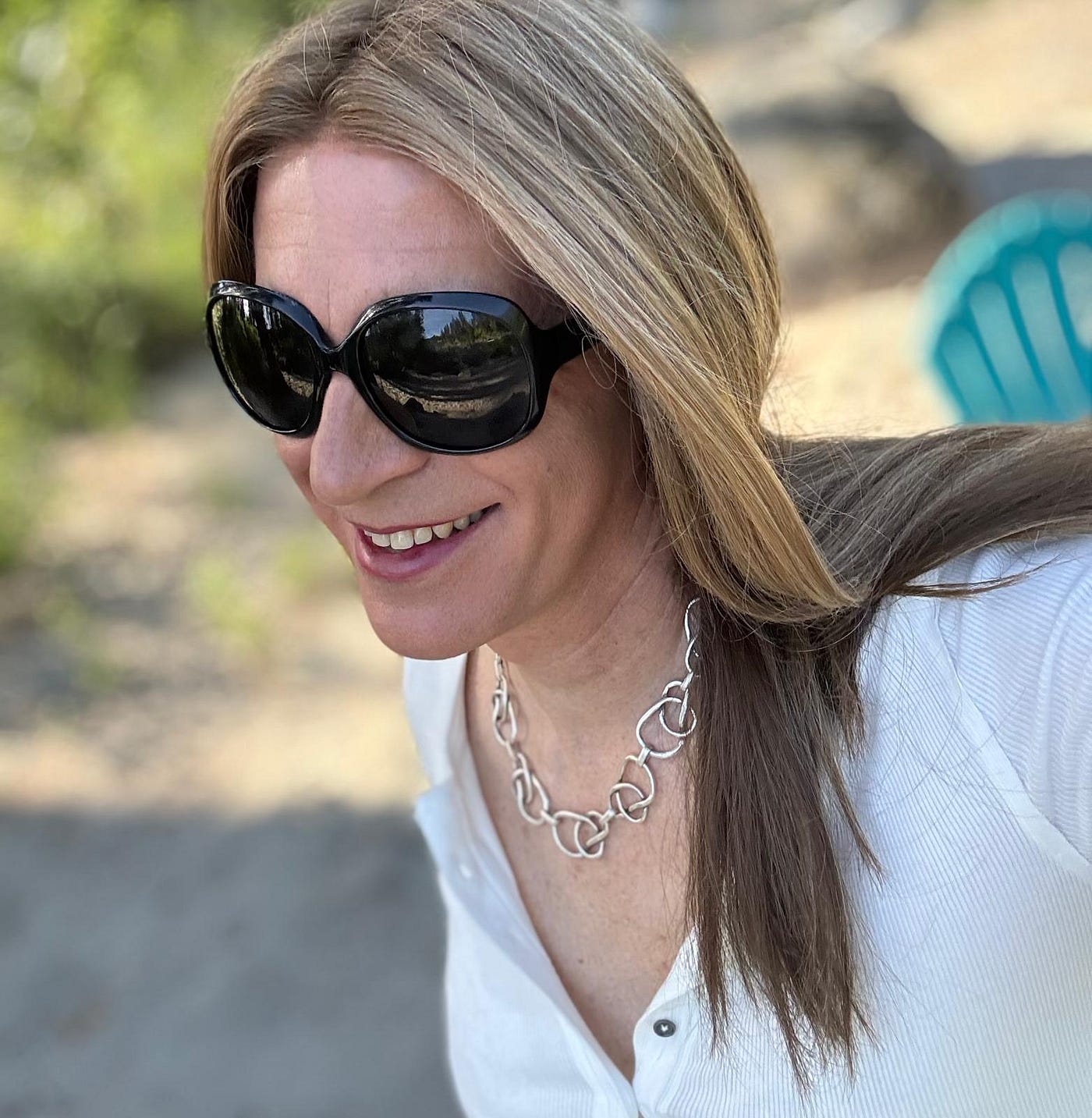
Breaking the Promise I Never Meant to Break
In sickness and in health… plot twist: gender evolution? — This was not addressed during our premarital retreat.
Breaking the Promise I Never Meant to Break
In sickness and in health… plot twist: gender evolution? — This was not addressed during our premarital retreat.
The words landed harder than I expected. “You’re breaking your promise.” It was early, the house still quiet, the coffee half-finished, and the day not yet in motion. Breast augmentation was getting closer, at least in theory, and in that moment, my wife said what she had circled around before but had never put so plainly. She told me I was breaking my promise about marriage and being a man. I felt it immediately. First guilt, then shame, then a flash of fear. Fear that she might be right. Fear that I was destabilizing something good. Fear of losing her.

Image from https://www.freepik.com/
She is trying. I need to say that clearly. She is trying to accept me as more feminine and to work on my transition. She is trying to reconcile this with her understanding of marriage, stability, and the life narrative she thought we were building. But trying does not mean it does not hurt. It hurts her and me. The word promise carries moral weight. It implies betrayal, intent, and a conscious decision to violate something sacred. That is where the shame hooks in.
Marriage vows are usually about fidelity, commitment, partnership, and shared life. They are not explicit contracts about fixed gender presentation, but they assume continuity. We marry with the implicit belief that the person standing in front of us will remain, in some essential way, who they appear to be. When she says “You’re breaking your promise,” what she feels is rupture. The man she married is shifting. The script of husband and wife, provider and protector, feels unstable. From her perspective, surgery is permanent. It is crossing a threshold that cannot be uncrossed. From mine, it represents alignment.
The question that will not leave me alone is whether I intended deception. When I married her, did I believe I was a man? The honest answer is mostly yes. I had questions, but I framed them as something weird I labeled as a kink (but see now as misinterpreted dysphoria), as compartments I could manage privately. I believed suppression was a responsibility. Research on late-transition adults shows that many genuinely believed they could override dysphoria at the time of marriage, and that sustained suppression correlates with worsening depression over time. That complicates the moral framing. I was not trying to change who I am. I was trying to survive. There is a difference between fraud and evolution. Deception requires intent. Identity misalignment often unfolds slowly and under pressure. Still, guilt does not evaporate just because logic improves.
When I ask myself whether I am choosing myself over her or choosing survival, the answer is uncomfortable because it is both. Preference-based decisions feel flexible. Survival-based decisions feel nonnegotiable. When I imagine permanently stopping transition, I do not feel relief. I feel despair. It feels like suppression and erosion. That matters. If this were just an indulgence, I could compartmentalize it forever. I did that before. But when I imagine doing that for the rest of my life, something in me collapses and fails. There is no clean binary between our internal identities and marriage. It is a conflict between psychological congruence and relational destabilization. Neither option is cost-free.
There’s a layer that makes sharing this a bit tricky because it touches on sexuality (some might call it perversion). In the past, feminine expression was often linked to sexual arousal, leading to cycles of impulse, shame, and promises to stop. These feelings are still part of both my and my wife’s memories. The underlying fear is strong: what if something sexual that developed under repression somehow invalidates something more genuine? It’s common for early gender expression to be tied to arousal under repression, but arousal itself doesn’t define the core experience. Over time, though, that sexual charge has lessened. Now, dressing more femme brings me relief, helps me feel grounded, and provides emotional stability. It helps me focus, function better, and reduce rumination and depressive spirals. Rather than escalating, this journey tends toward integration. If it were just a fetish, the intensity might grow with repeated acts, but instead it’s softened, and what’s left is a sense of alignment. Shame doesn’t just disappear when patterns shift; it whispers that if sexuality was ever involved, the whole thing might be considered corrupt. That’s a tough voice to silence.
Her grief is real and deserves space. When she says “being a man,” she means being a provider, a protector, and a solid emotional rock. I used to be less emotional. Now I cry more. I have breakdowns. Chronic fatigue from ET (Essential Thrombocythemia) and depression mean I cannot always carry (physically and mentally) what I used to. Something as simple as going shopping can wipe me out. She also says that life has never really been about her. It has been about my job, the kids, responsibilities, and now this. From her perspective, transition may look like one more adaptation she has to absorb. Research on transition and marriage suggests that destabilization often arises not from morality but from shifts in orientation and identity. Orientation is not infinitely elastic. If she is heterosexual and deeply oriented toward male bodies, asking her to remain fully attracted may be neurologically unrealistic. Just as suppressing my gender identity can harm me long term, suppressing her orientation can harm her long term. Neither of us should live in erasure. That is the structural question beneath the moral language.
Breast augmentation is concrete and visible in a way that hormones are not. Research shows surgery reduces dysphoria and improves body congruence, but it does not automatically resolve depression unless dysphoria was the primary driver. I do not expect it to fix everything. I know it will not repair every dysphoric strain. Now, BMI requirements may delay it again (as may other general health concerns). Part of me sees that as a strategic breathing room that could help us strengthen the foundation. Another part feels punished and undeserving. ADHD complicates exercise routines. Fatigue complicates consistency. Delay can be strategic, but it can also be shame disguised as caution. I am still sorting out which it is.
The most honest conclusion I have reached is that neither of us is a villain. Identity evolution is not inherently promise-breaking. Marriage survival depends on compatibility and compromise amid change, not on original assumptions. The real question may not be whether I broke a vow but whether this marriage can metabolize the shift. I could live with partial acceptance. I do not need ideological agreement or a perfect theological reconciliation. I don't want to be framed as sick or selfish. I need her to see that suppressing the feminine hurts me. If she could say she does not fully understand it but recognizes it is real for me and needed and may even be able to help, the first emotion I would feel would be relief, then calm (and only then joy 😊). That says something about what I am actually seeking.
When I imagine myself at seventy, two regrets compete. One is that I never allowed myself alignment and slowly eroded inside a life that looked stable from the outside. The other is that I risked too much pursuing it. The first regret feels sharper. That does not erase the relational cost or trivialize her grief. It simply clarifies the axis of fear. I am not chasing novelty or drama. I am trying to stop eroding. Will the internal doubt ever go away? maybe. Maybe not. What I’d really love is that we become a very close, huggy, touchy-feely out lesbian couple and we live “happily ever after”….. I don’t see that happening, but I can dream 😊.
This is not a clean story. I do not want victory or moral purity. It is messy, structural, and human. I loved her when I thought I was a man. I love her now. I do not want to win an argument about what gender is. I want us to be a team again. I want shared ground. I want to know I am not corrupt for needing alignment, and I want her to feel her grief matters. I did not set out to break a promise. I set out to survive. And somewhere between survival and partnership, we are trying to figure out whether we can both exist fully without erasing each other.
That is the real work. Not proving whether I am “really” trans. Not proving whether she is “really” supportive. But deciding, together, which future contains the least cumulative harm and the most honesty. I don’t know yet how it ends. But I know this: When I imagine being accepted (not celebrated, just accepted), the feeling is relief. And calm. And that tells me more than any button question ever could.
Thank you for reading my work. Post comments below if you have any pointers, ideas, suggestions, support, etc.
Loveya,
-Bev
Sorry, but I use lot’s of ellipses…. many trailing thoughts…. Checkout these articles also:
- ADHD, Dysphoria, and Intrusive Thoughts — https://medium.com/the-rational-garden/adhd-dysphoria-and-intrusive-thoughts-4773c1a8915d
- Hello, welcome to my trans journey — https://medium.com/@Bev_B/hello-welcome-to-my-trans-journey-c8e5196fa448
- My Wife’s book and her profile: https://medium.com/@amburnett
- My Son’s book and his profile: https://medium.com/@cbburnett
You can also ☕buymeacoffee☕ or ☕ko-fi.com☕. Did you know you can clap more than once, up to 50 times! I really like claps 😊🙂.
Thank you for your support!
메타데이터
- post_id
- 09a8b87cb58a
- slug
- breaking-the-promise-i-never-meant-to-break-09a8b87cb58a
- url
- https://medium.com/lost-in-transitions/breaking-the-promise-i-never-meant-to-break-09a8b87cb58a
- canonical_url
- https://medium.com/lost-in-transitions/breaking-the-promise-i-never-meant-to-break-09a8b87cb58a
- author_url
- https://medium.com/@Bev_B
- status
- ok
- fetched_at
- 2026-06-09 15:37:30