Not Too Cold, Just Right!
This publication highlight is part of the SBGrid Communities Project focused on science education and demonstrating how structural biology…
Publication Highlight
Not Too Cold, Just Right!
This publication highlight is part of the SBGrid Communities Project focused on science education and demonstrating how structural biology and preclinical science connect to medicine, a collaboration between SBGrid PI Piotr Sliz and Jamaine Davis of Belmont University.
When checking for a fever, a physician first checks your temperature. The physician proceeds with treatment based on the thermometer reading. Organisms similarly respond to temperatures, in a response called temperature sensing. Temperature sensing is crucial for organisms’ detection and response to environmental changes, and therefore for their survival. Thermoreceptor ion channels typically mediate this process, but the mechanisms underlying this sensing are poorly understood. To learn more, scientists used the SthK protein from the Spirochaeta thermophila model. Spirochaeta thermophila is a bacterium that can survive only within a specific temperature range, a property linked to SthK’s temperature sensitivity. SthK is a cyclic nucleotide-gated (CNG) ion channel protein that activates upon binding cAMP. Previous studies have shown that lipid headgroup type strongly affects SthK’s activity, with some enhancing activation and others inhibiting it. Crina Nimigean and researchers at Weill Cornell Medicine discovered that the ion channel SthK operates through a Goldilocks principle: in the presence of amine-containing lipids, at low temperatures, senses temperature by weakening the intersubunit salt bridge, and becomes open and active.
Given that SthK’s activity depends on the presence of cAMP and lipid type, researchers adjusted only the temperature of the SthK solution to assess SthK’s thermosensitivity at its root. This change led to the discovery of SthK as a cold-sensitive ion channel. Testing SthK’s activity in the absence of cAMP at low temperatures proved that cAMP must be bound for SthK to be thermosensitive. Next, researchers tested whether the lipid environment affects thermosensitivity. After confirming that it does, they assessed how variations in lipid type affect temperature sensitivity and found that temperature sensitivity ceases in the absence of an amine group. Researchers also observed SthK’s bias towards an intermediate closed confirmation. This work is important because SthK is a homolog of the eukaryotic CNG and HCN channels, and may share similar mechanisms that will aid future research of thermoreceptor ion channels and their possible uses in humans.
In their study, the authors uncovered an intersubunit salt bridge between Arg136 and Asp226. The salt bridge appeared state-dependent, with a shorter distance between the two residues in the closed state and longer in the open state. For SthK to achieve an open, active state, the bridge needed to be weakened. Because of this dependence on the salt bridge’s strength in the presence of amine-containing lipid, researchers identified the salt bridge as the “cold” sensor. To confirm its role as the cold sensor, researchers sought to disrupt the salt bridge by altering one of the residues responsible for its production, which led to the elimination of the bridge as a whole. Pivoting, researchers next mutated a chain near Asp226 to arginine, forming SthK K229R and observed high activity and an open state in SthK, as well as increased temperature sensitivity. They concluded that the salt bridge does, in fact, act as a temperature sensor, but only in a specific lipid environment at lower temperatures, in the presence of cAMP, thereby further supporting SthK’s use of the Goldilocks principle.
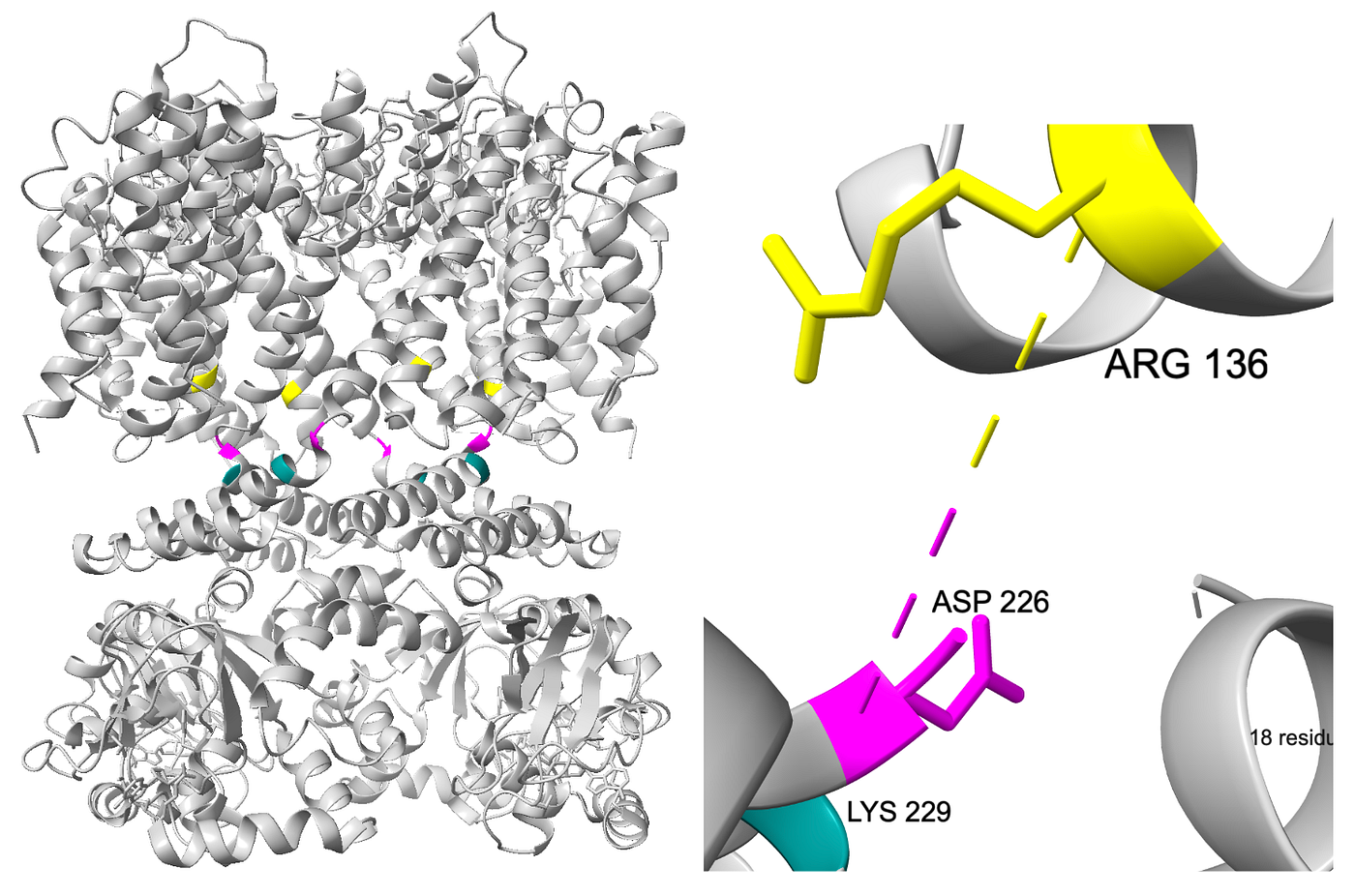
Left: Full view of ion channel SthK in an open state with key residues highlighted (PDB 7TJ6). Right: Superimposed view of SthK in an open state with a focus on the membrane interface that depicts key residues (PDB 7TJ6). The intersubunit salt bridge is between Asp 226 (magenta) and Arg 136 (yellow), represented by the dashed line. Lys 229, which was mutated to verify the salt bridge’s role as the cold sensor, is highlighted in teal. CC by SBGrid.
SthK is in an active, open state when surrounded by amine-containing lipid groups and at lower temperatures, both of which weaken the salt bridge that would otherwise keep SthK closed. Understanding how lipid headgroup composition affects thermoreceptors like SthK is crucial to defining their mechanisms as a whole, as many thermoreceptors are membrane proteins embedded in lipid bilayers. Additionally, recognizing the presence of the salt bridge and its lipid-type dependency can be applied when investigating other cold-sensitive thermoreceptors and could also serve as a foundation for exploring hot-sensitive thermoreceptors.
Read more in *Nature Communications*.
By Cariuna M. Ellison (Cariuna Ellison), Fisk University
Cariuna M. Ellison is an undergraduate student at Fisk University, pursuing a Bachelor’s degree in Biochemistry and Molecular Biology. She is on track to graduate in May 2028. In her free time, she enjoys reading, exercising, and giving back to her community in any way she can.
메타데이터
- post_id
- 19ebb647354e
- slug
- not-too-cold-just-right-19ebb647354e
- url
- https://medium.com/sbgrid-community-news/not-too-cold-just-right-19ebb647354e
- canonical_url
- https://medium.com/sbgrid-community-news/not-too-cold-just-right-19ebb647354e
- author_url
- https://medium.com/@sbgrid
- status
- ok
- fetched_at
- 2026-06-09 15:37:30