The Heroic Boston Marathon Video Is Challenging Me To Be a Better Person
Two runners sacrificed their times to help another runner in need
The Heroic Boston Marathon Video Is Challenging Me To Be a Better Person
Two runners sacrificed their times to help another runner in need
Photo by Richard Scordato on Unsplash
By now, millions of people have probably seen a video of the finish at the 2026 Boston Marathon. A runner is collapsing on the ground, struggling to get up and finish the race. Several seconds pass as he’s encouraged by spectators and keeps trying to finish, but struggles to. About a hundred runners pass by without helping him.
Then, one runner stops and gives him a hand to carry him, but struggles to get a good grip. Another runner, two or three seconds later, also stops by to give more support, and each runner takes one arm. They carry him to the finish, where he can receive medical attention and finish the race.
As a marathoner myself who has also struggled in the Boston Marathon, it is a heartwarming moment in a world and time that feel especially chaotic, where it is difficult to have a lot of faith in the good in the world. But this inspiring moment of two runners willing to sacrifice time in the Boston Marathon, one of the most prestigious marathons in America, to help another struggling runner gave a lot of hope, and went viral for good reason.
[embed]
I usually try not to use the names of regular, average people like myself in articles. They didn’t ask for the attention, but the video has gone viral enough, and these men deserve more recognition.
Aaron Beggs was the runner in the yellow singlet, and Robson De Oliveira was the runner in the white singlet, and they helped Ajay Haridesse. Despite the situation, all three runners finished with an excellent time of 2:44 (around 6:20 mile pace), with Beggs and Oliveira only narrowly missing their personal bests to help out Haridesse.
When I saw the video, I almost cried at the inspiring and sacrificial actions of the two runners. I still almost cry every time I watch the video as a grown, stoic presenting man.
But then I scrolled through the comments on this video and various other places this video was re-posted on my Instagram feels. There were very negative comments. A couple mentioned how the Haridesse deserved a disqualification (DQ) for being aided to the finish line. A couple very negative people questioned why people would spectate and film Haridesse for about 20 seconds and not help. Some questioned why a medic did not come to aid Haridesse sooner.
But there was a common criticism that gained a lot of likes and traction: Why did all those runners run past him and not do anything to help?
Upon reading that comment, I felt a bit guilty. Like a lot of runners, I watched the video and thought:
“Would I have stopped to help him?”
The unfortunate answer? It depends. If I were running a personal best and cared so much about the time that I was not willing to sacrifice it, I would probably not have stopped to help him. I may have asked, “are you good, man?” and then tried to flag down a medic at the finish line.
But if I were not hitting my time anyway and did not care about the time anymore, I would have likely stopped to help him.
I felt guilty that my answer to this self-imposed question was not an unequivocal yes. But clearly, a hundred people also passed Haridesse without stopping to help, and I want to push back against the implication that these were bad people, as there are several reasons why runners don’t help that are common thoughts or experiences for a lot of runners. I’ll just summarize these reasons:
- You don’t want to get that runner DQ’d.
- You don’t notice because you’re in so much pain yourself, especially after running 26 miles.
- You’re worried about your own time and race.
- You might need medical attention and hydration yourself when you cross the finish.
- You’re worried you won’t be much help and will only make the situation worse since you’re not a doctor or medic.
I recall one marathon where another runner was struggling substantially and I did offer to help. It was the 2022 Baltimore Marathon. By mile 15, I had fallen substantially off my goal time and was having spasms in my hamstrings and calves. I was aerobically feeling fine and not breathing hard, but my legs did not have it on that day.
I ended up running around 2:52 for that marathon, which was well off my goal time. There were several runners around me, and as some of them were struggling and had to walk or stop, I did my best to encourage them, tell them they were doing great, and invited them to run with me to the finish. I wanted ot be that positive presence since I was feeling so negatively about my own race at that point.
But I distinctly recall one runner who was vomiting continuously in the last six miles of the race. He was running faster than I was, and would pass me, and then peel off to the side of the road and vomit again. I saw this happen about four or five times.
I did stop and ask him at one point if he wanted me to get him some help from a medic, and he said no and that he was fine. At the time, I did question whether someone who kept vomiting on the course was fine, but as I kept running, he kept passing me and was capable of keeping up a faster pace than me. Looking back, he was probably just having some major digestive issues, but that’s not what I thought at the time. Regardless, he was insistent on finishing and doing so without assistance.
I don’t recall if he beat me or not, but it’s possible. I remember it was pretty close, given he could run faster than I could at that stage of the race. I found him after the finish. He thanked me for checking on him and encouraging him, and at that point, he was not vomiting anymore and was fine, so we went about our days and wished each other the best.
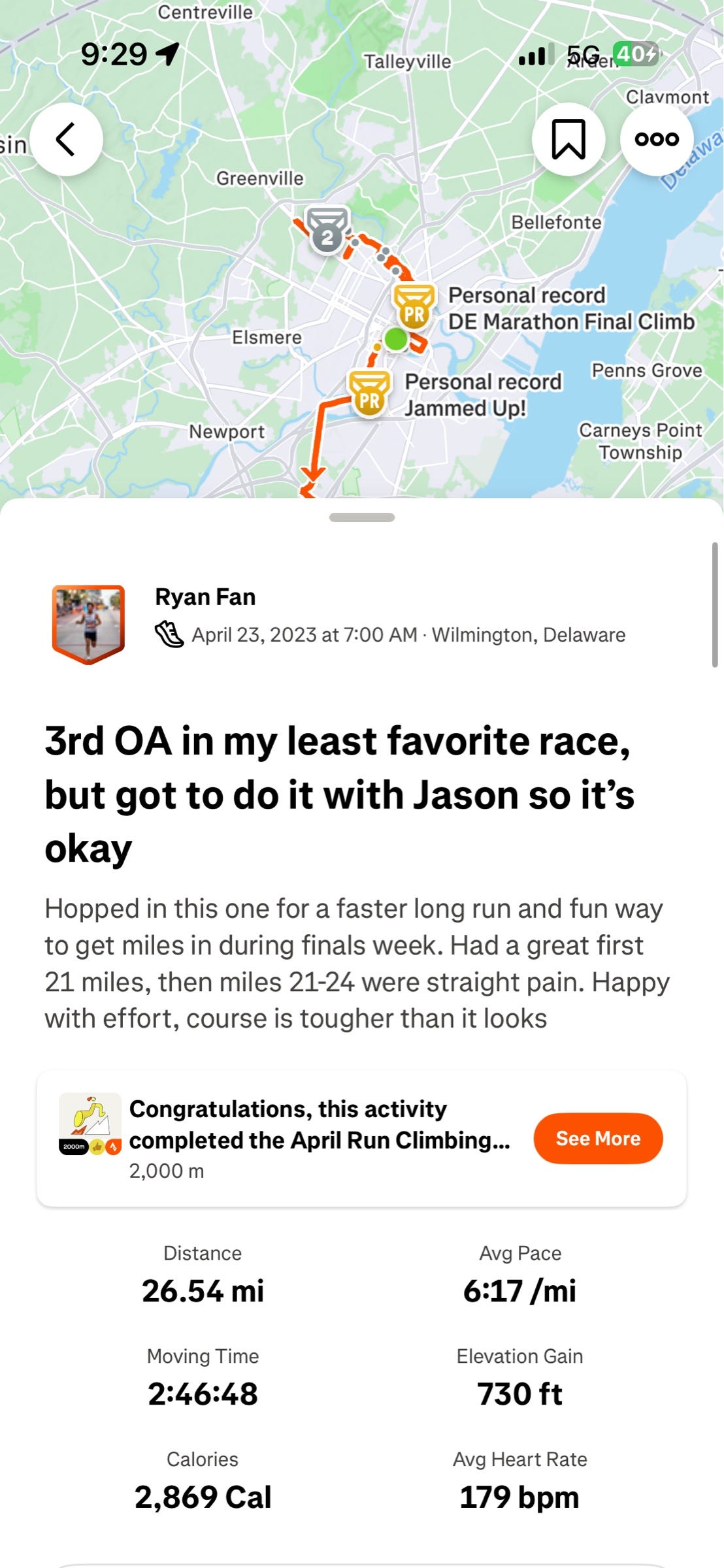
I have run the Boston Marathon before. I ran it in 2024, and ran my worst marathon time ever: a 3:14. I did it limping and walking to the finish line after the halfway point.
It is not the same as Haridesse, but at various times, I had to stop and stretch as I was having major cramps and spasms in my calf. Some spectators asked me if I was fine, and I waved them off. I did not want a DQ, but I also did not want to inconvenience anyone, especially not another runner who was going for their time. It was also not my first rodeo with these types of spasms — I knew I needed electrolytes and some time to not run for a bit for my calf to recover and to run again. I walked/jogged for a while before I was able to run at a pretty slow pace again.
My situation was not a medical emergency that year. It was about 70 degrees Fahrenheit, which is a lot warmer than is ideal for the marathon, and to me, a very tough temperature to compete in. The spasms and cramps came from a combination of undertraining and the heat. My breathing was fine, but my legs were not.
What happened with Haridesse happens, unfortunately, many times over the course of a race, particularly from miles 17–23 (“the wall”) and particularly in a race as big as the Boston Marathon. The conditions were good this year, but the year I did it was particularly brutal for people who had to drop out due to the heat.
I often look over in medical tents to see people getting IVs. I see runners have to stop, walk, limp, runners who are crying when the race has cratered for them and they have to drop out. I like to think they are trying to find the closest medical tent, but I don’t know. I probably only see a fraction of people who need medical attention in the middle of the race, as I try to only look in front of me and not what happens when someone has to pull to the side of the road and stop. There is a tunnel vision of just getting to the next mile or checkpoint when in pain.
I often find that unless people know the person, very few people stop to help or even check on them. I think this video went viral because it captured not only the heroic actions of De Oliveira and Beggs, but also because it was at the finish line. Logistically, the most medical help Haridesse was going to get was the finish.
But, throughout the race, this isn’t true since the finish is so far away. The runner who peels off to the side of the road, possibly needing medical support, will receive the most support from a medical tent. Most other runners do not know where the next tent is, and would only make the situation worse by trying to render aid if they didn’t know where that runner could get support.
Spectators would be a lot better equipped in that situation to call for help. Sometimes, I will run past another runner who is stopped or walking and in pain, and feel guilty: while I feel really bad in that moment, at least I don’t feel that bad. I know that is a bad thing to think, but I also know it is a very human thought that a lot of runners feel.
It’s not that we runners don’t feel bad when we see runners struggle like this or have medical situations, but at certain stages of the race that are not close to the finish line, there is nothing we can do. Most of us are not doctors or paramedics, and many of us are also feeling exhausted ourselves.
During that Boston Marathon, I did not want to stop because I really wanted to finish. As bad as it was going, I needed to finish the race. I wanted to drop out badly, but at the same time, never would have let down having a “DNF” next to my name at the Boston Marathon. Of course, I could have just come back to run it another year to redeem my poor performance, but I at least wanted to finish.
Plus, I had several logistical considerations despite my considerable physical pain and suffering. What was I going to do to get back to the finish? Wait for an ambulance? With all the road closures in the race? How long would that take? How was I going to get my bag with my phone, wallet, and keys?
During the Boston Marathon, one option is to take the train that’s to your left into Boston. I did not want to do this either, as I did not have my phone on me and did not have any money for the fare. I had to finish fast enough to drive back to Baltimore from Boston and make it to work the next day. Thus, the fastest and most convenient way to end the pain and suffering was to somehow finish the race.
“I had absolutely no doubt in my mind that I was going to get to the finish line…That may sound overconfident, or even arrogant, given how messed up I was, but I would have never forgiven myself if I didn’t cross…I watched one of my idols, Cooper Teare, crawl to the finish in a national championship a couple years ago and I was mentally preparing to have to do the same,” Haridesse said.
For the record, Haridesse is referencing this video of elite runner Cooper Teare collapsing meters from the finish line and needing to crawl and limp to the finish at the 2021 NCAA Cross Country Championships. Teare brushes off medical assistance from medics, and dozens of runners pass him.
[embed]Video from NCAA Championships on YouTube
What many people, including me, didn’t see in this video is what happened at the finish line. Beggs helps Haridesse get medical attention, but De Oliveira is in the background, collapsing himself. He ends up needing a wheelchair from the medical staff at the Boston Marathon.
Beggs notes that De Oliveira, at the finish, was in worse shape than Haridesse. This makes it even more admirable that De Oliveira stopped to help in that moment when he was at a point of absolute exhaustion himself.
“I knew I wouldn’t have the strength to help him on my own…And God was so generous to us that Aaron Beggs stopped, and I knew I could help, because two are stronger than one,” De Oliveira said.
Beggs and De Oliveira are true heroes, and this context is a challenge to us all to be better, especially us runners, especially those of us like myself who likely would have run past Haridesse and not offered assistance. I haven’t been in the exact situation as Haridesse, especially that close to the finish, but I can empathize with that type of pain during a marathon.
There’s probably some valid criticism that we’re glamorizing and taking inspiration from moments that could be medical emergencies, but I think a lot of those critics don’t understand what goes through the mind of the runner at the moment, who desperately wants to finish and will do everything possible to do so. There is a point when medical staff need to save the runner from themselves, like trainers do when athletes are injured. I don’t know if Haridesse’s struggle at that moment was one of those times.
Perhaps I just take too much stock in random commenters on Reddit, YouTube, and Instagram, where I always should expect a lot of negativity. But I felt like people did not adequately understand why so many people passed without helping or fully appreciate the significance of what Beggs and De Oliveira did in that moment.
Being a runner, I appreciate the actions of Beggs and De Oliveira more than a lot of people because I know what they had to sacrifice to give a fellow runner a helping hand during a time of need. They had to sacrifice not only their own times and personal bests, but months and years of training to make it to the Boston Marathon. They put the well-being of another human being above their own goals and ambitions, something many of us, including myself, would struggle to do. And they had to do this in a state of their own exhaustion.
I went back and forth over whether the hundred runners who didn’t stop, and runners like me, who likely wouldn’t stop, were bad people for not doing so. Ultimately, I don’t think so, given the totality of factors and considerations of each situation, including this one. Most people do not know how much pain and agony the average runner feels at mile 26 of the marathon, so I think casting judgment on split-second decisions made at that moment is wrong.
Beggs and De Oliveira’s actions in this moment are a challenge to all of us runners to look out for each other and do what they would do in that situation. They are a challenge for me to remember that there are more important things than running fast times and personal bests.
Above all, they are a reminder that in this sea of demoralizing news, there are still good people in this world willing to go out of their way to help another human being in need.
메타데이터
- post_id
- 2192bc3c6ab1
- slug
- the-heroic-boston-marathon-video-is-challenging-me-to-be-a-better-person-2192bc3c6ab1
- url
- https://medium.com/@ryanfan/the-heroic-boston-marathon-video-is-challenging-me-to-be-a-better-person-2192bc3c6ab1
- canonical_url
- https://medium.com/@ryanfan/the-heroic-boston-marathon-video-is-challenging-me-to-be-a-better-person-2192bc3c6ab1
- author_url
- https://medium.com/@ryanfan
- status
- ok
- fetched_at
- 2026-06-15 20:49:13