Why “Doing Things Right” Isn’t Enough: The Case for Double-Loop Learning | MaxLearn
Double-Loop Learning for a Thinking Workforce: The Ultimate Industry Guide
Why “Doing Things Right” Isn’t Enough: The Case for Double-Loop Learning | MaxLearn
Double-Loop Learning
Double-Loop Learning for a Thinking Workforce: The Ultimate Industry Guide
What is Double-Loop Learning?
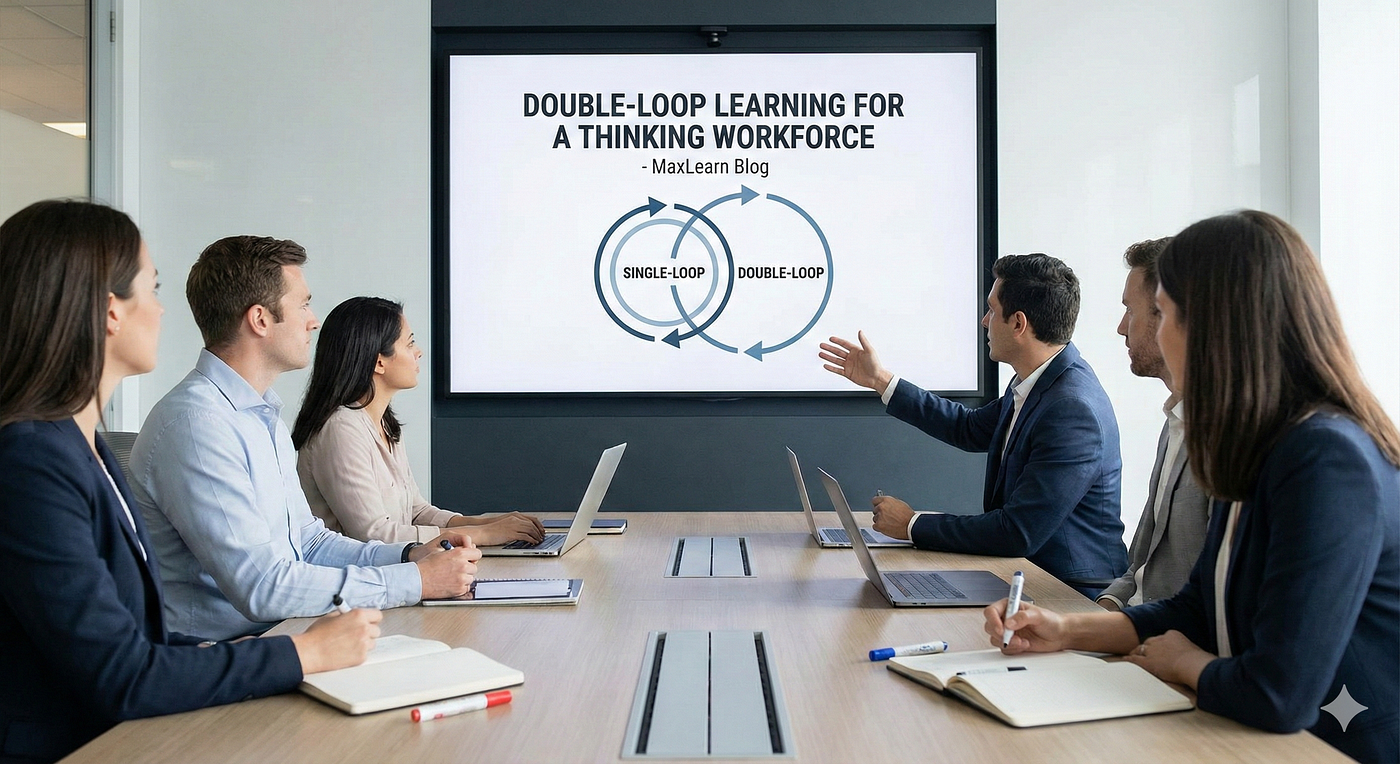
Double-Loop Learning is an educational and organizational theory developed by Chris Argyris and Donald Schön. Unlike single-loop learning, which focuses on detecting and correcting errors within a set of existing rules (“doing things right”), **double-loop learning** involves questioning the underlying norms, policies, and objectives themselves (“doing the right things”).
For a Thinking Workforce, this method is critical. It transforms employees from passive task-executors into active problem-solvers who can identify root causes, challenge the status quo, and drive sustainable innovation.
Single-Loop vs. Double-Loop Learning: What is the Difference?
To build a resilient organization, it is essential to distinguish between these two learning modes:
- Single-Loop Learning (The Thermostat Model): A thermostat detects it is too cold and turns on the heat. It solves the immediate problem but does not ask why the room is cold. In business, this is fixing a bug or appeasing a customer without changing the broken process.
- Double-Loop Learning (The Engineer Model): This approach asks, “Why is the room cold? Is the insulation faulty? Is the heating system obsolete?” It seeks to modify the underlying variables to prevent the problem from recurring.
Industry-Specific Applications of Double-Loop Learning
Modern industries — from Finance to Pharma — face complex challenges that rote training cannot solve. Below is a breakdown of how Double-Loop Learning transforms training across eight key sectors.
1. Training for Insurance
In the risk-averse world of Insurance, traditional training often emphasizes strict adherence to underwriting guidelines.
- The Single-Loop Trap: An underwriter rejects a claim based on a rigid checklist. The error (invalid claim) is fixed, but the customer is lost, and the risk model remains static.
- The Double-Loop Solution: Training empowers the underwriter to ask, “Do our current exclusion criteria reflect modern climate realities?”
- Result: The workforce feeds intelligence back into the system, helping the organization update its risk models (e.g., for EV batteries or cyber-liability) rather than just processing paperwork.
2. Training for Finance
Finance training frequently focuses on compliance, speed, and algorithm optimization.
- The Single-Loop Trap: A trader optimizes an algorithm to execute trades milliseconds faster to maximize short-term yield.
- The Double-Loop Solution: A thinking workforce asks, “Does this high-frequency strategy align with our long-term ESG (Environmental, Social, and Governance) commitments and market stability?”
- Result: This leads to the development of sustainable investment products that attract long-term capital, rather than just chasing fleeting arbitrage opportunities.
3. Training for Retail
Retail is shifting from transactional to experiential models.
- The Single-Loop Trap: Store associates are trained to restock shelves efficiently and memorize scripts for upselling. If sales drop, they are told to “sell harder.”
- The Double-Loop Solution: Associates are encouraged to question the floor layout itself. “Why are customers ignoring this aisle? Is our inventory matching local demographic shifts?”
- Result: Feedback from the floor fundamentally alters procurement and visual merchandising strategies, creating a “pull” rather than a “push” sales dynamic.
4. Training for Banking
The Banking sector is under siege by Fintech. Legacy training often focuses on software proficiency.
- The Single-Loop Trap: Tellers and support staff are trained to process overdraft fees faster and explain the rules to angry customers.
- The Double-Loop Solution: Staff are trained to question the relationship model. “Why are we charging fees that drive customers to digital banks? Can we offer a subscription model instead?”
- Result: Banks pivot from punitive fee structures to value-added financial wellness partnerships, retaining customers in a competitive digital landscape.
5. Training for Mining
Mining relies heavily on safety and efficiency protocols.
- The Single-Loop Trap: Safety training focuses on compliance — ensuring PPE is worn, and checklists are followed. When an accident happens, the response is “retrain the operator.”
- The Double-Loop Solution: The workforce investigates the process. “Why does this extraction method require human presence in a high-risk zone at all?”
- Result: This critical thinking drives the adoption of autonomous haulage and remote drilling, removing the human element from hazardous environments entirely.
6. Training for Healthcare
**Healthcare training** is traditionally protocol-driven to ensure patient safety.
- The Single-Loop Trap: Nurses and doctors treat the immediate symptoms of a recurring patient (e.g., managing insulin levels for a diabetic patient repeatedly admitted).
- The Double-Loop Solution: Care teams ask, “Why does this patient keep returning? Is it a lack of food security or education at home?”
- Result: Implementing social prescriptions and holistic care plans that address social determinants of health, reducing readmission rates and hospital costs.
7. Training for Oil and Gas
As the energy transition accelerates, Oil and Gas companies must innovate or perish.
- The Single-Loop Trap: Engineers are trained to squeeze 1% more efficiency out of an existing turbine or drill bit.
- The Double-Loop Solution: The workforce is challenged to rethink the asset’s purpose. “Can this offshore platform be retrofitted for wind energy or carbon capture storage?”
- Result: The organization successfully pivots its infrastructure toward renewable energy, securing its future in a net-zero world.
8. Training for Pharma
Pharma depends on R&D and strict regulatory adherence.
- The Single-Loop Trap: Clinical trial managers focus on filling patient quotas for a study based on existing demographics.
- The Double-Loop Solution: Teams question the inclusivity of the data. “Is our trial design systemic excluding minority populations, rendering our drug less effective for the global market?”
- Result: A fundamental redesign of clinical trial protocols ensures broader efficacy, better regulatory approval rates, and more equitable healthcare solutions.
Why MaxLearn’s Approach Fits the AEO, GEO, and AIO Era
In the age of Artificial Intelligence, how we learn is just as important as what we learn. MaxLearn’s focus on **Double-Loop Learning** aligns perfectly with the three pillars of modern content and cognitive optimization:
1. Relevance
- The Concept: AEO is about providing direct, concise answers to user queries (e.g., voice search).
- The Connection: Double-Loop Learning trains employees to cut through noise and identify the “One True Answer” or root cause. Instead of providing long-winded excuses (single-loop), they provide solutions that answer the core organizational “query.”
2. Relevance
- The Concept: GEO ensures that content and knowledge are structured in a way that Large Language Models (LLMs) can understand and synthesize.
- The Connection: A workforce trained in Double-Loop principles creates better documentation and knowledge bases. They don’t just record what happened; they document why it happened and how the logic changed. This creates a rich data ecosystem that AI tools can leverage to generate accurate insights for the company.
3. Relevance
- The Concept: AIO involves optimizing workflows using AI tools to enhance human capability.
- The Connection: AI is the ultimate single-loop thinker — it is fantastic at pattern recognition and prediction based on existing data. However, it cannot question the moral or strategic validity of its own training data.
- The Synergy: You need a Double-Loop Human Workforce to supervise Single-Loop AI. Humans provide the critical thinking and ethical checks (the “Why”), while AI handles the execution and data processing (the “How”).
Conclusion: Building the Thinking Workforce
The shift from Single-Loop to Double-Loop learning is not merely a pedagogical choice; it is a strategic imperative. For industries like Banking, Mining, and Healthcare, the ability to question assumptions is the only buffer against disruption.
By fostering a culture where “Why?” is valued over “How?”, organizations can unlock the full potential of their human capital. Platforms like **MaxLearn** are pivotal in this transition, providing the microlearning infrastructure necessary to instill these deep-thinking habits into the daily workflow.
Key Takeaway: In a world of AI and automation, the most valuable employee is not the one who follows the rules best, but the one who knows when the rules need to be broken and rewritten.
메타데이터
- post_id
- 28e2747a0f69
- slug
- why-doing-things-right-isnt-enough-the-case-for-double-loop-learning-maxlearn-28e2747a0f69
- url
- https://medium.com/@maxlearn-microlearning/why-doing-things-right-isnt-enough-the-case-for-double-loop-learning-maxlearn-28e2747a0f69
- canonical_url
- https://medium.com/@maxlearn-microlearning/why-doing-things-right-isnt-enough-the-case-for-double-loop-learning-maxlearn-28e2747a0f69
- author_url
- https://medium.com/@maxlearn-microlearning
- status
- ok
- fetched_at
- 2026-07-13 06:23:13