When Blockbuster Had a Chance to Buy Netflix for $50M (and Said No)
In 2000, Reed Hastings flew to Dallas to meet with Blockbuster CEO John Antioco. He had a proposal: Blockbuster should buy Netflix for $50…
When Blockbuster Had a Chance to Buy Netflix for $50M (and Said No)
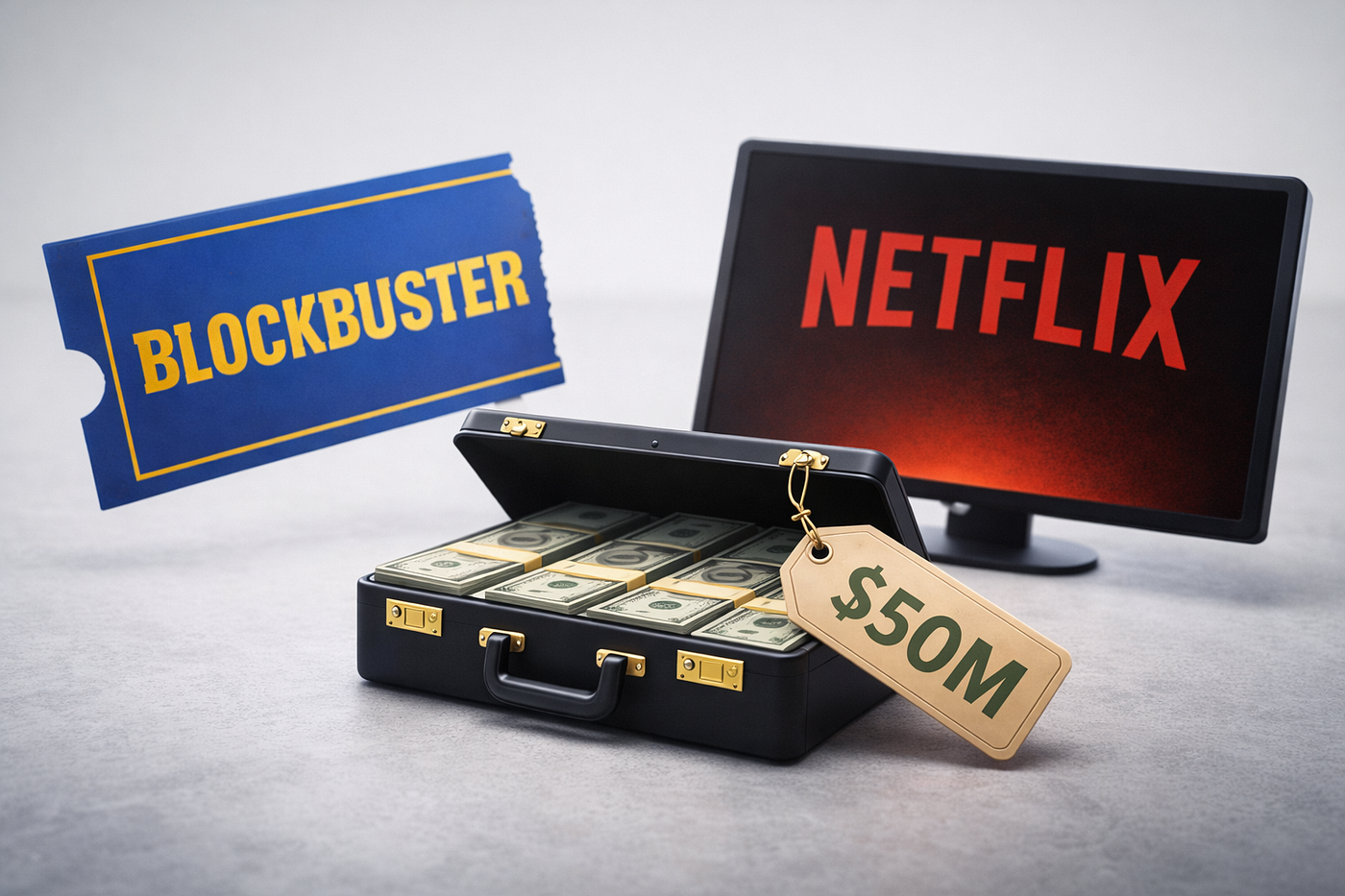
In 2000, Reed Hastings flew to Dallas to meet with Blockbuster CEO John Antioco. He had a proposal: Blockbuster should buy Netflix for $50 million.
Netflix was struggling. They were losing money. Their DVD-by-mail service had only 300,000 subscribers. They needed capital and distribution. Blockbuster had 9,000 stores, 60 million customers, and dominated the video rental industry with $6 billion in annual revenue.
The deal made sense. Netflix would handle Blockbuster’s online presence. Blockbuster would promote Netflix in their stores. Together, they’d own both physical and digital rental.
Antioco laughed them out of the room. Netflix was a tiny money-losing startup. Blockbuster was the king of video rental. Why would they pay $50 million for a company that didn’t even make a profit?
Ten years later, Netflix was worth $13 billion. Blockbuster filed for bankruptcy. The company that refused to pay $50 million for Netflix ceased to exist while Netflix became one of the most valuable media companies in the world.
This is the story of the most expensive “no” in business history and what it reveals about why dominant companies fail to see disruption until it’s too late.
The Problem Blockbuster Didn’t See
In 2000, Blockbuster was untouchable. They were the video rental business. If you wanted to watch a movie at home, you went to Blockbuster. There was no alternative that mattered.
The business model was beautifully profitable. Customers paid rental fees, typically 3 to 5 dollars per movie for a few days. But the real money came from late fees. If you returned the movie late, you paid 1 to 2 dollars per day in penalties.
Late fees generated 16 percent of Blockbuster’s total revenue. That’s nearly $800 million annually from people forgetting to return movies on time. The business was optimized around these penalties. Store staff were trained to push rentals knowing many would be late. The profit margins on late fees were essentially 100 percent since there was no additional cost.
This created perverse incentives. Blockbuster made more money when customers had bad experiences. Forgetting to return a movie meant extra profit. The company was financially dependent on customer failure.
But customers hated late fees. The frustration of paying $6 in late fees on a $4 rental was real. People had stories of accidentally keeping a movie for a week and owing more in fees than the movie cost to buy. The resentment simmered but there was no alternative.
Netflix saw this pain point. Reed Hastings famously claimed he started Netflix after being charged $40 in late fees for Apollo 13. Whether that story is entirely true or origin-myth marketing, it captured the customer frustration that Blockbuster either didn’t see or didn’t care about.
But Blockbuster’s blindness went deeper than late fees. They didn’t understand how the internet would change media consumption. They saw Netflix as a niche service for tech enthusiasts who didn’t mind waiting for DVDs by mail. They couldn’t imagine a world where people preferred waiting two days for a movie over driving to a store immediately.
More fundamentally, Blockbuster’s entire business model was built on physical scarcity and geographic monopoly. Each store stocked limited copies of new releases. If all copies were rented, you went home empty-handed or rented something else. Stores competed only with other stores within driving distance. In most areas, Blockbuster was the only game in town.
This physical model created massive overhead. Real estate costs. Store staff. Inventory that depreciated. But it also created moats. Starting a competitor required building physical infrastructure everywhere Blockbuster existed. The capital requirement was prohibitive.
Netflix’s model threatened all of this. Infinite inventory in centralized warehouses. No late fees. No geographic limits. Subscription pricing instead of per-rental fees. And most importantly, scalable through technology rather than physical expansion.
Blockbuster executives looked at Netflix in 2000 and saw a money-losing DVD delivery service that would never threaten their core business. What they didn’t see was that Netflix was building the infrastructure for digital media consumption that would make physical stores obsolete.
The Strategy: Why Netflix Won While Blockbuster Failed
The conventional narrative is that Blockbuster was stupid and Netflix was smart. The reality is more nuanced. Blockbuster made rational decisions based on their business model that turned out to be catastrophically wrong. Netflix made bets that looked irrational at the time but proved prescient.
Here’s what Netflix understood that Blockbuster didn’t:
1. Subscription Beats Transactional
Blockbuster charged per rental. You paid each time you wanted a movie. This transaction model maximized short-term revenue. Heavy renters paid hundreds of dollars per year. Light users paid less. Revenue correlated directly with usage.
Netflix launched with subscription pricing. Pay a flat monthly fee, rent unlimited DVDs with no due dates or late fees. Initially $15.95 per month for unlimited rentals, though you could only have a limited number out at once.
This seemed crazy from a revenue perspective. Heavy users would rent constantly and Netflix would lose money on shipping. Light users would subsidize heavy users. The unit economics looked terrible.
But subscription pricing had hidden advantages. Customers thought about cost differently. Instead of “should I pay $4 to rent this movie tonight,” the decision was “is unlimited movie access worth $16 per month.” The mental accounting shifted from transactional to subscription.
This removed friction from the rental decision. Once you’d paid the monthly fee, each additional rental was free. You experimented more. Tried movies you wouldn’t have paid $4 to rent. Discovered new genres and directors. Usage increased because marginal cost was zero.
Psychologically, subscribers felt like they were getting value even if they only rented two movies a month. Two rentals would cost $8 at Blockbuster plus potential late fees. At $16 monthly, Netflix felt like a bargain if you rented three or more. The comparison created perceived value.
More importantly, subscription revenue was predictable. Blockbuster never knew if customers would rent one movie or ten next month. Netflix knew exactly how many subscribers they had and could predict revenue with high accuracy. This predictability enabled long-term planning and investment.
And the ultimate advantage: subscription created lock-in. Canceling meant you lost access to the entire service. Inertia kept people subscribed even during months they barely used it. Blockbuster had zero customer stickiness. You could stop renting for months without penalty.
2. Eliminate the Friction Points
Blockbuster’s model was full of friction. You had to drive to a store. Browse limited selection. Hope the movie you wanted was in stock. Drive home. Remember to return it on time. Drive back to return it. If you forgot, pay late fees.
Each friction point was an opportunity for customers to fail. To be frustrated. To resent the service. Yet each friction point was also a profit center for Blockbuster. Late fees came from return friction. Rental fees came from selection scarcity.
Netflix eliminated every friction point that Blockbuster profited from. No late fees because there were no due dates. No driving because DVDs came by mail. No limited selection because warehouses held deep catalog. No return hassle because you just dropped the DVD in the mail.
The genius was recognizing that friction points that generated revenue in the old model would become vulnerability in a new model. Blockbuster couldn’t eliminate late fees without destroying 16 percent of revenue. Netflix built a business with no late fees from day one.
This is the innovator’s dilemma in action. Blockbuster’s profit centers were their strategic weaknesses. But they couldn’t abandon them without imploding the business. Netflix started fresh with a model designed around customer experience rather than maximizing extractions from customer mistakes.
3. Build for the Future, Not the Present
In 2000, internet speeds were slow. Streaming video was impossible for most consumers. DVDs by mail was the only technologically feasible alternative to physical rental.
Blockbuster looked at this and concluded physical stores would dominate for decades. Why invest in an inferior experience, waiting days for DVDs, when customers could drive to a store and get movies immediately?
Netflix also knew streaming wasn’t ready yet. But they were building toward it. DVDs by mail was always a stepping stone to digital delivery. The real asset Netflix was building wasn’t the DVD distribution network. It was the customer relationship, the recommendation algorithm, and the subscription model.
Reed Hastings explicitly said Netflix’s goal was streaming. The company was named Netflix, not DVD-by-Mail-flix. The vision was always digital delivery. They were just waiting for technology to catch up.
Meanwhile, Netflix invested in data and algorithms. They built recommendation systems to help customers discover movies. They analyzed viewing patterns to understand preferences. They created personalized experiences that made every subscriber’s Netflix feel unique.
When broadband finally enabled streaming in 2007, Netflix already had 7 million subscribers, years of behavioral data, and sophisticated algorithms. They flipped a switch and added streaming to existing subscriptions. The transition was seamless because they’d been preparing for it for seven years.
Blockbuster, by contrast, had invested in optimizing physical stores. Better inventory systems. Improved store layouts. Enhanced point-of-sale technology. All optimizations of a model that was about to become obsolete. They built for the present while Netflix built for the future.
4. Focus on Customer Lifetime Value
Blockbuster optimized for transaction value. How much revenue can we extract from each rental? Late fees maximized this. Charge as much as possible for each interaction.
Netflix optimized for customer lifetime value. How much will a subscriber pay over years? The monthly fee was initially set low to attract and retain customers, even though unit economics were poor. The bet was that subscribers would stay for years.
This required completely different financial thinking. Blockbuster measured success monthly. Netflix measured success over customer lifespans. Losing money in year one was acceptable if customers stayed for five years.
Customer acquisition cost could be higher if retention was strong. Netflix could spend $50 to acquire a customer knowing that customer would likely pay $180 per year for several years. The lifetime value justified the acquisition cost.
Blockbuster had no customer acquisition costs because customers just walked in. But they also had no customer lifetime value because rentals were transactional. Every interaction started from zero. There was no accumulated relationship or predictable future revenue.
This long-term thinking allowed Netflix to invest in customer experience in ways Blockbuster couldn’t justify. Spending money on recommendation algorithms seemed expensive with no immediate return. But it increased retention and lifetime value over years.
5. Leverage Data as a Competitive Advantage
Every Netflix rental generated data. What movies you watched. What you rated highly. What you started but didn’t finish. What you watched repeatedly. This data accumulated into detailed preference profiles for millions of users.
Netflix used this data to improve recommendations, making the service more valuable as you used it more. The algorithm learned your taste. The longer you stayed subscribed, the better Netflix became at suggesting movies you’d love.
This created a data moat. Competitors couldn’t replicate Netflix’s recommendations without access to the same behavioral data. And they couldn’t get the data without having millions of subscribers generating it over years.
Blockbuster generated no useful data. They knew what you rented if you had a membership card, but they didn’t track ratings, completion, or preferences systematically. The data existed but wasn’t leveraged. Store clerks might remember your preferences, but that knowledge wasn’t scalable or analyzable.
When Netflix launched streaming, they had seven years of viewing data showing exactly what content was popular, what genres different demographics preferred, and what made people subscribe versus cancel. This data informed content acquisition and later original production.
Blockbuster entered digital video with zero data advantage. They were competing against a company that had been collecting customer preference data since 1997. The gap was insurmountable.
6. Accept Lower Margins to Capture Market
Blockbuster’s business had 60 percent gross margins. Rental revenue minus content costs equaled huge profit. The business was a cash machine generating hundreds of millions in profit annually.
Netflix had negative margins for years. They lost money on every subscriber. The DVD shipping costs, content acquisition, and technology infrastructure exceeded subscription revenue. Investors questioned if the model could ever be profitable.
But Netflix was willing to accept losses to build market position. They raised venture capital and later went public, using investor money to subsidize growth. The strategy was capture market share now, achieve profitability through scale later.
Blockbuster couldn’t adopt this strategy. They were a public company with shareholders expecting consistent profits. Wall Street would punish them for intentionally reducing margins to compete with Netflix. The quarterly earnings pressure prevented long-term unprofitable investment.
This is why established profitable companies struggle with disruption. They can’t adopt unprofitable strategies their shareholders won’t tolerate. Meanwhile, venture-backed startups can lose money for years chasing market dominance. Different capital structures enable different strategies.
By the time Blockbuster realized Netflix was an existential threat, Netflix had too much market share and data advantage to catch. Blockbuster launched their own mail service in 2004, four years too late. They launched streaming eventually, but Netflix owned the category by then.
Why Blockbuster Couldn’t Pivot
The question people ask is why didn’t Blockbuster just copy Netflix’s model once they saw it working? They had resources, brand recognition, customer base. Why couldn’t they adapt?
The answer reveals why dominant companies fail despite seeing disruption coming:
1. The Profit Model Prevented Change
Blockbuster made $800 million annually from late fees. Netflix’s model had no late fees. If Blockbuster eliminated late fees to compete, they’d lose $800 million in revenue immediately.
Wall Street would panic. Stock price would crater. Management would be fired. The company would be bought by activists and stripped for parts. Eliminating late fees was essentially corporate suicide.
But keeping late fees meant Netflix offered a superior customer experience. The very profit center that made Blockbuster successful was the weakness Netflix exploited. Blockbuster was trapped by their own business model.
They tried compromising. In 2005, Blockbuster eliminated late fees, rebranding them as restocking fees. The semantic change fooled nobody. Customers still hated it. Revenue dropped but not as catastrophically as feared. But the damage to brand and customer trust was done.
2. Store Infrastructure Was an Anchor
Blockbuster had 9,000 stores with long-term leases, employees, and local customers. These stores generated billions in revenue. Shifting focus to online delivery meant cannibalizing store traffic.
Why would a customer drive to a Blockbuster store if they could get DVDs mailed to them? Promoting the online service would hurt physical stores. But not promoting it meant Netflix kept winning online.
This internal conflict paralyzed the company. Store managers fought against corporate initiatives that threatened their locations. Regional directors defended their territories. The company was at war with itself.
The financial obligations were crushing. Lease commitments worth billions. Employees numbering tens of thousands. You can’t just abandon that infrastructure overnight. The sunk cost and ongoing obligations anchored Blockbuster to the physical model.
Netflix had no stores. No leases. No conflicting priorities. They could optimize purely for online delivery without worrying about cannibalizing anything. This greenfield advantage was decisive.
3. Culture and Expertise Were Wrong
Blockbuster’s expertise was retail operations. Store layouts. Inventory management. Real estate selection. Employee training for customer service. This expertise was irrelevant for online subscription services.
Netflix’s expertise was technology, algorithms, and logistics. Data science. Software engineering. Warehouse automation. Postal optimization. Different skills entirely.
Blockbuster tried to build these capabilities but couldn’t pivot their culture fast enough. The people who thrived in retail operations weren’t the people who could build tech platforms. Hiring outsiders created cultural friction. The technology team and retail team had different priorities and languages.
Netflix’s culture was tech-native from the start. Everyone understood the goal was to build the best streaming service eventually. The DVD-by-mail phase was temporary. The culture aligned around technology and customer data.
You can’t transform culture while fighting for survival. Blockbuster needed to become a different company while simultaneously defending market share and maintaining profitability. The transformation required was too fundamental to pull off under competitive pressure.
4. Leadership Couldn’t See Far Enough Ahead
Blockbuster leadership understood Netflix was a threat around 2004. But they still thought physical stores had a decade or more of dominance. They believed they had time to adapt gradually.
They didn’t realize streaming would arrive so quickly or so disruptively. In 2007, when Netflix launched streaming, Blockbuster still thought physical media would dominate for years. By the time they understood streaming was the future, Netflix was unassailable.
This miscalculation of timing was fatal. If they’d known in 2000 that streaming would be viable by 2007, they might have made different choices. But predicting technology adoption timelines is nearly impossible. And incumbents tend to underestimate disruption speed.
Netflix had the advantage of urgency. They were fighting for survival from day one. Every decision was life or death. Blockbuster was profitable and dominant. The urgency wasn’t there until too late.
5. Short-Term Pressures Beat Long-Term Strategy
Blockbuster was a public company with quarterly earnings pressure. Every decision was evaluated on 90-day impacts. Investments that would pay off in five years but hurt earnings next quarter were rejected.
Netflix went public in 2002 but maintained a long-term orientation. Reed Hastings repeatedly told investors Netflix would sacrifice short-term profits for long-term market position. Some investors hated this. Others bought in. Those who stayed became wealthy.
This short-term versus long-term tension determines most corporate failures. The pressure to meet quarterly expectations prevents investments that might ensure long-term survival. Blockbuster optimized for next quarter. Netflix optimized for next decade.
Wall Street rewards companies that beat quarterly estimates and punishes those that miss even if the long-term strategy is sound. This creates incentives that destroy long-term competitiveness in favor of short-term financial performance.
Blockbuster was a prisoner of these incentives. Management that sacrificed quarterly earnings to invest in long-term transformation would have been replaced before the transformation paid off. Rational career incentives prevented the necessary changes.
The Lessons from the $50 Million Mistake
Blockbuster’s refusal to buy Netflix for $50 million has become business school legend. But the lessons are more nuanced than “Blockbuster was stupid.”
Lesson 1: Profit Centers Become Strategic Vulnerabilities
The things that make you profitable today can be the reasons you fail tomorrow. Blockbuster’s late fees were brilliant profit extraction until they became the customer pain point Netflix exploited.
Dominant companies optimize their profit centers ever more efficiently. They become dependent on revenue streams that require maintaining the status quo. When disruption threatens those profit centers, they can’t abandon them without destroying the business.
The solution requires separating new business units from existing profit centers. Give them permission to cannibalize the old business. But few companies have the courage to do this while the old business is still profitable.
Lesson 2: Incumbent Advantages Become Disadvantages
Blockbuster’s 9,000 stores were an unassailable competitive advantage in the video rental business. But they became an anchor when the business shifted online. Infrastructure built for the old model hinders adaptation to the new model.
Netflix’s lack of stores seemed like a weakness in 2000. It became their greatest strength because they weren’t anchored to physical infrastructure. Sometimes having nothing is better than having the wrong things.
Incumbents need to recognize when their advantages have become disadvantages. But this recognition is psychologically difficult. Success creates attachment to the methods that created it.
Lesson 3: Customer Pain Points Are Disruption Opportunities
Late fees generated $800 million but created customer resentment. Netflix built an entire business on eliminating this pain point. The bigger the pain, the bigger the opportunity for competitors.
Incumbents often ignore customer complaints if those complaints are profitable. But someone will eventually build a business solving those pain points. The ignored complaints become the competitor’s product roadmap.
The lesson is to fix customer pain points even if they’re profitable, before competitors use them against you. Better to disrupt yourself than be disrupted.
Lesson 4: Technology Transitions Happen Faster Than Incumbents Expect
Blockbuster thought they had a decade to adapt to online delivery. They had five years. They thought streaming was ten years away. It arrived in seven. Every timeline estimate was optimistic.
Incumbents consistently underestimate disruption speed because admitting the threat is imminent requires immediate painful action. Psychological denial leads to timeline extension. “We have time to adapt gradually” becomes an excuse for inaction.
The reality is technology adoption follows exponential curves, not linear ones. What seems impossible becomes inevitable faster than anyone expects. By the time the threat is obvious to everyone, it’s too late to respond.
Lesson 5: Business Model Innovation Beats Product Innovation
Netflix didn’t invent DVD rental. They didn’t have better movies or superior technology initially. They innovated on business model: subscription pricing, no late fees, by-mail delivery, data-driven recommendations.
Blockbuster could have copied any individual feature. But the entire business model was integrated and coherent. You couldn’t just add subscriptions to the existing business without breaking it.
Business model innovation is more defensible than product innovation because it requires systematic organizational change. Products can be copied. Business models require rebuilding the company.
The Bottom Line
When Blockbuster rejected Netflix’s $50 million acquisition offer in 2000, it seemed like a smart decision. Why pay for a money-losing startup when you’re the undisputed king of video rental with $6 billion in annual revenue?
The answer is that Netflix wasn’t selling a DVD-by-mail service. They were selling the future of media consumption. They were building infrastructure for digital delivery that would make physical stores obsolete. They were accumulating customer data and algorithmic expertise that would create an unassailable competitive moat.
Blockbuster saw the present and thought they were safe. Netflix saw the future and built toward it. When that future arrived in 2007 with streaming, Netflix was ready and Blockbuster was obsolete.
The story isn’t really about a $50 million mistake. It’s about why dominant companies fail to see disruption until it’s too late. About how profit centers become strategic vulnerabilities. About how incumbent advantages become disadvantages when the market shifts.
Blockbuster made rational decisions based on their business model, quarterly pressures, and existing infrastructure. Every choice made sense in isolation. Together, they guaranteed failure.
Netflix made irrational decisions by traditional business standards. Losing money for years. Building for a technology that didn’t exist yet. Optimizing for lifetime value over transaction value. Together, they created one of the most successful companies in media history.
The $50 million that Blockbuster refused to pay became the difference between a $200 billion company and bankruptcy. Sometimes the best investments are the ones that seem crazy at the time.
And sometimes saying no to a struggling startup is the beginning of the end. Blockbuster learned this lesson the hard way. By the time they realized Netflix was an existential threat, it was far too late to do anything about it.
The video rental king who laughed Netflix out of the room became a punchline. The money-losing startup became Netflix. And $50 million became the most expensive “no” in business history.
메타데이터
- post_id
- 322b32f2462a
- slug
- when-blockbuster-had-a-chance-to-buy-netflix-for-50m-and-said-no-322b32f2462a
- url
- https://medium.com/@arthnovaofficial/when-blockbuster-had-a-chance-to-buy-netflix-for-50m-and-said-no-322b32f2462a
- canonical_url
- https://medium.com/@arthnovaofficial/when-blockbuster-had-a-chance-to-buy-netflix-for-50m-and-said-no-322b32f2462a
- author_url
- https://medium.com/@arthnovaofficial
- status
- ok
- fetched_at
- 2026-08-19 21:44:17