What Myntra’s AR Try-On Says About India’s Mobile-First Shopping
Indians love shopping for fashion online. But they hate returning things.
What Myntra’s AR Try-On Says About India’s Mobile-First Shopping
Indians love shopping for fashion online. But they hate returning things.
The return rates in Indian e-commerce are brutal. For fashion, they hover around 30 to 40 percent. That’s one in three purchases coming back. The reason? Fit issues. Wrong size. Looks different on you than on the model. Color isn’t what you expected.
Returns are expensive. Logistics costs. Processing time. Restocking. For every return, e-commerce companies lose money. And customers lose trust.
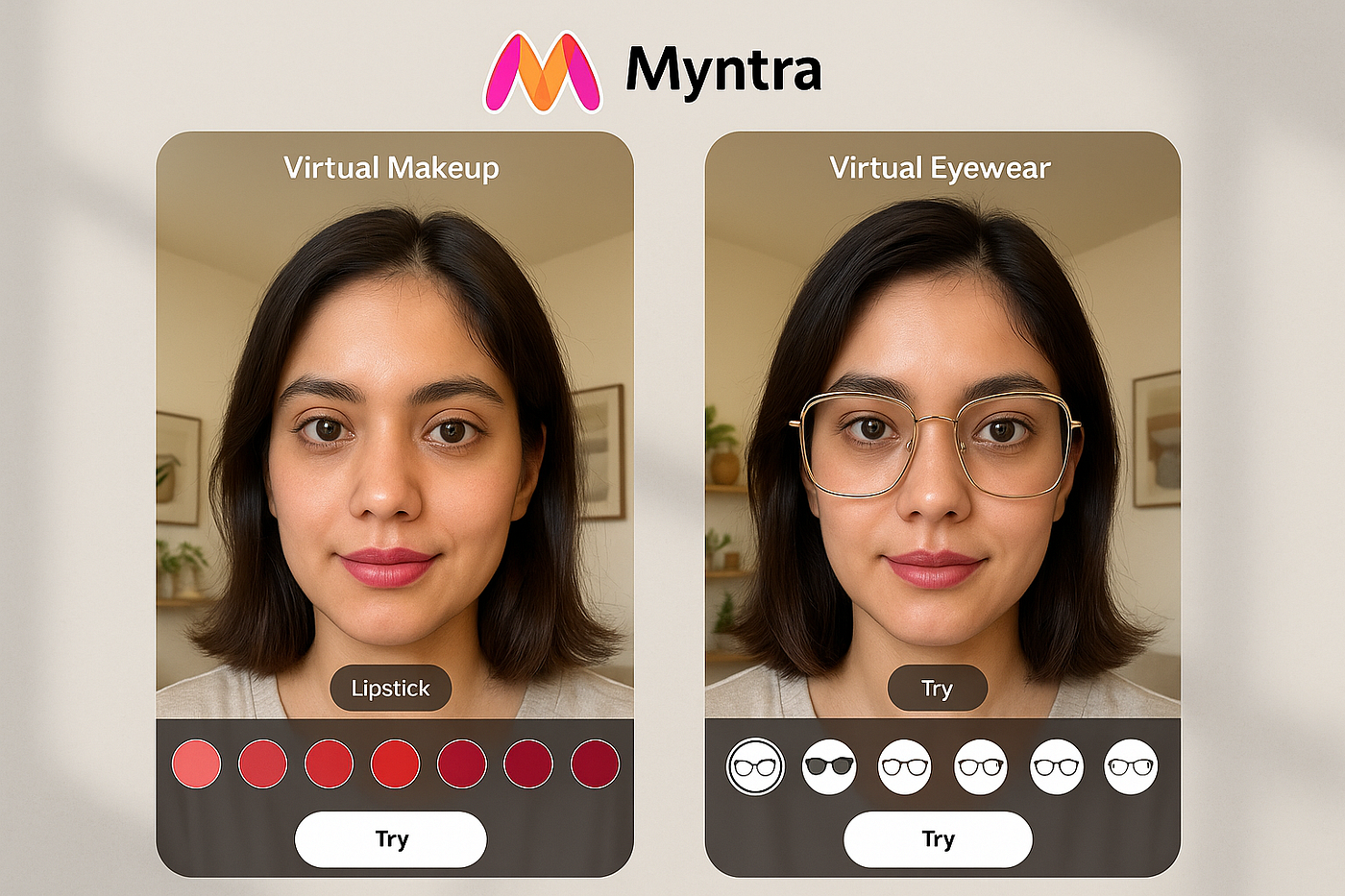
Then Myntra launched augmented reality try-on features in 2021. Virtual makeup trials. AR glasses fitting. Jewelry visualization. And most recently, full garment try-on where you see how clothes look on your body before buying.
The result? Return rates dropped by 20 to 30 percent for products with AR try-on enabled. Customer confidence increased. Purchase conversion rates went up.
This is the story of how Myntra is solving India’s biggest e-commerce problem through mobile-first AR technology and what it reveals about the future of shopping in India.
The Problem with Fashion E-Commerce in India
Before understanding Myntra’s solution, you need to understand why fashion e-commerce in India is fundamentally different from the West.
In the US or Europe, customers have decades of experience buying clothes online. They know their sizes across brands. They’re comfortable with the risk. They have easy return processes.
Indian consumers are newer to online fashion. Most still prefer buying from physical stores where they can touch fabrics, try things on, and negotiate prices.
The barriers to online fashion adoption in India are massive.
Size inconsistency is worse in India because sizing standards don’t exist. A medium from one brand fits completely differently from another brand’s medium. Indian consumers can’t rely on size charts because there’s no standardization.
Visual uncertainty is huge. Product photos on white backgrounds with professional models don’t tell you how that kurta will look on your body type. That lipstick shade on a fair model might look completely different on your skin tone.
Fabric concerns are real. Indians are particular about fabric quality and feel. You can’t tell if cotton is soft or rough from photos. You can’t judge if silk is genuine or synthetic through a screen.
Cultural fit matters. A western dress that looks great on a model might not work for Indian occasions or body types. Customers need to visualize how clothes work in their actual life contexts.
And the return process in India is painful. Unlike Amazon’s easy returns in the West, returning fashion items in India involves scheduling pickups, waiting days, and often arguing with customer service about refunds.
All of this meant Indian consumers were hesitant to buy fashion online. They’d browse on apps but complete purchases in stores. The mobile traffic was there, but conversion rates were terrible.
Myntra needed to solve the confidence problem. How do you make someone trust an online purchase as much as a physical store experience?
The Strategy: Bring the Trial Room to Your Phone
Myntra’s approach wasn’t just about adding AR as a gimmick. It was about fundamentally reimagining how Indians shop for fashion on mobile.
Here’s how they did it:
1. Start With Low-Risk Categories
Myntra didn’t launch AR try-on with full garments. They started with makeup and accessories where the stakes were lower.
Virtual makeup try-on came first in 2021. You could see how lipstick, eyeshadow, or foundation looked on your face using your phone’s camera. Real-time, accurate color matching.
This served two purposes. First, it actually solved a real problem. Buying makeup online is risky because shades vary wildly. AR let you see actual results before purchasing.
Second, it trained users to trust AR technology. Once customers saw that virtual lipstick matched real lipstick accurately, they’d trust AR for other categories.
The makeup AR feature reduced return rates for cosmetics by nearly 25 percent. More importantly, it increased purchase confidence. Customers who used AR were 40 percent more likely to complete purchases.
2. Expand to Accessories and Eyewear
After proving AR worked for makeup, Myntra moved to eyewear and jewelry.
Trying on glasses virtually made perfect sense. You could see how different frames looked on your face shape. Whether aviators suited you better than wayfarers. If that oversized frame was too large for your face.
For jewelry, AR let you visualize how earrings, necklaces, and bangles looked on you. This was especially valuable for online jewelry shopping, which Indians were skeptical about because they couldn’t judge craftsmanship or size.
These categories had higher average order values than makeup. Getting AR right here meant bigger revenue impact with every prevented return.
3. Build AR for Indian Faces and Skin Tones
This is where Myntra’s localization became critical.
Most AR try-on technology is built and trained on Western faces. The algorithms work poorly on Indian skin tones, face structures, and facial features.
Myntra invested heavily in training their AR models specifically on Indian faces. They captured data across different skin tones, face shapes, and facial features common in India.
This meant their AR actually worked accurately for Indian customers. A lipstick shade looked correct on brown skin, not just on fair complexions. Glasses fit properly on different nose bridges common in Indian faces.
This localization investment was expensive but essential. Generic AR tools would have failed in India. Myntra built for Indian diversity specifically.
4. Optimize for Low-End Smartphones
Here’s the critical insight about India: most people shop on budget Android phones with limited processing power.
AR is computationally intensive. It requires camera processing, 3D rendering, and real-time tracking. On high-end iPhones, this works smoothly. On 10,000 rupee Android phones with 3GB RAM, it’s challenging.
Myntra’s engineering team optimized AR to work on low-spec devices. They compressed models. They reduced processing requirements. They made AR load quickly even on 3G connections.
This optimization was what made AR actually usable in India. If it only worked on premium phones, it would reach maybe 10 percent of their user base. By working on budget devices, it reached 70 to 80 percent.
5. Launch Full Garment Try-On
In 2023, Myntra introduced their most ambitious AR feature yet: full garment try-on.
You take a photo of yourself or use your camera in real-time. The app maps your body shape. Then you can virtually try on clothes and see how they fit your specific body type.
Not just size, but actual fit. How a dress drapes on your shoulders. Whether a shirt is too tight across the chest. If a kurta length is right for your height.
This was the holy grail of fashion e-commerce. If customers could see realistic fit before buying, return rates would plummet.
The technology required was complex. Accurate body mapping. Realistic fabric simulation. Accounting for different fabrics behaving differently. Making it work in real-time on mobile.
Myntra pulled it off. And early results showed 30 percent reduction in returns for items tried virtually before purchase.
6. Integrate AR Throughout the Shopping Journey
Myntra didn’t treat AR as a separate feature. They integrated it into the natural shopping flow.
When you look at a lipstick, a “Try it on” button appears right next to “Add to Cart.” One tap and you’re testing it on your face.
For eyewear, the default product view includes AR try-on. It’s not hidden in a menu. It’s the primary way to view products.
This integration meant customers didn’t have to seek out AR. It was presented as the default way to shop. This drove usage rates far higher than if AR was a buried feature.
Why This Works When Traditional E-Commerce Struggled
Myntra’s AR strategy addresses the fundamental trust issues preventing Indians from buying fashion online.
1. It Solves the Confidence Gap
The biggest barrier to online fashion purchases isn’t price or selection. It’s confidence. You’re not sure it will look good. You’re not sure it will fit. You’re not sure the color is right.
AR removes 80 percent of that uncertainty. You see it on yourself before buying. The mental barrier drops dramatically.
This confidence translates directly to conversion. Myntra found that customers who used AR features converted at 2x to 3x higher rates than those who didn’t.
The business impact is massive. Even a small increase in conversion rate on high-traffic mobile apps means millions in additional revenue.
2. It Reduces the Expensive Return Problem
Every return costs Myntra money. Logistics. Processing. Customer service. Restocking. The margins in fashion e-commerce are thin, and returns can turn profitable sales into losses.
By reducing returns by 20 to 30 percent through AR try-on, Myntra saves crores in operational costs annually.
More importantly, it improves customer satisfaction. Customers who don’t need to return items have better experiences. They’re more likely to buy again. Lifetime value increases.
3. It Differentiates Myntra From Competitors
Amazon and Flipkart sell fashion too. But their AR capabilities are limited compared to Myntra’s focused investment.
Myntra positioned AR as a reason to use their app over competitors. If you want to know how clothes actually look on you, shop on Myntra. Other platforms can’t offer that experience.
This differentiation matters in a crowded market. When selection and prices are similar across platforms, features like AR become deciding factors.
4. It Captures the Mobile-First Indian Consumer
India skipped desktop internet and went straight to mobile. Over 85 percent of e-commerce traffic in India comes from mobile devices.
Myntra optimized their entire AR experience for mobile-first users. Not a desktop feature ported to mobile, but built mobile-first from the ground up.
This alignment with how Indians actually shop online made adoption natural. The technology met users where they already were.
5. It Generates Social Sharing
AR try-on isn’t just functional. It’s fun. People screenshot their virtual try-ons and share with friends for opinions. They share funny results on social media.
This sharing creates organic marketing. Every shared AR try-on is free advertising. Friends see the feature in action and want to try it themselves.
Myntra even built sharing features into the AR experience. Easy ways to send try-on results to friends or post to Instagram stories. The product becomes its own marketing channel.
The Challenges That Remain
Despite success, Myntra’s AR strategy faces significant obstacles.
Technology limitations persist. AR garment try-on still isn’t perfectly accurate. Fabric draping doesn’t always look realistic. Fit predictions can be wrong. The technology is improving but not flawless yet.
Data and privacy concerns exist. AR requires camera access and sometimes body measurements. Indian consumers are increasingly privacy-conscious. Building trust around data usage is ongoing.
Infrastructure gaps remain. AR works poorly on slow internet connections. In tier 2 and tier 3 cities where connectivity is inconsistent, the experience can be frustrating.
Cost of implementation is high. Building and maintaining AR features requires significant investment in engineering and data science. Smaller e-commerce players can’t afford this level of tech development.
Behavior change takes time. Despite benefits, many users still default to traditional shopping without trying AR features. Myntra has to continuously educate and encourage usage.
And the fundamental challenge: AR will never fully replace physical try-ons. Feeling fabric quality and perfect fit assessment still require in-person shopping. AR reduces uncertainty but doesn’t eliminate it.
What This Means for E-Commerce in India
Myntra’s AR success reveals the future direction of Indian e-commerce.
Mobile-first isn’t just about responsive design anymore. It’s about building experiences that only make sense on mobile. Features like AR that use phone cameras and work seamlessly on small screens.
Localization matters more than scale. Generic global solutions fail in India. Technologies need to be rebuilt specifically for Indian faces, body types, connectivity, and devices.
Trust-building through technology is essential. Indian consumers are skeptical of online shopping for categories where touch and feel matter. Technology that bridges that trust gap wins market share.
The solutions that work in India are different from the West. Amazon’s model worked in America. It needed adaptation for India. Companies that build India-specific solutions rather than importing Western playbooks will dominate.
Investment in reducing friction pays off. Every barrier to purchase removed, whether size uncertainty or return hassle, directly impacts bottom line. The companies willing to invest in solving these problems will capture the growing market.
The playbook for other categories is clear. Furniture needs AR to visualize in homes. Footwear needs virtual fit technology. Groceries need ways to assess freshness virtually. Any category with a confidence gap can benefit from immersive technology.
The Bottom Line
Myntra’s AR try-on features aren’t a gimmick. They’re a fundamental reimagining of how fashion e-commerce works in a mobile-first market where trust is the biggest barrier to purchase.
By letting customers virtually try products before buying, Myntra solved the two biggest problems in Indian fashion e-commerce: low conversion rates due to uncertainty and high return rates due to fit issues.
The success reveals a larger truth about Indian e-commerce. Technology wins not by being impressive, but by solving real problems Indian consumers face.
AR try-on reduces uncertainty. It increases confidence. It prevents costly returns. It differentiates Myntra from competitors. And it does all this on the low-end Android phones that most Indians actually use.
As India’s e-commerce market continues growing, the winners will be companies that invest in mobile-first technologies built specifically for Indian consumers, not those that simply transplant Western e-commerce models.
Myntra proved that the future of shopping in India isn’t just online. It’s virtual, mobile-first, and built for Indian faces, bodies, and smartphones.
메타데이터
- post_id
- 35e4a4b2b3e2
- slug
- what-myntras-ar-try-on-says-about-india-s-mobile-first-shopping-35e4a4b2b3e2
- url
- https://medium.com/@arthnovaofficial/what-myntras-ar-try-on-says-about-india-s-mobile-first-shopping-35e4a4b2b3e2
- canonical_url
- https://medium.com/@arthnovaofficial/what-myntras-ar-try-on-says-about-india-s-mobile-first-shopping-35e4a4b2b3e2
- author_url
- https://medium.com/@arthnovaofficial
- status
- ok
- fetched_at
- 2026-06-29 02:33:43