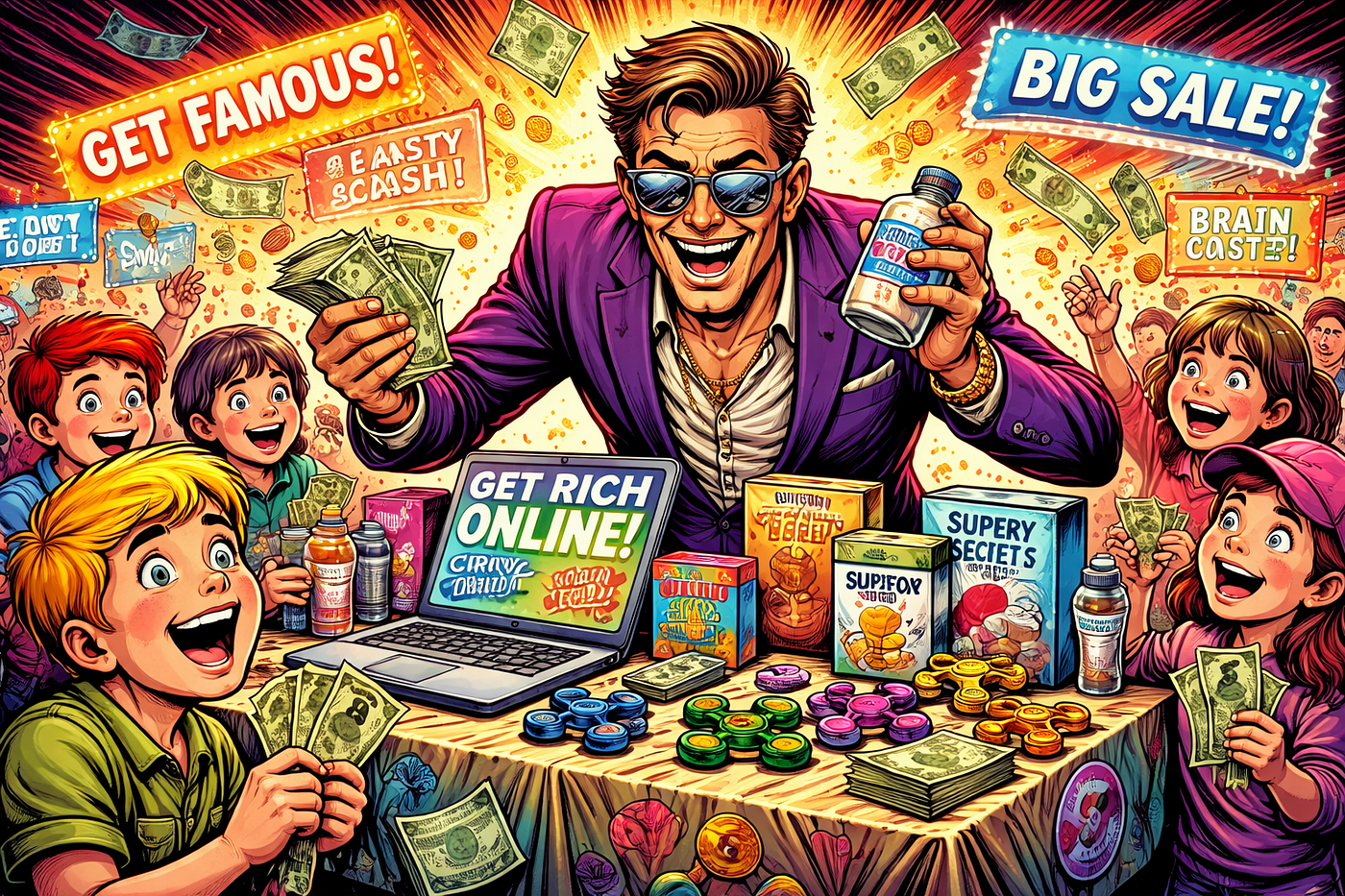
The Consumer Has Picked Up a Spray Can. Is Your Brand Ready?
Brandalism, consumer hacktivism, and why CEOs can no longer afford to hide behind their positioning.

Brandalism
The Consumer Has Picked Up a Spray Can. Is Your Brand Ready?
Brandalism, consumer hacktivism, and why CEOs can no longer afford to hide behind their positioning.
There’s a scene that’s been playing out with increasing frequency across the world’s cities and timelines. An artist, or a collective, or an anonymous handle with 200,000 followers, takes a brand’s own imagery and turns it against the brand itself. They call it Brandalism. Brand-vandalism. Consumer hacktivism. Whatever the name, the mechanics are the same: virality is built into the act. The audience doesn’t just witness the critique. They amplify it.
Ten years ago, this was a fringe phenomenon. Today, it is a fully formed strategic weapon in the hands of an increasingly organised, increasingly impatient consumer base, and the brands that aren’t paying attention are finding out the hard way.
The New Rules of the Social Contract
Let’s start with a number that should give every brand strategist pause: 71% of global consumers now say that trust in brands has become a “buy or boycott” factor. Not a preference. Not a nice-to-have. A binary decision point. You’re trusted, or you’re cancelled.
The 2025 Edelman Trust Barometer characterises today’s climate as a global “Crisis of Grievance,” the result of events over the past 25 years that have chipped away at trust in leaders and institutions. Four in ten global respondents now report that they view hostile activism as a viable means for driving change. Among 18–34 year olds, that ratio rises to one in two.
Read that again. Half of the world’s young adults consider hostile brand activism, not petition-signing, not politely worded feedback, a legitimate tool for forcing corporate accountability. That is the consumer landscape brands are navigating in 2025.
And India? India is accelerating into this reality faster than most.
The Me-Me-Me to Us-Us-We Shift Has Begun
For years, a reasonable argument could be made that Indian consumers were too busy with their own lives to sustain organised brand outrage. The logic went: Indians are aspirational, status-driven, and largely forgiving of the brands they love. Look at Maggi, recalled in a blaze of regulatory fury in 2015, but forgiven and welcomed back with open arms within months. Habit and emotional attachment, the argument went, would always win out over principle.
That calculus is shifting, and it’s shifting fast.
The categories most immediately vulnerable, food and beverages, personal care, financial services, are precisely those where the “Me-Me-Me” consumer is most directly impacted. When a brand messes with what you eat, what you put on your skin, or what happens to your money, the outrage becomes personal. It sticks.
We’ve watched this unfold in real time. Zomato faced viral backlash over ads perceived to trivialise the welfare of delivery partners. Manyavar was hit with a #Boycott trend over a campaign that touched cultural sensitivities. Lenskart found itself embroiled in controversy just this month over internal workplace policies that surfaced publicly on social media. In every case, the mechanism was the same: someone on the inside, or someone paying close attention from the outside, turned the brand’s own narrative into ammunition.
A food delivery startup in 2024 discovered that responding to an internal wage exploitation exposé with a feel-good “celebrating delivery heroes” campaign, without any actual policy change, without third-party audits, earned more condemnation than the original controversy. The internet labelled it “manipulative optics.” The campaign was paused within a week.
The lesson is blunt: you cannot PR your way out of a substance problem.
Dark Patterns and the Transparency Reckoning
The hacktivism wave isn’t limited to cultural and social issues. It’s increasingly trained on the mechanics of how brands operate.
In May 2025, India’s Ministry of Consumer Affairs issued formal notices to eleven major e-commerce and technology platforms for deploying “dark patterns,” deceptive user interface practices that manipulate consumer decision-making. India’s Central Consumer Protection Authority advised platforms to refrain from deploying deceptive design interfaces that mislead consumers or manipulate their decision-making, marking the first serious enforcement action in India’s emerging consumer protection framework.
This is brandalism by regulation, the state itself turning the spotlight on practices that brands assumed consumers either didn’t notice or would simply accept. They were wrong on both counts. Consumers noticed, talked, and the government listened.
Nearly 80% of Indian consumers now identify protection of their personal data as one of the most crucial factors in earning their trust. The era of assuming consumer passivity on these issues is over.
The Transparency Economy Is Already Here
Here’s the prediction that has aged the best: we are definitively living inside a Transparency Economy. Not approaching it. In it.
87% of shoppers in 2025 say they will pay more for brands they trust. 60% say trust and transparency are now the most important brand traits, not price, not product quality, not convenience. Trust.
The business model implications of this are profound. The “back-of-pack babelfish” concept, a service that tells consumers what they are truly consuming, what a brand’s supply chain actually looks like, what the real ingredients of a product are beyond what marketing wants them to see, is no longer a provocative thought experiment. It exists. It’s growing. Yuka, the ingredient-scanning app, has over 50 million users globally. In India, a generation of young consumers is learning to read labels, question sourcing claims, and share what they find.
The question for every brand is no longer whether their practices will be scrutinised. They will be. The question is whether the scrutiny will find something defensible, or something damaging.
What This Means for the CEO in the Socio-Digital Age
The instinct in many boardrooms, when conversations about brand activism and transparency arise, is still one of careful avoidance. Don’t take sides. Don’t make enemies. Stay in your lane. Let the product do the talking.
That instinct is now actively dangerous.
According to Havas’s 2024 Meaningful Brands report, 73% of consumers want companies to show more humanity and generosity during tough times, and 71% want businesses to step up on social issues. Silence, which used to be neutral, is increasingly interpreted as complicity or evasion. In 2025, staying quiet on the issues your consumers care about is itself a form of brand communication. And it’s rarely the one you intended.
Almost half of consumers are now more likely to buy from companies that speak out about specific causes or topics in the news, according to Sprout Social’s Q3 2025 Pulse Survey. Among Gen Z, that figure rises to 63%.
But, and this is the crucial qualification, consumers are not asking brands to perform values. They are asking brands to demonstrate them. There is a canyon of difference between the two, and most brands are currently standing on the wrong side of it.
The Woke-Washing Trap
The fastest way to turn brand goodwill into brand backlash is to take a visible public stance on a cause while your internal practices tell a different story. This is what researchers and consumers alike are now calling “woke-washing,” the strategic deployment of progressive language and imagery without the organisational substance to back it up.
When US companies roll back DEI initiatives, over half of Gen Z and 36% of consumers overall say they will boycott. The same dynamic applies to environmental claims, labour practices, and supply chain ethics. Consumers are no longer evaluating the campaign. They’re evaluating the gap between the campaign and the company.
The western social hacktivist playbook, which Indian activists are rapidly adopting, has evolved beyond simple brand-calling. It now includes what might be called the shame-cascade: first expose the gap between what a brand claims and what it does, then publicly shame the consumers who continue to buy regardless. This is how niche activism becomes mainstream pressure.
The Right Response: Two Kinds of CSR That Actually Work
There is a better path, and some of India’s most enduring brands have already found it. But it requires genuine strategic will, not just communication budget.
The first model is what might be called Core-to-Business CSR, where the social good the brand creates is inseparable from how it conducts its core operations. Amul is the canonical example: a cooperative structure that invests in farmer welfare isn’t a CSR programme running parallel to the business. It is the business. The social impact and the commercial model are the same thing.
The power of this approach in the transparency era is substantial. When a consumer or a hacktivist looks behind the curtain of such a brand, what they find is not a liability. It is the best possible marketing asset. You cannot be brandalised if your back-of-pack tells a better story than your front-of-pack.
The second model is what could be called Founder-Soul CSR, where the CEO or founder genuinely and personally champions a cause that is close to them, and the brand becomes a vehicle for that advocacy. The Tata and Mahindra traditions are the gold standard here. Deliberately non-advertised, organically discovered, and deeply trusted precisely because they don’t feel like marketing. A 2024 Kantar study found that 69% of Indian consumers trust brands that invest in local employment, infrastructure, or education programs, even more than those offering discounts or rewards.
The key in both cases is the same: authenticity is not a communications strategy. It is a business strategy. The consumer in 2025 does not ask whether your messaging is polished. They ask whether your actions match your words.
The Corporate Pivot That’s Already Happening
There’s a larger structural movement underway that deserves acknowledgment, because it’s precisely what was predicted a decade ago and is now visibly in motion.
Large corporate conglomerates that built their wealth in categories now under scrutiny, tobacco, aerated beverages, non-transparent processed foods, are pivoting hard into organic, ethical, and health-oriented businesses. They’re using the capital earned from the old categories to buy legitimacy in the new ones. ITC expanding into organic staples. Beverage giants acquiring wellness brands. FMCG conglomerates repositioning legacy assets under sustainability narratives.
The cynical read is that this is reputation laundering. The strategic read is that it is an entirely rational response to the Transparency Economy, and the brands that execute this pivot with genuine product integrity and operational coherence, rather than as a branding exercise, will build the category-defining positions of the next decade.
The hacktivist has done the market research for them. Consumer anxiety about what they’re putting in and on their bodies is real, documented, and growing. The brand that resolves that anxiety authentically wins. The one that exploits it without substance gets found out, and the finding-out goes viral.
A Specific Note for India’s Financial Brands
The financial services category in India carries a particular exposure that still isn’t taken seriously enough. Financial products directly impact the “Me-Me-Me” consumer, their savings, their loans, their futures. The combination of complex products, opaque fee structures, and historically low financial literacy makes this a high-value target for consumer hacktivism.
And yet, the dominant communication strategy in the category remains insipid awareness campaigns. Tips to be financially savvy. Reminders to invest. Product launches dressed as education.
The real opportunity, and the real defensive play against the inevitable transparency reckoning, is to do what the category’s expertise actually enables: genuinely demystify finance for the Indian consumer. A crowdsourced, colloquial glossary of financial terms. Animated explainers built for first-generation investors. A fund structured explicitly around a charitable outcome, that uses market returns to build something visible and real, a school, a skill centre, a community asset, while demonstrating the category’s actual investment competence.
This kind of initiative doesn’t just generate goodwill. It creates something a hacktivist cannot vandalise: a genuine monument to what the brand actually stands for.
The Bottom Line
The spray can is out. The consumer has figured out that virality is a weapon, and they’re learning to use it with increasing precision and strategic intent.
The brands that survive this era, and more importantly, the ones that thrive in it, are not the ones with the most polished crisis communication playbooks. They are the ones whose inside story is already clean. The ones where the CEO’s values are visible in the organisation’s actual behaviour, not just in the annual report. The ones whose CSR is genuinely core to how they make money, not a 2% afterthought deployed in distant communities.
As one strategist recently put it: “No more bullshit. No more forgiveness. We will take our money elsewhere.”
The question for every founder and CEO is simple: if a skilled, motivated consumer hacktivist turned their attention to your brand tomorrow, what would they find?
Whatever that answer is, your strategy starts there.
At WolfzHowl Strategic Instigations, we humanize data and digitize culture, helping brands build deeper, more meaningful and mutually profitable relationships with the people they serve.
메타데이터
- post_id
- 47ff09b7a97e
- slug
- the-consumer-has-picked-up-a-spray-can-is-your-brand-ready-47ff09b7a97e
- url
- https://medium.com/@acoount/the-consumer-has-picked-up-a-spray-can-is-your-brand-ready-47ff09b7a97e
- canonical_url
- https://medium.com/@acoount/the-consumer-has-picked-up-a-spray-can-is-your-brand-ready-47ff09b7a97e
- author_url
- https://medium.com/@acoount
- status
- ok
- fetched_at
- 2026-06-12 22:02:08