Anxiety, Freedom, and Escape
An Astrological Reading Through Rollo May
Anxiety, Freedom, and Escape
An Astrological Reading Through Rollo May
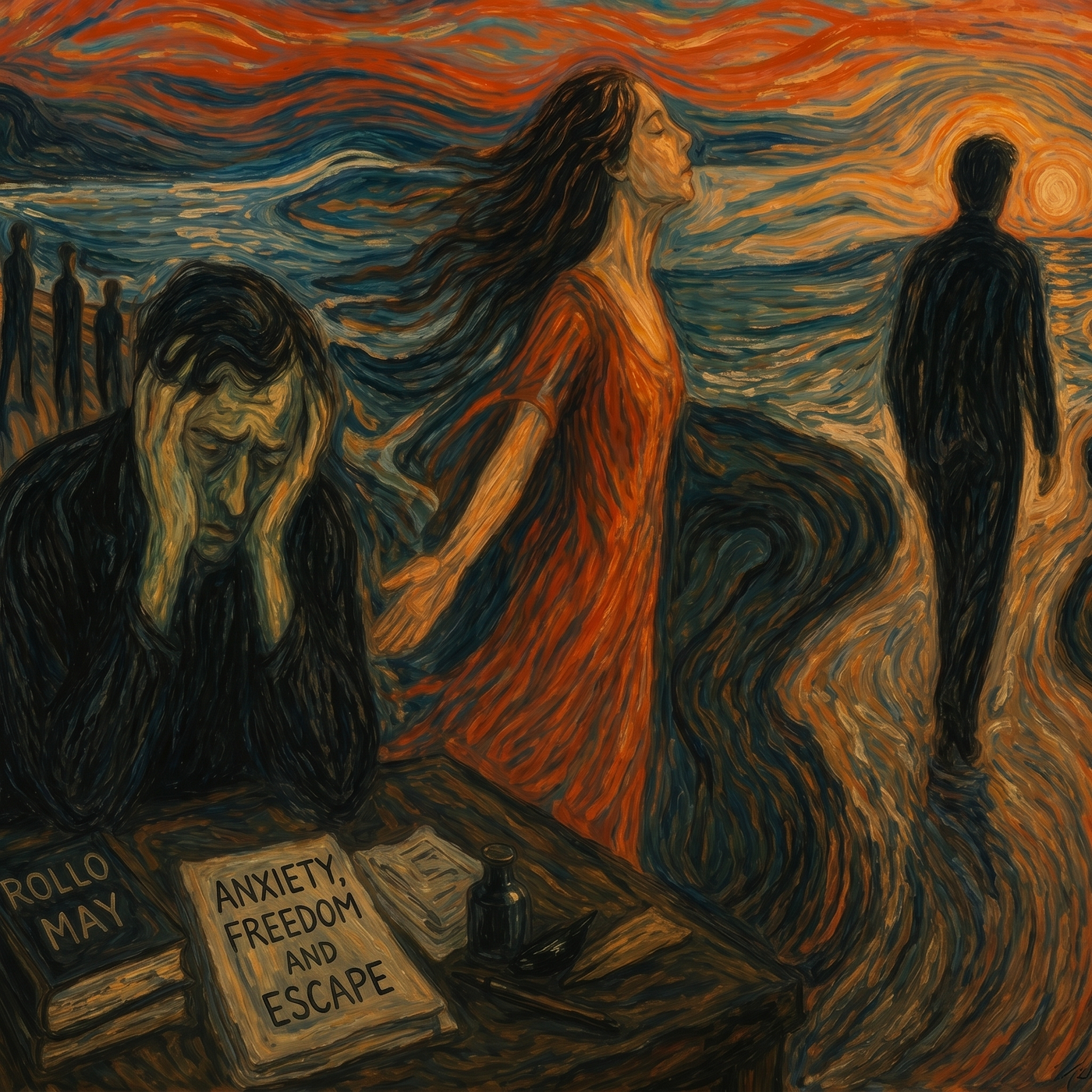
This article will examine the nature of anxiety and the different strategies people develop to cope with it, drawing on Rollo May’s perspective. In particular, it will offer a reading through archetypal tendencies in order to understand how the individual responds in the face of anxiety. Because even though our ways of escaping anxiety may differ, the fundamental issue is the same: what we will do with freedom.
Modern people generally see anxiety as a problem that must be eliminated. Yet according to the existential psychologist Rollo May, anxiety is an inevitable consequence of being human. Especially in Love and Will, May positions anxiety not as a disorder, but as the price of freedom. This is because, unlike other living beings, the human being is a creature capable of making choices, determining direction, and bearing responsibility for their own life. And this freedom brings with it uncertainty, risk, and the possibility of making mistakes.
It is precisely at this point that anxiety emerges.
Anxiety is, in fact, the awareness of the human capacity to choose. In other words, it is confronting the thought that “it could have been otherwise.” But this confrontation is often unsettling. Because making a choice does not simply mean choosing one path; it also means leaving behind all other possibilities. And this inevitably leaves a person alone with doubt, indecision, and responsibility.
Design By Cemre
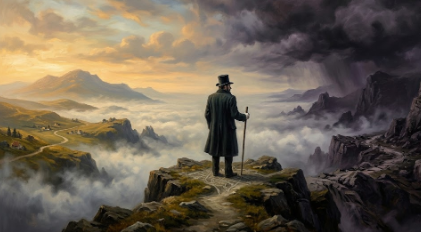
At this point, the reality Søren Kierkegaard points to removes anxiety from being merely a psychological state and places it at the very center of existence. According to Kierkegaard, when a person stands at the edge of an abyss, they do not fear only the possibility of falling; what is truly unsettling is the possibility that they could throw themselves down. In other words, anxiety is not the echo of an external danger, but of an inner freedom. For a brief moment, the person realizes this: nothing is forcing them — yet precisely for that reason, everything is possible. This is where the dizziness begins. Because freedom, contrary to what is often assumed, is not comforting; it is a state of consciousness that carries the weight of limitless possibility. A person is shaken to the extent that they become aware of what they are capable of doing.
And this trembling is, in fact, the self seeing itself in its most naked form. In this sense, anxiety is not merely an inevitability, but a revelation: it is the tension created in the moment when a person realizes not their limits, but the absence of limits. That is why escaping anxiety is not simply escaping a feeling; it is the narrowing of one’s own freedom, the deliberate closing off of one’s own possibilities.
For this reason, people give up their freedom in order to escape anxiety. Because freedom brings with it not only choices, but also responsibility for those choices. And for many people, that responsibility feels too heavy to bear. As a result, the individual unconsciously narrows their own field of action, withdraws where they might otherwise take risks, and chooses safety over uncertainty. This condition reveals itself not only in individual lives, but also on a collective level throughout history.
For example, the Reformation movement initiated by Martin Luther opened up a vast space of freedom by asserting that the individual could establish a direct relationship with God. However, this freedom also required the individual to confront their own faith and conscience. Within a short time, many communities were unable to tolerate the uncertainty created by this freedom and began constructing new, more rigid doctrines and systems in order to rebuild a secure structure. In other words, freedom was opened up, but then it was restricted again.
Similarly, the idea expressed in Fyodor Dostoevsky’s “The Grand Inquisitor” presents this reality in a striking way:
Human beings do not want freedom; they want bread, order, and certainty.
For this reason, when freedom is given to them, they cannot bear it and voluntarily surrender themselves to an authority. Because being free means having to make choices constantly.
As a more modern example, as Erich Fromm analyzed, the fact that many people turned toward totalitarian regimes in the twentieth century was also the result of the same mechanism. Instead of confronting uncertainty and individual responsibility, the individual chooses relief by transferring the burden of decision-making to a leader or to a system. In this way, they give up their freedom, but in return, they reduce their anxiety.
These examples make one thing unmistakably clear: human beings desire freedom in theory, yet in practice they tend to flee from it. Because freedom is not merely a right; it is also a burden of consciousness that must be carried continuously. And when that burden becomes too heavy, the human being’s first reflex is to put it down.
“Man is condemned to be free.” — Jean-Paul Sartre
When a person is not free, they do not remain suspended in emptiness; they inevitably attach themselves to something. Because freedom brings with it uncertainty and anxiety, and not every mind is capable of tolerating that anxiety. For this reason, the individual chooses something to lean on in order to reduce this inner tension — a system, an authority, a belief, or a habit. Yet this attachment is not merely an attempt to find direction; it is also the repression of anxiety. Instead of bearing the weight of making choices, the person hands that choice over. In this way, a sense of relief is achieved in the short term. But that relief comes at a price. Because to the extent that a person becomes attached, they move farther away from their own will. And over time, they cease to be the subject of their own life and become the object of the structure they have chosen.
It is precisely at this point that the way this invisible surrender operates as an inner mechanism becomes clearer. In order to escape anxiety, the person fixes themselves in place; they suspend change and make the preservation of balance their primary goal. But this balance is not a living and conscious mode of existence; it is a static form of holding on. Thus, without realizing that they have given up freedom, the person begins to live within a structure that narrows their own limits.
So how does a person break this cycle, and how do they become truly free?
This question is not merely philosophical; it is existential. Because freedom does not begin with a change in external circumstances, but with the transformation of a person’s inner structure. Learning plays a key role here — but this kind of learning is not about memorizing or accumulating information. It is about beginning to notice oneself, one’s reactions, fears, and choices. According to Rollo May, the most fundamental human power is the capacity to develop consciousness. And as this consciousness increases, the person moves away from automatic reactions and becomes a being capable of choosing.
In other words, learning is not only about understanding the outer world; it is about seeing one’s own inner mechanisms. The moment a person begins to realize what they are doing and why they are doing it, the possibility of truly choosing emerges for the first time. And that is exactly where freedom begins: in the courage to step outside learned patterns.
If you can choose, you are free!
Freedom is often misunderstood, as if it were a space in which the burdens on a person are lifted and everything becomes lighter. But true freedom is the opposite. As a person gains consciousness and begins to see their options, life does not become easier — it becomes deeper. After a certain point, you can no longer say, “I didn’t know.” Because seeing, knowing, and becoming aware draw you directly into the realm of responsibility. And this responsibility is not only about what you do; it is also about what you do not do. That is why freedom is not a condition that makes a person lighter; it is a condition that gives weight to their existence.
You can see this even in a very simple situation. Let’s say a job opportunity comes your way. In the past, if someone else had made the decision for you, or if circumstances had forced your hand, the responsibility would have remained outside of you. But now you see the options: Should you stay or leave? Should you take the risk or remain safe? No matter which path you choose, you will also carry the weight of the other possibilities. That is where the first cost of freedom begins: having to decide.
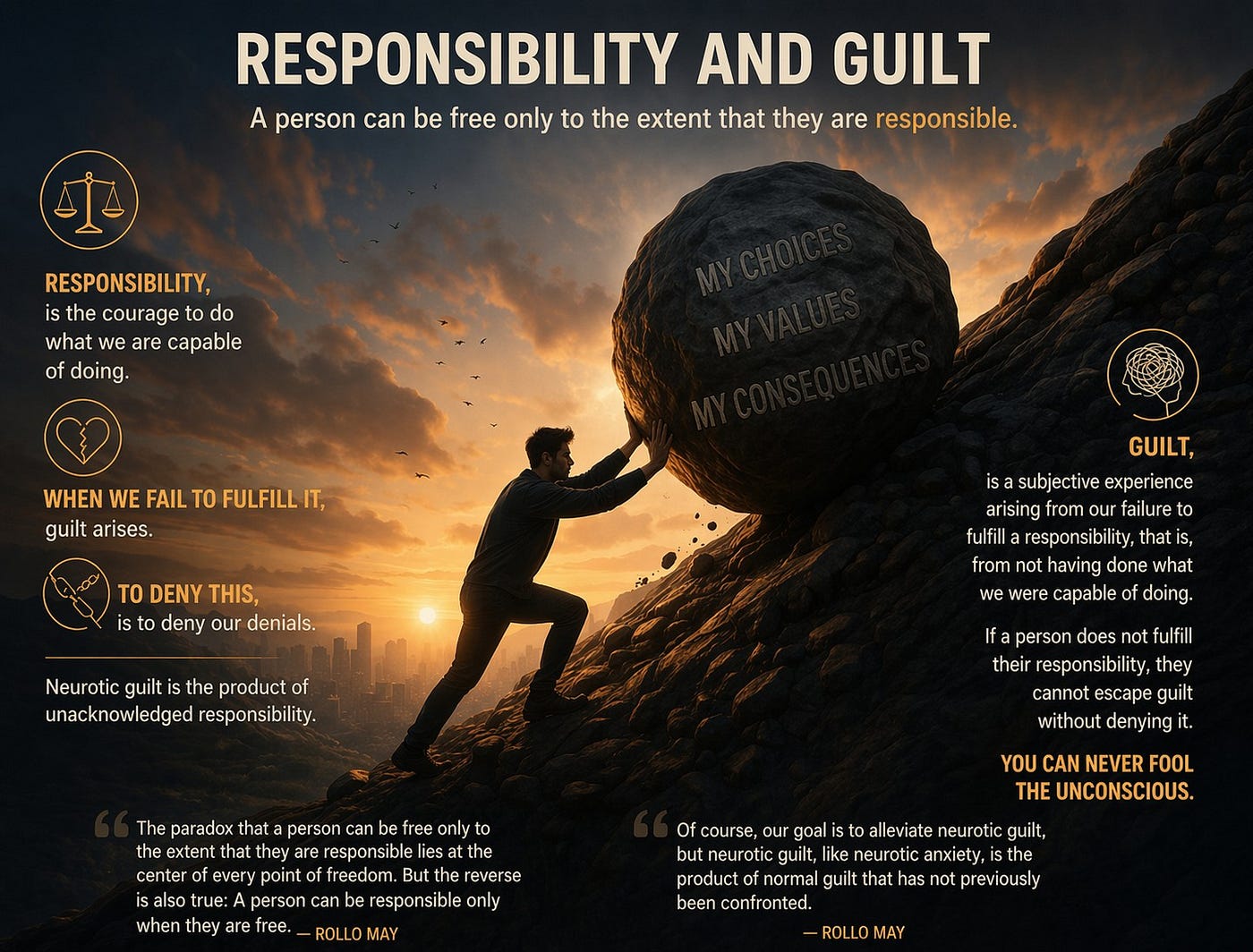
At this point, uncertainty enters the picture. Because you can never be completely sure that the path you choose is the right one. And yet, you still have to move forward. Freedom exists precisely in this gray area. The human mind, however, craves clarity; that is why as freedom increases, anxiety increases as well. Because there is no longer just one path — there are endless possibilities. Every possibility gives rise to another possibility, and after a while, a person begins to feel this: “Everything is possible… but nothing is certain.”
Many people step back at exactly this point. They want to escape the inner tension that freedom creates. For example, someone comes along and tells you what you should do — a system, an authority, a relationship. And in order to feel relief, you cling to it. Because not having to choose brings a temporary sense of peace. But that peace is actually a trade-off: you free yourself from the burden of making decisions, but at the same time, you also give up your own potential. אולי you may no longer make mistakes, but at the same time, you can no longer create anything great.
As freedom expands, it also isolates the person. Because the kind of life that most people live automatically is no longer enough for you. For example, when you reject the path that everyone else calls “reasonable” and choose your own, people struggle to understand you. To them, you are someone taking risks; to you, this is simply being faithful to your own truth. But that difference creates an invisible distance between you and others. And this is another cost of freedom: being willing to accept not being understood.
And then a deeper stage arrives: grief. When a person leaves behind an old identity and steps out of their old safe zones, they are confronted with a sense of emptiness. Imagine stepping out of an identity you defined for yourself for years by saying, “This is who I am.” Once that identity is gone, for a while, you may no longer know what you are. This emptiness is often frightening, and the person immediately wants to fill it — with a new role, a new belief, or a new story. But real transformation begins when you do not rush to fill that emptiness. Here, grief is not a collapse; it is a purification. In this process, the person becomes truly honest with themselves for the first time.
It is precisely at this point that the balance between freedom and fate becomes clear. A person cannot choose everything. The place they are born, the people they encounter, certain limitations — these are fate. But how they move within those limits, and how they assign meaning to them, is freedom. Imagine two people under the same conditions: one withdraws, using what they have lived through as an excuse; the other turns those same conditions into a launching pad. The conditions are the same, but the life that is lived becomes entirely different.
That is why freedom is not limitlessness. On the contrary, it is the ability to choose direction while being aware of one’s limits. A freedom without limits turns into directionless energy — it flows, but it does not arrive anywhere. But the person who moves consciously within limits, even slowly, builds their own path.
In the end, freedom is not a destination, but an ongoing choice. It begins again every day. Every day it asks for risk. And every day it asks the person this question:
“Are you really living your own life, or are you living the path someone else drew for you?”
The line is very clear: freedom → self-awareness → responsibility → risk → anxiety → choice → confronting fate → transformation. In other words, freedom is not a “zone of comfort”; on the contrary, it is a process that constantly expands and challenges the human being. And at the center of this process lies the following paradox: a person is responsible only to the extent that they are free, but they also become free only when they take responsibility. For this reason, it is not peace, as most people assume, but rather a state of tense consciousness.
The more a person becomes aware of their options, the less they can move through life by saying, “I didn’t know.” Every choice carries with it the weight of all the other choices not made. And this inevitably produces guilt, inner conflict, and anxiety.
As Kierkegaard says, not taking a risk is to lose the self; yet taking a risk also leaves the person in the middle of uncertainty.
But if we look at the matter not from here, but from the sky, we begin to see that nothing we have been describing is accidental at all.
In this sense, all these processes we call freedom, responsibility, guilt, and fate are not merely psychological; they are direct reflections on earth of an astrological mechanism. The moment a person says, “I am free,” they are in fact entering a planetary tension. Because in the birth chart, freedom never exists on its own — there is always a force on the other side that balances it.

Design By Cemre
The first threshold of freedom is not, as people often assume, breaking the chains. The moment the chains are broken, what actually opens up is a void. And that void is the place where a person is forced to establish their own center. In astrology, this moment is the tension of the Aquarius–Leo axis: one side pulls you out of the system, while the other pushes you onto the stage.
Aquarius — meaning Uranus and the 11th house — is a mental break. Here, the person separates from the collective, rejects patterns, and steps out of the herd. But this is not yet freedom; it is only the dissolution of belonging. Because in the nature of Aquarius, there is no identity, only distance. At this stage, the person realizes: “I am no longer one of them.” But they still cannot say: “Who am I?” This is where the first fracture of freedom takes place. Because the old structure has dissolved, but the new center has not yet formed.
The opposite axis, Leo, refuses to accept this void. Leo — the 5th house — the Sun refuses to remain in emptiness and demands a center. It says, “Exist.” It says, “Be seen.” It says, “Put yourself forward.” And it is exactly here that freedom turns into a real tension. Because Aquarius pulls you out of the crowd, but Leo leaves you alone. You are no longer part of a group, but at the same time, you are now required to become a center yourself.
This is precisely where Rollo May’s perspective comes into play. According to May, freedom is not the removal of the chains in front of a person; it is the ability to face that moment after the chains are gone, when they do not know what to do next. Because what truly shakes a person is not the oppression itself, but the burden of choice that appears once the oppression is removed. As long as external authority exists, a person still has an excuse. As long as the system exists, the group exists, the collective truths exist, the individual can still dissolve themselves into them.
But when the Aquarian rupture takes place — when that collective shell cracks — the person is confronted for the first time with the nakedness of their own freedom. And as May says, this is exactly where anxiety is born. Because anxiety is not merely fear; it is the awareness of one’s possibilities. It is knowing that one could live differently. It is sensing that one could speak differently, love differently, exist differently.
For this reason, Aquarius’s rupture is not, by itself, liberation. In fact, in its first stage, it often produces an even greater anxiety. Because the moment belonging dissolves, the person finds themselves in a void. And in that void, they can no longer hide in anyone else’s shadow. In Rollo May’s existential framework, freedom becomes heavy հենց here: the person has stepped outside automatic living, but has not yet built their own center. In other words, the old self has dissolved, but the new self has not yet been born. Astrologically, this is the in-between zone between Aquarius’s energy of rupture and Leo’s demand for essence. And this is also the most painful territory. Because here, the person is neither fully in the past nor fully in their new identity. They remain suspended.
Leo refuses this suspension. Because Leo’s issue is not merely being seen, but being seen from one’s essence. The Sun here is not simply ego; it is consciousness, it is center, it is the power to say “I.” If we translate this into May’s language, Leo is the point at which freedom must become will. Aquarius opens up the options; Leo gives you the responsibility of embodying one of those options in lived reality. In other words, if Aquarius is intellectual freedom, Leo is ontological risk. Aquarius says, “Another order is possible.” Leo asks, “Then who will you be within that possibility?”
This is exactly where anxiety intensifies. Because a person’s deepest fear is often not being chained, but not knowing whether, once the chains are gone, they can carry their own light. If one remains within Aquarius, the individual can easily become an observer. They criticize, analyze, create distance, and know that they do not belong to the system. But this state is still safe. Because it is possible to be different without being seen. It is possible to be intelligent without being seen. It is possible to be oppositional without being seen. Leo does not allow that. Leo says: “If you are truly different, then step forward and embody it. If you speak of freedom, then show it through your own existence.” And it is precisely here that the sharpest form of anxiety is born. Because there is a vast gulf between freedom as an idea and freedom as something lived.
According to Rollo May, people often give up their freedom in order to escape this anxiety. Because freedom is not, as many assume, limitless ease; it means responsibility, risk, and visibility. This becomes especially striking on the Aquarius–Leo axis. In Aquarius, the person steps outside the collective; in Leo, they are now required to become the subject of their own life. And this process of becoming a subject comes at a cost: the risk of being judged, the risk of making mistakes, the risk of being rejected, the risk of being misunderstood. The fundamental existential truth May emphasizes takes on an astrological form here: the more freedom increases, the more anxiety increases as well, because the person now knows that they alone will bear the consequences of their choices.
For this reason, the first threshold of freedom is not fighting with the outer world, but being able to establish a center within the inner world. Aquarius teaches you how to leave the herd, but Leo teaches you how to stand alone after you have left it. One dissolves you; the other gathers you back together. One differentiates you; the other makes you whole. And if we express it in Rollo May’s language, a person matures only to the extent that they can bear this tension. Because a person who has completely escaped anxiety is usually not someone who has become free, but someone who has once again taken refuge in a structure. True freedom begins not in the absence of anxiety, but in the power to remain centered in the presence of anxiety.
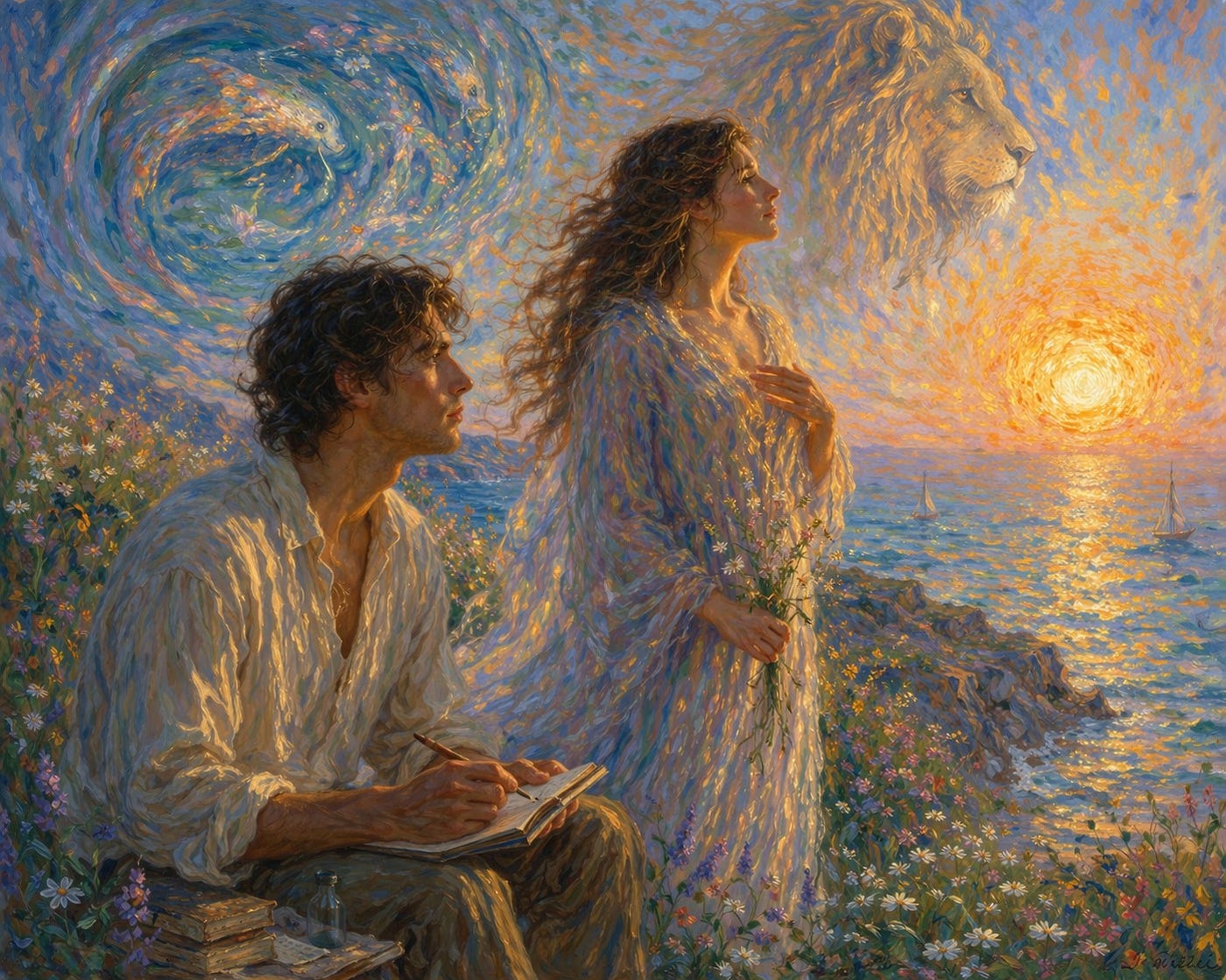
That is why the Aquarius–Leo axis is not merely an axis of individuation; it is also the axis of paying the price of freedom. Aquarius takes you outside. Leo says to you, “Now, in the middle of that outside, ignite your own sun.” And this is where the greatest shaking of the human being takes place. Because now the issue is no longer being against the system, but remaining loyal to your own light. And that loyalty is, in the sense Rollo May meant it, the first serious test of freedom.
Ozz and Witch
Now let’s open up the issue through a sharper example: let us consider a person with the North Node in Leo, Virgo Rising, and the Sun in Pisces. This is one of the structures that reveals the inner tension of the Leo–Aquarius axis in the most striking way. Because the issue here is not merely “moving into one’s own center.” The real issue is that a consciousness whose nature is to scatter, dissolve, open itself to the needs of others, and easily loosen its boundaries must ultimately learn how to establish its own core center.
That is precisely why this person has difficulty becoming free. Because here, true freedom is not simply thinking independently; it is accepting that one must become the subject of one’s own fate. Yet that acceptance carries a heavier burden in this person’s structure than one might assume. The North Node in Leo reminds the person again and again: “Ideas are no longer enough; feeling is no longer enough; you now have to stand consciously in your own center.” But the nature of a Pisces Sun is more inclined to dissolve the self than to stabilize it, more inclined to make boundaries permeable than to define them, and more inclined to surrender to the flow than to make itself definite.
For this reason, instead of directly claiming their own essence, the person may often find it more natural to live through intuitions, emotions, collective fields, the suffering of others, or by dissolving into some greater meaning. Pisces gives great spiritual openness here; but at the same time, it loosens the boundaries of the self. And this is exactly where the real problem begins: the soul feels a great deal, knows a great deal, but may struggle to gather that feeling and that knowing into its own center.
In this structure, the fear is not merely the fear of being visible, as it appears on the surface. At a deeper level, a much subtler and far more exhausting tension is at work: “If I step into my own center, I will no longer be able to remain scattered. I will no longer be able to dissolve myself. I will no longer be able to hide behind other people’s emotions, needs, systems, or collective ideas. And what if I can’t control it? What if I fail?” For a Pisces Sun, this question is profoundly destabilizing. Because the shadow of Pisces often protects itself by refusing to define itself, refusing to solidify itself, and refusing to become clear. In a sense, it feels safe to remain in the mist; because there, everything is possible, yet nothing can be fully demanded of you. But the North Node in Leo does not accept this dissolved state. It gradually pushes the person toward this: “Gather your intuition into a center. Turn your compassion into identity. Unite your flow with a spine.”
It is exactly here that Virgo Rising enters the picture and produces a very familiar defense against fear: control. Because Virgo Rising brings into the way one approaches the outer world a need for attention, analysis, correction, supervision, and minimizing the margin of error. In other words, while inwardly the person fears being scattered in the flow, uncertainty, and dissolution because of the Pisces Sun, outwardly they try, through Virgo, to pull everything together, organize it, and make it safe. In this way, the real fear is not experienced directly; instead, it takes on a more refined and more socially acceptable form. The person does not openly say, “I am afraid.” Instead, they prepare more, think more, correct more, and scan more intensely for what is missing. From the outside, this may look like responsibility, precision, and diligence. Yet underneath, what is often operating is this sentence:
“If I can control everything well enough, I can protect myself from failure.”
But this is exactly where life disrupts the subtle defense a person has constructed. Because life cannot be controlled in its entirety. No matter how prepared a person is, they cannot calculate everything in advance. They cannot guarantee every outcome. They cannot eliminate every possibility. And it is precisely at this point that the person comes face to face with their deepest fear: “Who am I in a place I cannot control?” If this person has built their self-worth around perfection, preparedness, usefulness, or flawlessness, then any disruption is not experienced merely as an event. The possibility of failure attaches itself directly to the self. It feels as though, if something goes wrong, it will not only be the plan that falls apart, but they themselves will be exposed as inadequate, insufficient, and fragile. That is why, instead of producing open failure, they sometimes produce deferred potentials. They do not begin. They wait. They examine. They revise. They look for a better time. Because rather than starting imperfectly and risking the loss of control, they may find it safer not to begin at all.
That is why liberation here is not merely a matter of courage; it is also a matter of learning the difference between control and center. Because for a long time, the person may assume that being centered means being able to manage everything. But it does not. Being centered does not mean being able to control everything; it means being able to remain undispersed within the very areas one cannot control. This is where the real lesson of the North Node in Leo begins. This node does not tell the person, “Be perfect.” Nor does it say, “Guarantee everything.” It says something much deeper: “Even if control is incomplete, remain in your own consciousness. Even if you do not know the outcome, do not lose your inner spine. Even when the possibility of error is present, do not depart from your essence.”
In other words, when making a decision, instead of immediately pulling back simply because you cannot guarantee every detail in advance, you must still be able to take a step while remaining loyal to your own values and inner voice. For example, when starting something, instead of endlessly delaying it by saying, “I’m not ready yet,” you must be able to accept the possibility of being imperfect and still bring that work forward in your own name. Because the issue here is not being flawless; it is being able to remain yourself even within uncertainty.
Therefore, this person’s fate is not simply to become visible; it is to preserve their inner center in the face of uncertainty and loss of control. They feel, but they must also learn how to give direction. They intuit, but they must also learn how to carry that intuition in their own name. They work hard, but they must offer that diligence not in the service of fear, but in the service of essence. When Virgo’s attentiveness serves fear, it drowns the person in details; but when it enters the service of essence, it becomes great mastery. When Pisces’ intuition surrenders to fear, it scatters the person; but when it is tied to a center, it gives rise to a high form of wisdom. And Leo here is not applause, performance, or attracting attention; it is healthy ego, meaning the ability of a person to say “yes” to their own existence from within.
Because the core wound in this structure is often related to self-worth. A Pisces Sun wants to feel love unconditionally; but in its shadow, it may make itself vague and undefined. Virgo Rising may choose to be useful, to correct, and to serve in order to feel valuable; but in its shadow, it may tie its worth to performance. The North Node in Leo steps in between these two structures and teaches this: “Your worth does not need to be proven. The possibility of failure does not mean that you are worthless. The areas you cannot control do not mean that you have no center. First, you must learn how to exist in your own center.”
True freedom begins precisely here. A person cannot become free either by dissolving solely into the suffering of others or by trying to correct their own flaws forever. Freedom is born here, when a person is able to establish the center of their own consciousness. In other words, when they can carry what they feel without scattering it, when they can give direction to their intuition instead of leaving it suspended in uncertainty, when they can place their diligence not in the service of fear but in the service of essence, and most importantly, when they can remain grounded in their own inner spine despite the question, “What if I can’t control it and I fail?” Then, for the first time, Virgo’s attentiveness, Pisces’ intuition, and Leo’s center unite along the same line. And the person no longer lives by waiting for external approval, by trying to perfect everything, or by falling apart inwardly; instead, they begin to live by relying on their own inner sun.
References May, Rollo. Love and Will. New York: W. W. Norton & Company, 1969. Kierkegaard, Søren. The Concept of Anxiety: A Simple Psychologically Oriented Deliberation on the Dogmatic Issue of Hereditary Sin. 1844. Sartre, Jean-Paul. Existentialism Is a Humanism. 1946. Dostoevsky, Fyodor. The Brothers Karamazov. 1879–1880. Fromm, Erich. Escape from Freedom. New York: Farrar & Rinehart, 1941. Luther, Martin. Ninety-Five Theses. 1517.
메타데이터
- post_id
- 498c19c88206
- slug
- anxiety-freedom-and-escape-498c19c88206
- url
- https://medium.com/@cemresirius/anxiety-freedom-and-escape-498c19c88206
- canonical_url
- https://medium.com/@cemresirius/anxiety-freedom-and-escape-498c19c88206
- author_url
- https://medium.com/@cemresirius
- status
- ok
- fetched_at
- 2026-06-11 22:20:54