DNAscope Pangenome for SV and CNV: Fast, Accurate, and Cost-Efficient Short-Read Structural Variant…
For decades, the linear reference genome has been the backbone of genomic analysis, but a single haploid reference cannot represent the…
DNAscope Pangenome for SV and CNV: Fast, Accurate, and Cost-Efficient Short-Read Structural Variant Detection
For decades, the linear reference genome has been the backbone of genomic analysis, but a single haploid reference cannot represent the full diversity of human genomes. The resulting alignment artifacts and variant calling errors fall especially hard on structural variants (SVs) and copy number variants (CNVs), two of the most clinically important classes of variation. Pangenome approaches solve much of this problem, but existing pangenome workflows tend to be resource-hungry and hard to deploy on standard infrastructure.
Sentieon’s DNAscope Pangenome pipeline now includes pangenome-informed SV and CNV detection, running in the same fastq-to-VCF workflow that handles small variants. The pipeline resolves complex and repetitive regions with accuracy that was previously only achievable with long-read sequencing, and it runs on standard x86 and ARM hardware without sacrificing speed.
The pipeline draws on two complementary sources of evidence: a new module, PangenomeSV, supplies breakpoint-level signal from pangenome-informed alignments, and CNVscope contributes read-depth information. The two are combined to produce an integrated CNV callset, with breakpoint evidence from PangenomeSV strengthening CNVscope’s depth-based calls.
How It Works
The pipeline constructs a personalized reference for each sample by leveraging pangenome data, followed by an optimized selective alignment strategy to refine reads in complex genomic regions. To ensure seamless integration with existing workflows, pangenome alignments are lifted back to the GRCh38/hg38 linear reference, maintaining full compatibility with downstream tools.
From there:
· Small variants. Sentieon DNAscope calls SNPs and indels from the alignments against the linear reference genome.
· Structural variants. PangenomeSV calls SVs by comparing the sample’s haplotypes directly against the linear reference, using the read alignments as supporting evidence.
· Copy number variants. Breakpoint evidence from PangenomeSV is combined with depth-based candidates from CNVscope to produce a single, high-fidelity CNV callset.
The workflow currently supports the HPRC minigraph-cactus pangenome today and is ready for the upcoming 400-sample HPRC release.
The Numbers
State-of-the-Art SV Performance (GIAB v5.0q)
On the GIAB v5.0q SV benchmark, the pipeline achieves Precision > 97.9%, Recall > 94.1%, and F1 > 96.0%. This performance significantly surpasses all other benchmarked commercial and open-source short-read workflows. For comparison, Manta scores 48.0% F1, and the pangenome-based vg call reaches 89.0%. Notably, short-read performance now rivals the 97.0% F1 of the ONT long-read WGS.
High-Resolution CNV Detection with CNVscope
Evaluated with Sentieon’s CNV-eval tool against the HG002 T2T benchmark, the new Pangenome CNVscope achieves F1 >80% across all size categories. By integrating breakpoint-level SV information from PangenomeSV, the pipeline pushes reliable CNV detection down to 500bp. This represents a major improvement over legacy tools like CNVnator, which exhibits limited sensitivity for events under 10kb.
Conclusion
Short-read sequencing is still the backbone of population-scale genomics. DNAscope Pangenome now brings long-read-class SV and CNV accuracy to short-read data, closing one of the most persistent gaps in the field.
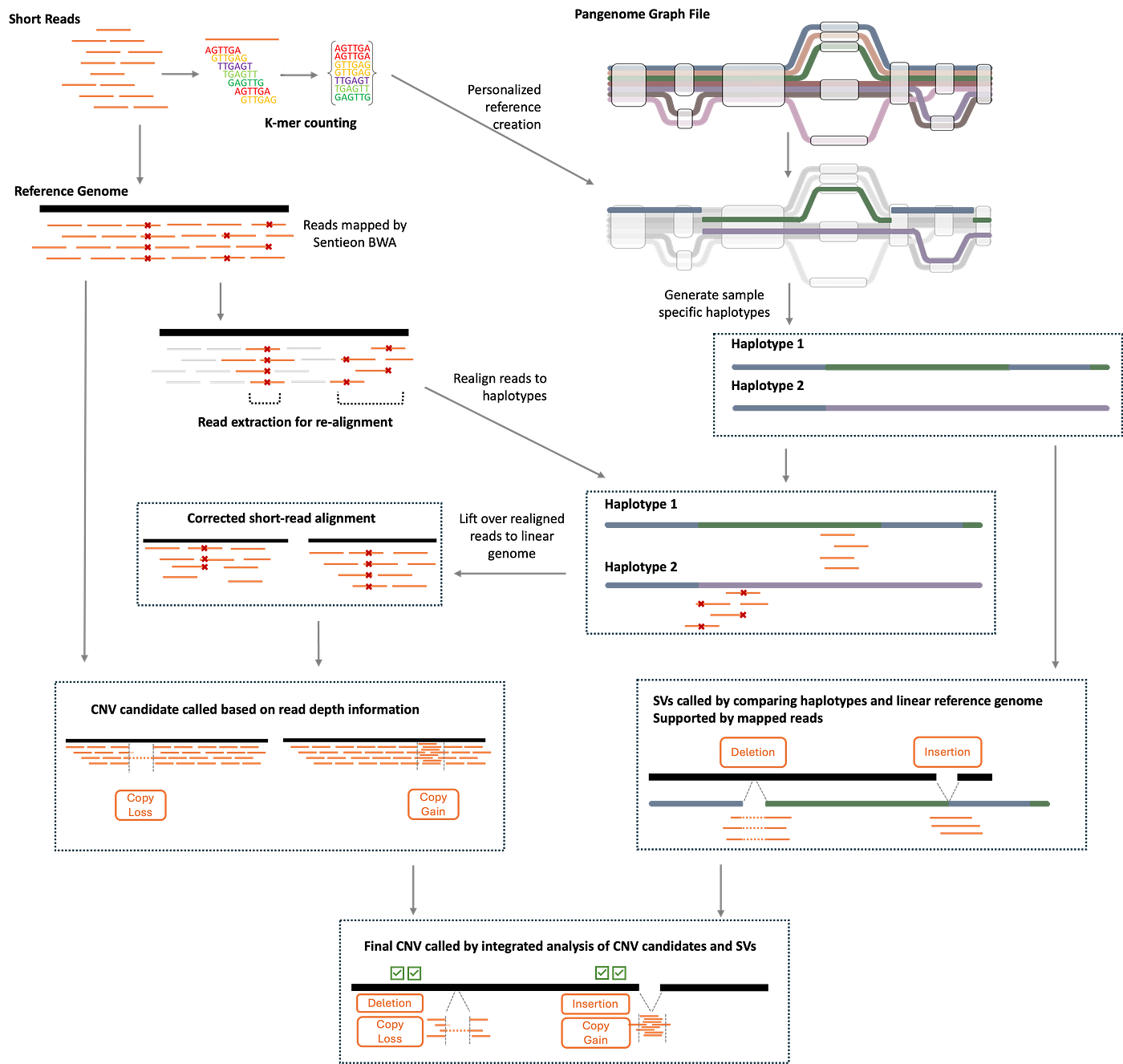
Figure 1. How the SV and CNV modules in DNAscope Pangenome pipeline work. K-mers from the input reads are matched against the full pangenome graph to identify the closest haplotypes. Reads are then aligned to the GRCh38 linear reference, and a targeted subset is pulled out and realigned to those best-matching haplotypes. The updated alignments are lifted back to the linear reference, and both sets of alignments are used in small variant calling. For SVs, the pipeline compares the sample’s haplotypes directly against the linear reference and uses the read alignments as supporting evidence. The resulting breakpoint evidence is then combined with depth-based CNV candidates from CNVscope to generate a single, integrated CNV callset.

Figure 2. Precision-recall plot evaluating SV detection accuracy using 30x Illumina WGS and 30x ONT datasets. “D” denotes a commercial short-read pipeline; Manta and vg call represent open-source pipelines for linear and pangenome-based short-read analysis, respectively. The Sentieon DNAscope LongRead pipeline on ONT data is provided as a high-fidelity reference.

Figure 3. Comparative accuracy of benchmarked pipelines across GIAB v5.0q whole-genome and CMRG regions. DNAscope Pangenome and DNAscope LongRead achieved the highest F1-scores, driven mostly by their higher recall in these challenging benchmarks. Long-read accuracies (ONT for GIAB v5.0q and PacBio for CMRG) are included for reference. Additionally, an Element dataset is included in the CMRG analysis to show cross-platform robustness.

Figure 4. Comparative accuracy of benchmarked pipelines across the whole-genome CNV benchmark. Both CNVscope (read-depth only) and CNVscope Pangenome (breakpoints from PangenomeSV plus read-depth) significantly outperform CNVnator, particularly for small events. The CNVscope Pangenome accuracy improvement is largest for copy number gains and smaller events, effectively pushing the reliable detection limit down to 500bp.

Table 1. Performance Summary. Detailed SV and CNV accuracy metrics for DNAscope Pangenome on a 30x Illumina WGS dataset.
메타데이터
- post_id
- 4fb96dd929ef
- slug
- dnascope-pangenome-for-sv-and-cnv-fast-accurate-and-cost-efficient-short-read-structural-variant-4fb96dd929ef
- url
- https://medium.com/@frank.hu_11452/dnascope-pangenome-for-sv-and-cnv-fast-accurate-and-cost-efficient-short-read-structural-variant-4fb96dd929ef
- canonical_url
- https://medium.com/@frank.hu_11452/dnascope-pangenome-for-sv-and-cnv-fast-accurate-and-cost-efficient-short-read-structural-variant-4fb96dd929ef
- author_url
- https://medium.com/@frank.hu_11452
- status
- ok
- fetched_at
- 2026-06-09 15:37:30